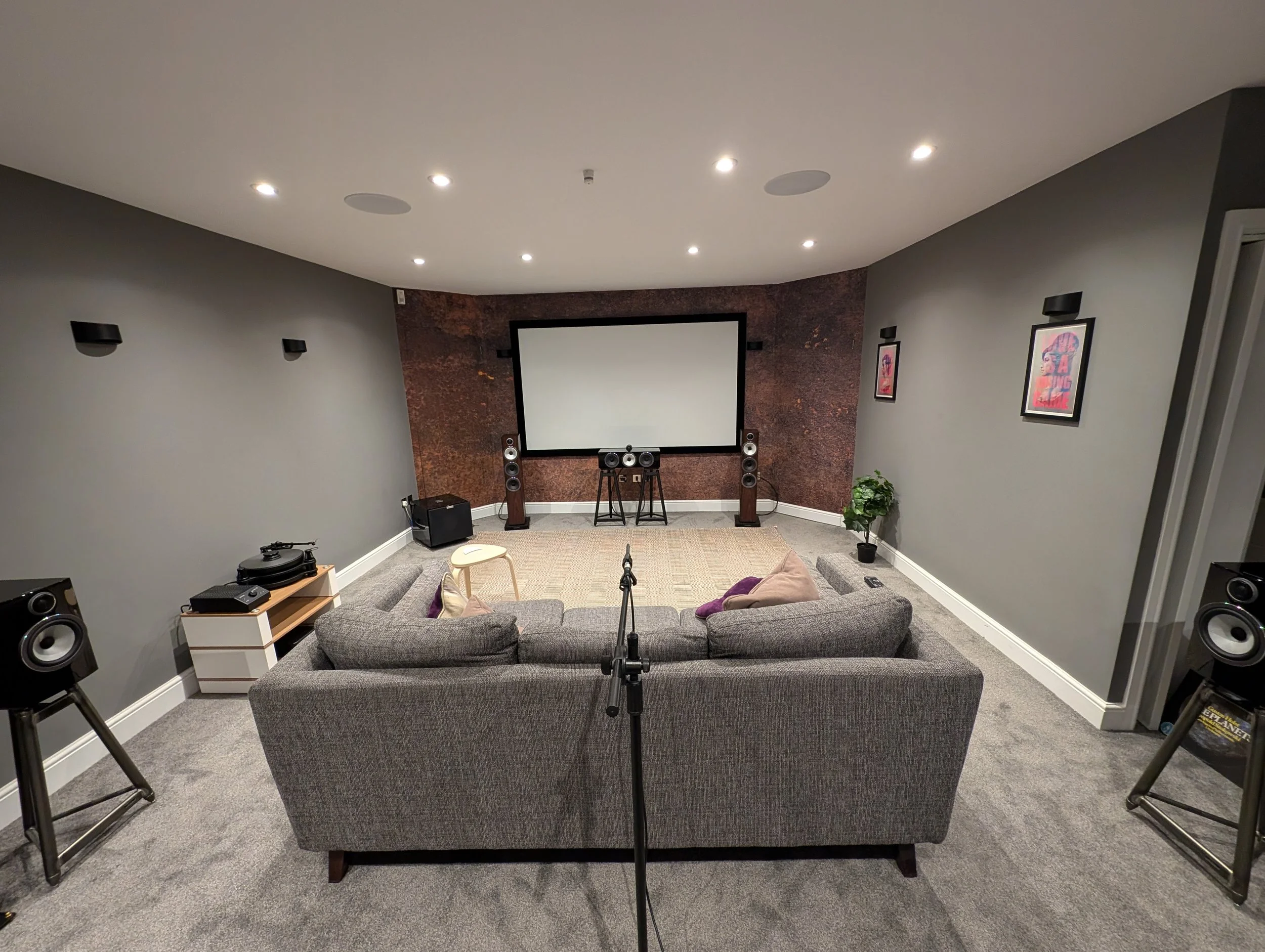
Centre Stage: The Speaker That Holds It All Together
/Optimising your centre speaker for clear dialogue, balanced sound, and seamless integration with your home theatre system.
Read MoreOptimising your centre speaker for clear dialogue, balanced sound, and seamless integration with your home theatre system.
Read MoreThere’s something special about experiencing a well put-together home theatre system. Whether that’s watching a film, immersing yourself in a gripping series, or enjoying a live music or sporting event with a few friends. It’s not just about loud sound or a big picture — it’s about scale, immersion, and feeling like you’re inside the story.
But putting together a home theatre system isn’t always as simple as grabbing a soundbar and sticking some speakers around the room. While this may be sufficient — and most cost-effective — in some cases, as there are some great soundbars out there, some want to reap the full benefits and experience sound and picture as they’re meant to be heard and felt, getting all the minute details that the film producers and sound engineers intended us to hear.
To build a balanced AV system that’s capable of doing the small things as well as the big things, a number of considerations need to be taken into account.
This month, we’re running through some of the key areas when it comes to building surround audio systems. Whether you’re planning a full-blown 7.3.4 Atmos install or just looking to add some rear speakers to your lounge setup, this guide should help point you in the right direction for how to add scale to your system.
The best AV systems start with a simple question: What do you want this system to do?
Some people are chasing that big, cinematic feeling — explosions, deep rumbling bass, voices that float across the room. Others want something that complements their two-channel hi-fi system without becoming overwhelming. Then there are setups that need to be family-friendly, easy to use, or discreet and hidden within cabinets — all of which require a slightly different approach.
So the main questions are: how are you planning to use the system, and how immersive do you want it to be?
Knowing this upfront can save you a lot of time (and money) down the line.
It’s easy to overlook, but the room itself is just as much a component as the amplifier or speakers.
Rooms with solid walls (brick or stone) tend to reflect and trap bass differently from stud walls. A suspended wooden floor can amplify low-end vibrations in a way that can either help or hinder — especially if the floor isn’t well-isolated. Even the ceiling plays a part: is there a void for in-ceiling speakers, or is it solid plasterboard with no access?
Also think about cable routing. Will you be lifting floorboards? Hiding speaker wire in the walls? Or are you happy to save a chunk of cash and use simple trunking to keep things neat?
In open-plan spaces or oddly shaped rooms, we often find bass nodes (hot or dead spots), flutter echo, or just general muddiness that affects dialogue clarity. It’s not always fixable with gear alone — sometimes a well-placed rug, some thick curtains or a bookshelf full of irregular items can make more difference than a new speaker.
Ceiling height also plays a role, particularly with Atmos. Lower ceilings tend to reflect sound too quickly, reducing the ‘overhead’ sensation, while very high ceilings may require more power or speaker directionality to get proper vertical impact. Sloped ceilings can cause their own directional quirks too, often leading to imaging being pulled off-centre or uneven surround balance.
Another thing worth checking is what’s above and below the room. Is it a suspended floor with cavity space beneath (which could cause bass to travel and resonate)? Is there a bedroom above, and do you need to consider soundproofing or isolation? For those in flats or terraces, neighbour-friendly bass might be a consideration.
Lastly, the listening position can make or break a setup. Sitting too close to a back wall can exaggerate bass; sitting directly between speakers can hollow out the soundstage. Even just nudging the sofa forward a foot or two can improve clarity and lock the system in place.
Before diving deeper, I think it’s a good idea to explain what the Dolby Atmos sound format is and what it does for a home theatre system.
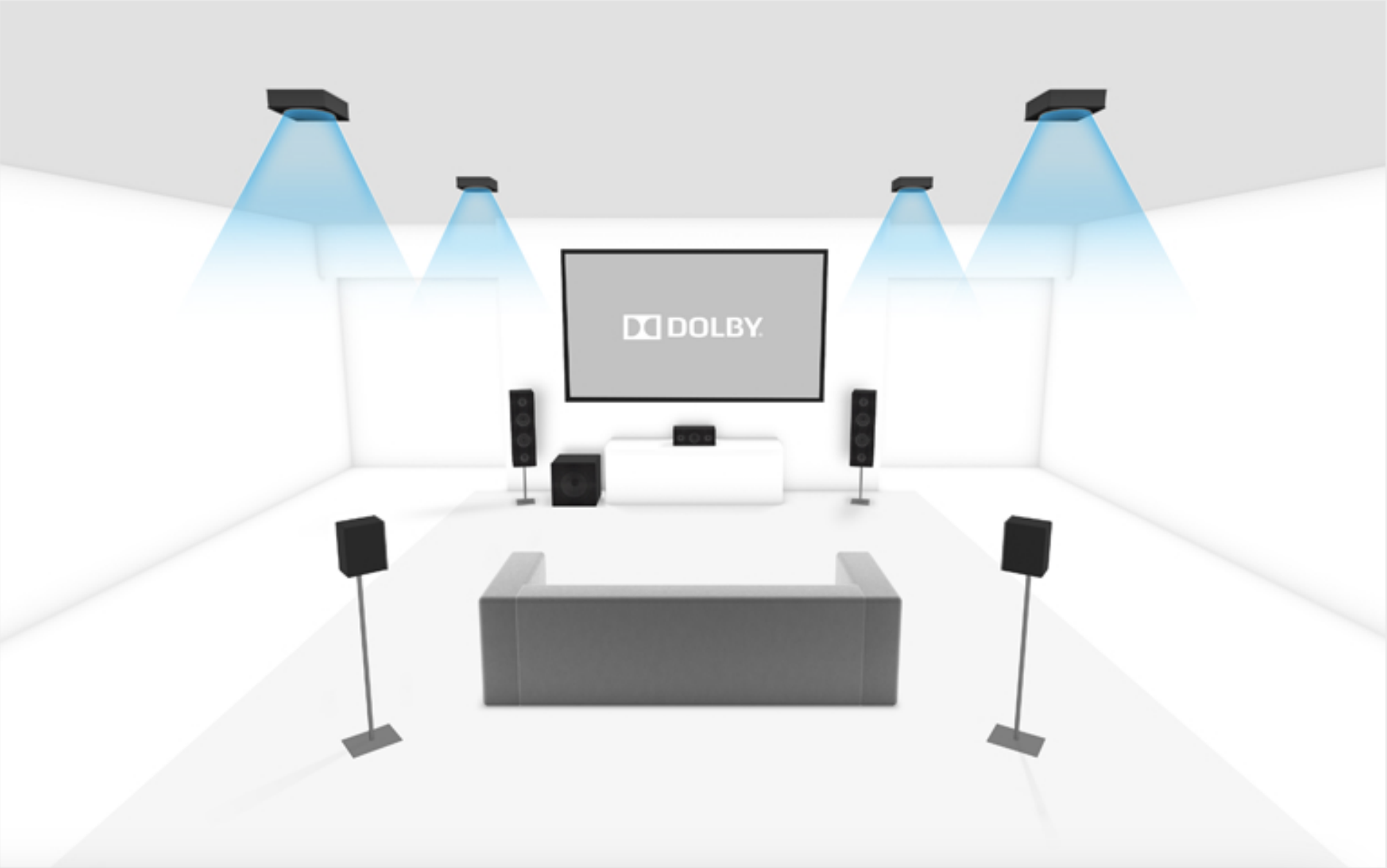
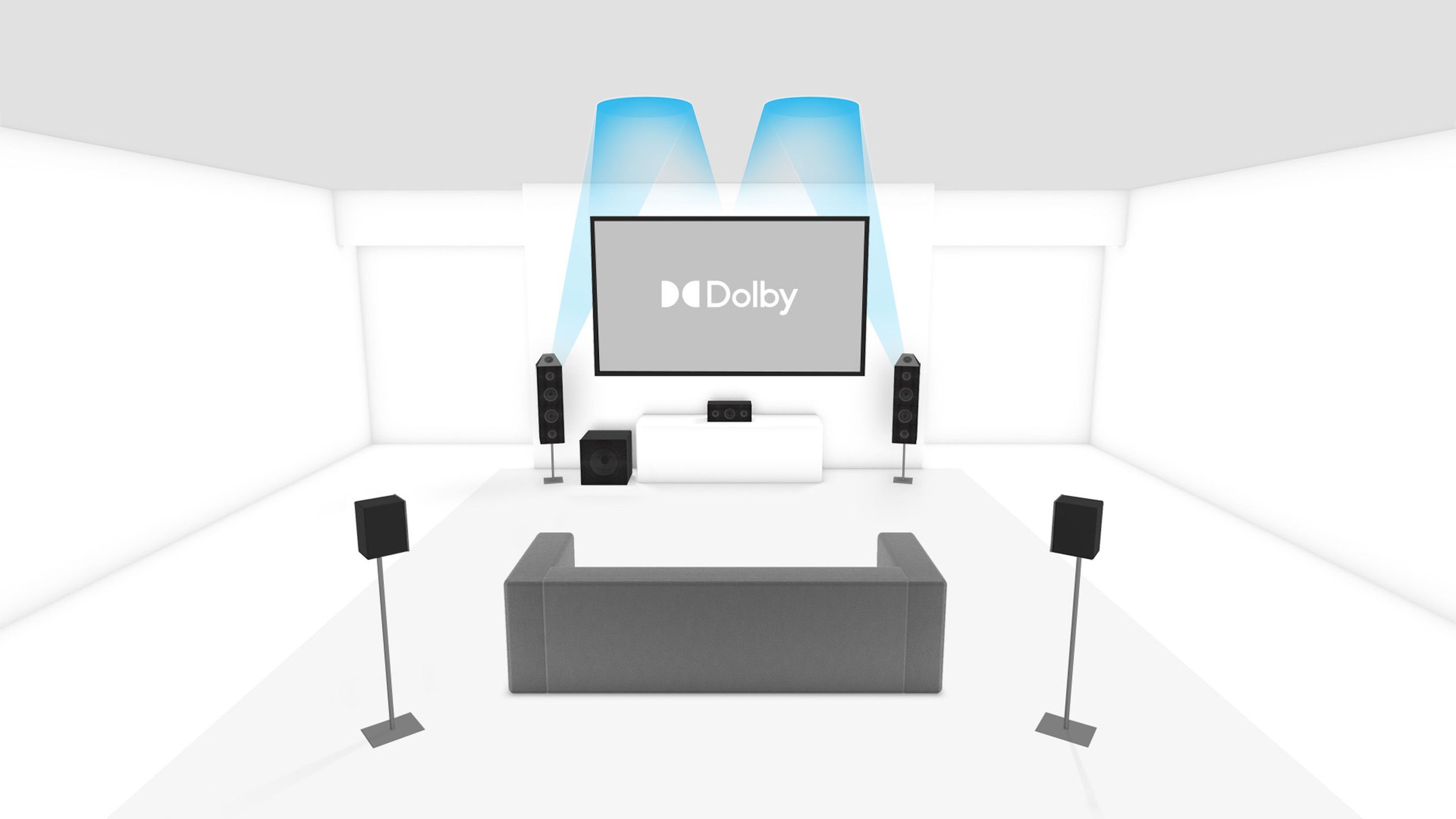
In short, a Dolby Atmos system adds height to surround sound by placing speakers above in the ceiling or using upward-firing drivers to create a 3D soundfield. Instead of just hearing sounds around you (like in 5.1 or 7.1), Atmos lets you hear effects above you.
5.1.4 - DOLBY ATMOS WITH OVERHEAD SPEAKERS
But it’s not just about more speakers or hearing a helicopter fly overhead. Standard 5.1 or 7.1 systems are channel-based, meaning sound is mixed and assigned to fixed speaker positions. Here, each speaker plays a dedicated audio track mixed specifically for that position — nothing moves outside of those predefined channels.
5.1.2 - Dolby Atmos with Dolby Enabled Speakers (sitting on top of front L & R speakers)
Atmos, by contrast, is object-based — meaning sound elements can move anywhere in a 3D space or ‘bubble’, making the experience more immersive and lifelike. Sound engineers are able to manoeuvre sounds with a lot more precision, transcribing that into a much more expansive sound experience, with sound flowing around the listening position and not restricted by the positioning of the speakers.
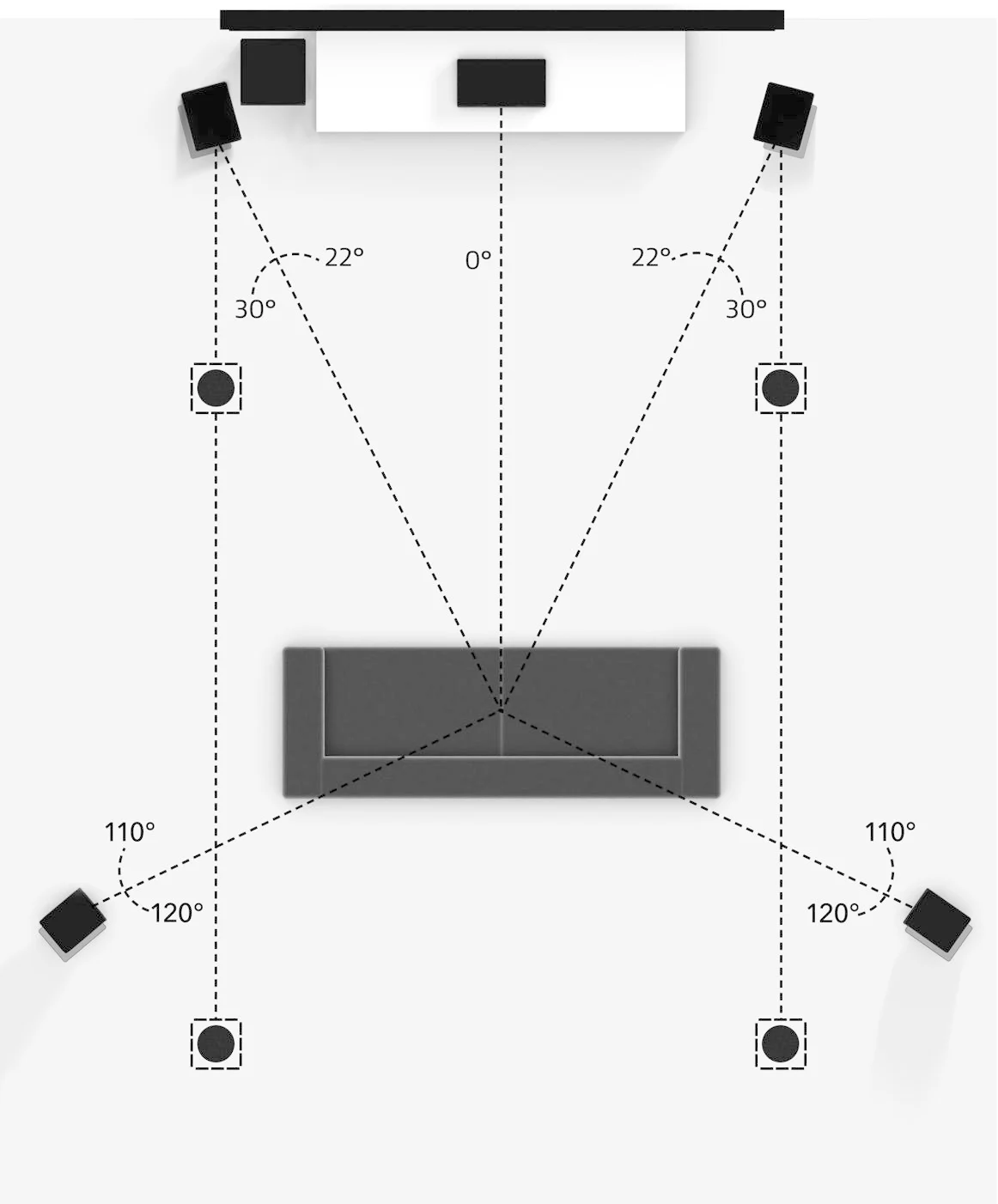
5.1.4 Dolby Atmos - Top view
While Dolby Atmos is a great tool, it’s not critical — you can still get a great surround experience with a well-positioned and correctly balanced 5.1 (or other non-height) configuration. Adding Atmos can also become expensive depending on the room design, and it can be tricky to get right. It’s always worth speaking to one of our staff to help plan the project properly before starting to cut holes in your ceiling and avoid any unwanted pitfalls.
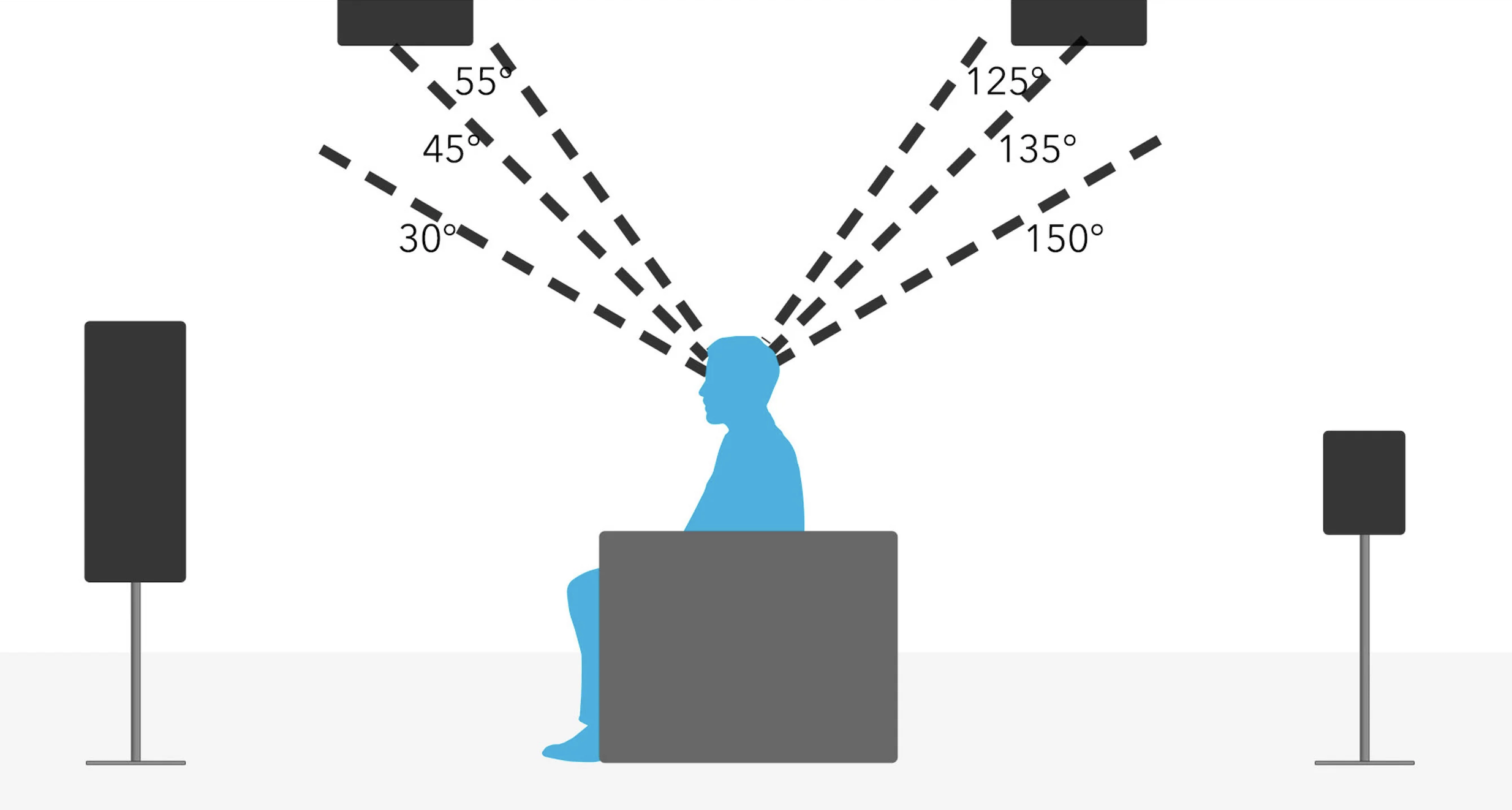
Dolby Atmos recommended Height Speaker positioning
AVR vs Processor + Power Amps?
One of the first gear decisions you’ll face is what to choose as the brain and the heart of the system. You can opt for an all-in-one AV Receiver (AVR), or split the system out into a dedicated processor and separate power amplification.
An AVR (Audio Video Receiver) is a single box that does it all: it takes in audio and video signals from your sources (like Blu-ray players, streamers, or game consoles), decodes the surround formats (like Dolby Atmos or DTS:X), processes the sound, converts the digital signal into analogue via built-in DACs, applies room correction (optional), and finally powers the speakers through its internal amplifiers.
In short: it switches, decodes, processes, converts, and amplifies — all in one box.
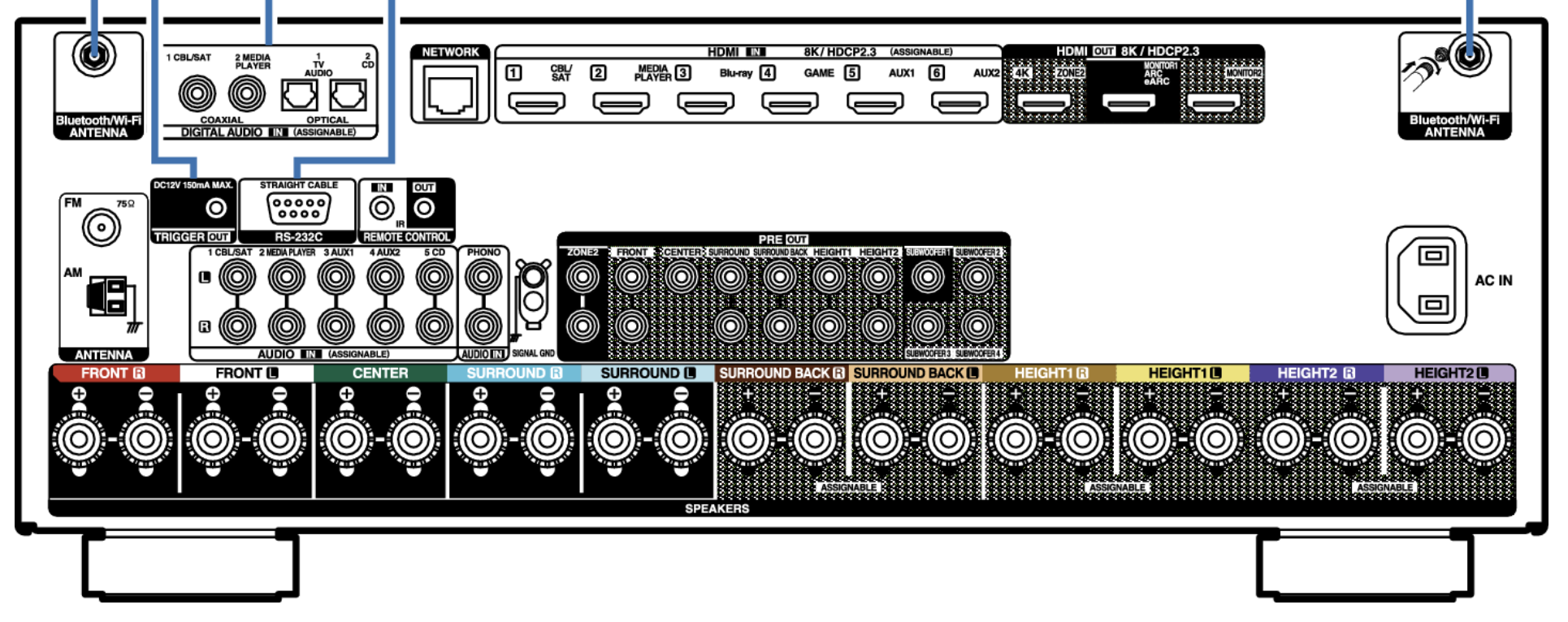
Rear Panel of a Denon AVC-X3800H AVR. Speaker outputs found at the bottom as well as pre-amp outputs IF WANTING TO RUN EXTERNAL AMPLIFICATION. ALL THE RELEVANT HIGH QUALITY VIDEO INPUT AND OUTPUTS FOUND AT THE TOP.
Most AVRs will handle standard 5.1 or 7.1 layouts out of the box, with mid-to-high-end models extending to 9.1 or even 11.2 configurations. They’re compact, cost-effective, and relatively straightforward to install and operate — perfect for most living rooms and mid-size home cinema setups.
If you’re building a higher-end system, want the flexibility to scale up later, or have more demanding speakers, then separates come into their own.
A dedicated AV processor (also called a pre-amp or pre-processor) handles everything mentioned above except amplification. It takes care of all the heavy lifting: surround decoding, bass management, digital-to-analogue conversion, room correction, and video passthrough — but it sends the signal out to external power amps, which do the actual work of driving the speakers.
The main advantages of going this route?
Cleaner signal paths (no shared power supply between processing and amplification)
More headroom and control over amplification
Better DACs and internal architecture, particularly in high-end models
Advanced room calibration systems (like Dirac Live or RoomPerfect)
Modular flexibility: you can upgrade amps or processors separately as the system evolves
The trade-offs? Separates cost more, take up more space, and require more cabling and setup time — but if performance is the goal, especially in dedicated cinema rooms, they’re often worth it.
Most AVRs and processors have built-in room correction technologies. In simple terms, it’s the process of measuring how your speakers interact with your room, and then automatically adjusting the sound to compensate for the room’s acoustic quirks. It goes beyond just EQ, by analysing things like early reflections, reverb time, speaker distance, and phase alignment.
Room Perfect from Lyngdorf measuring a B&W 700 Series system in Audio-T Reading
Using a calibrated microphone (sometimes included with the equipment), the system sends test tones around your space and builds a profile of how the room affects the sound. It then applies precise digital filters to fix timing issues, tighten up bass response, and ensure all speakers are working together cohesively.
Systems like Audyssey, Dirac Live, and RoomPerfect vary in depth and approach, but all aim to give you more accurate, balanced sound — even if your room isn’t acoustically ideal. In many cases, it can be a very important factor in making a system sound right.
• Denon – Denon AVRs are very capable, straightforward to use, and packed with features that are great for the money. Audyssey room correction is included on most models and offers a solid starting point for tailoring sound to your room. Prices start around £1,000, with models like the AVC-X3800H being a popular sweet spot. At the top of the range sits the AVC-A1H at £4,999, delivering more power, channels, and headroom for larger and more ambitious setups.
• Marantz – Shares much of its platform with Denon but is tuned with a warmer, more musical voicing. A great choice for those wanting strong cinema performance with a hint of two-channel finesse. The Cinema series starts at £649 for the slimline Cinema 70s, and stretches to £3,799 for their highest-end AVR. For those going fully down the separates path, the flagship AV10/AV20 processors and AMP10/AMP20 power amps (yet to be fully tested by me) aim to take things to a new level, both in performance and price, around £10,000–£12,000 for the pair.
Customer Install - Arcam AVR21 Driving B&W Speakers
• Arcam – More “Hi-Fi-first” in character. Sound is rich, analogue-like, and unforced. Once the initial setup is dialled in, the units are easy to use and don’t require any further tinkering. All models include Dirac Live room correction, giving precise control over the sound in difficult rooms. The AVR11, AVR21, and AVR31 range from £2,499 to £5,499, with the top-tier AVR31 using Arcam’s Class G amplification for added clarity and dynamic control.
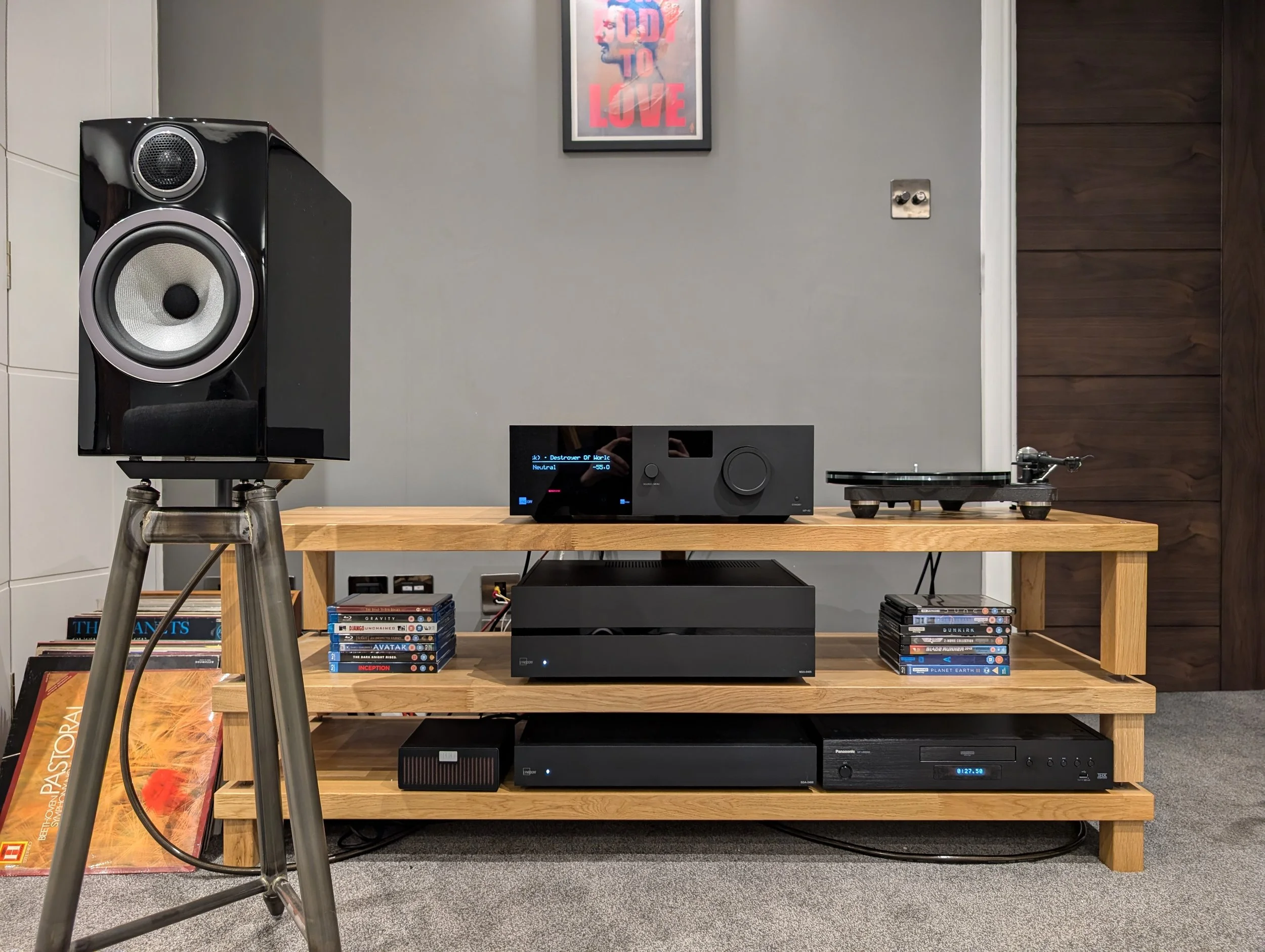
Lyngorf MP-40 Processor + Lyngorf MXa-8400 & SDA-2400 Power Amps
• Lyngdorf – A different league altogether. Sound is ultra-clean, open, and deeply immersive. Lyngdorf’s RoomPerfect remains one of the most effective room correction systems we’ve ever used. When we talk about Atmos and the 3D soundstage, Lyngdorf handles it with remarkable subtlety, where the sound seems to “live” in the space around you rather than being tied to individual speakers, making you just sit back and enjoy the experience rather than think about where the sound is coming from. The MP-40 processor starts at £9,350, with the flagship MP-60 coming in at £14,995, both requiring external amplification and a well-matched speaker system.
The Power Options
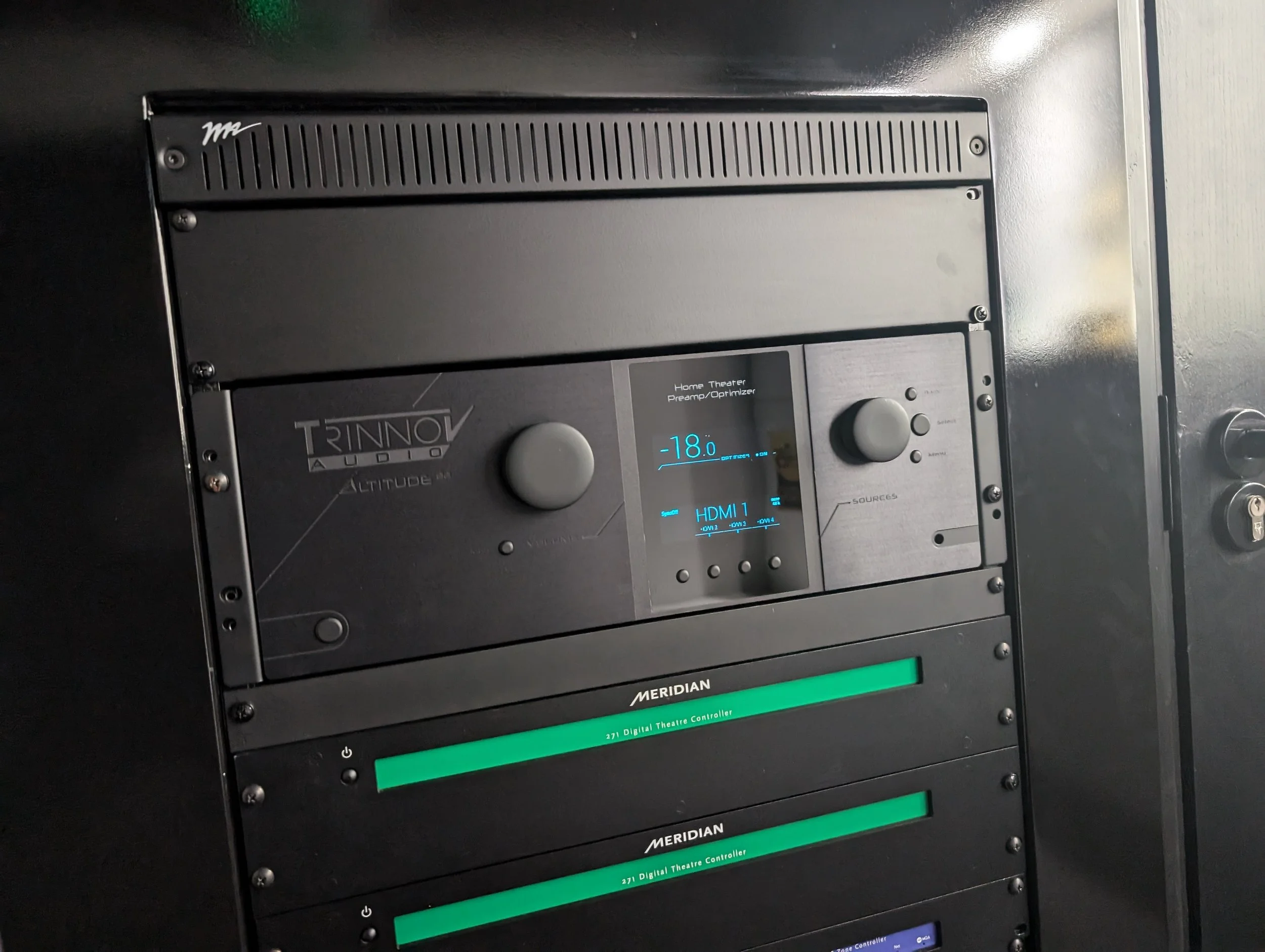
Trinnov Altitude 32 Processor
If you’re going down the separate amplification route, the choices are vast and often come down to what processor you’re using, what speakers you’re driving, and what kind of sonic character you enjoy.
For example, the spacious and open nature of a Lyngdorf processor pairs beautifully with Dynaudio speakers when powered by the MXA-8400, Lyngdorf’s own ultra-clean 8-channel power amplifier. On the other hand, Denon’s more neutral and slightly drier presentation can benefit from a warmer amp, like the Arcam PA720, which adds some richness and musicality.
There’s no one-size-fits-all solution here. Power amps vary massively in tone, dynamics, and synergy with different speakers. This is why we always recommend speaking with your local dealer and, more importantly, auditioning combinations in person. Trust your ears — your ideal sound signature may not be what the spec sheet suggests.
Stereo Integration for Music Lovers
If music is just as important as movies in your system, another great option is to run a dedicated stereo hi-fi amplifier alongside your home cinema setup. Some stereo amps feature AV Bypass (also known as Home Theatre Bypass) — a fixed-level input that allows the amp to be part of your surround system without interfering with its stereo performance.
This means you can enjoy true hi-fi sound for music playback via your stereo amp, and still use the same front speakers as part of your surround setup for films. It’s a great way to blend two-channel performance with multi-channel convenience.
That said, if you are using front left and right speakers from a brand that doesn’t manufacture a dedicated centre channel, it can lead to a disjointed soundstage during films — especially if speakers from two different brands operate in different frequency ranges. This brings us to the next important part of a surround system…
Speakers: Consistency Is Key
In an ideal world, you’d use the same speaker model across your front left, centre, right, and surrounds. That way, when a voice or a sound effect pans from one side of the screen to the other, it doesn’t change in character or tone. More so, when listening to concerts, musicals, high-quality films or dedicated Dolby Atmos music — where surround speakers play a more prominent role — having a full-range set of speakers throughout will create a more captivating and balanced experience.
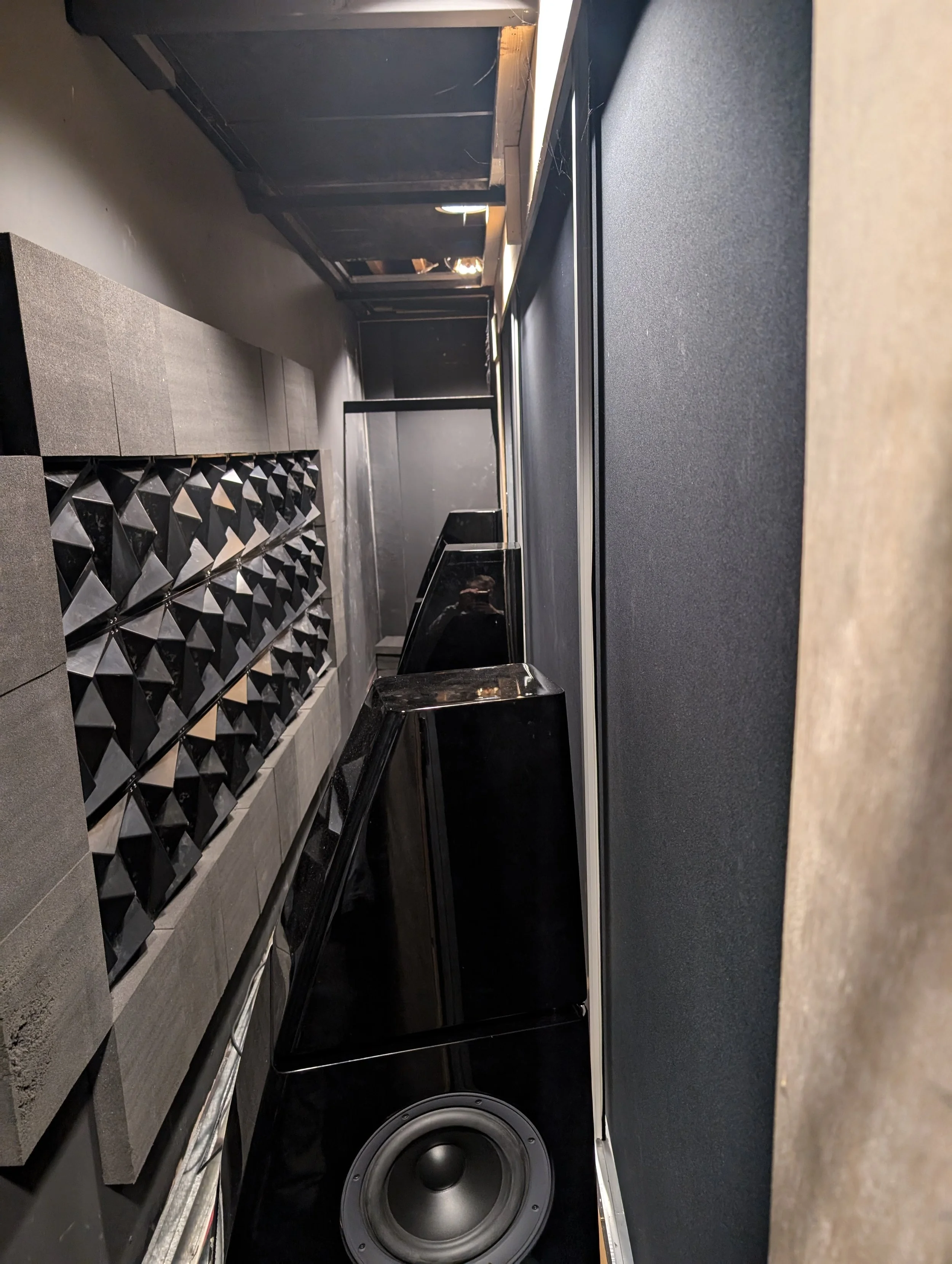
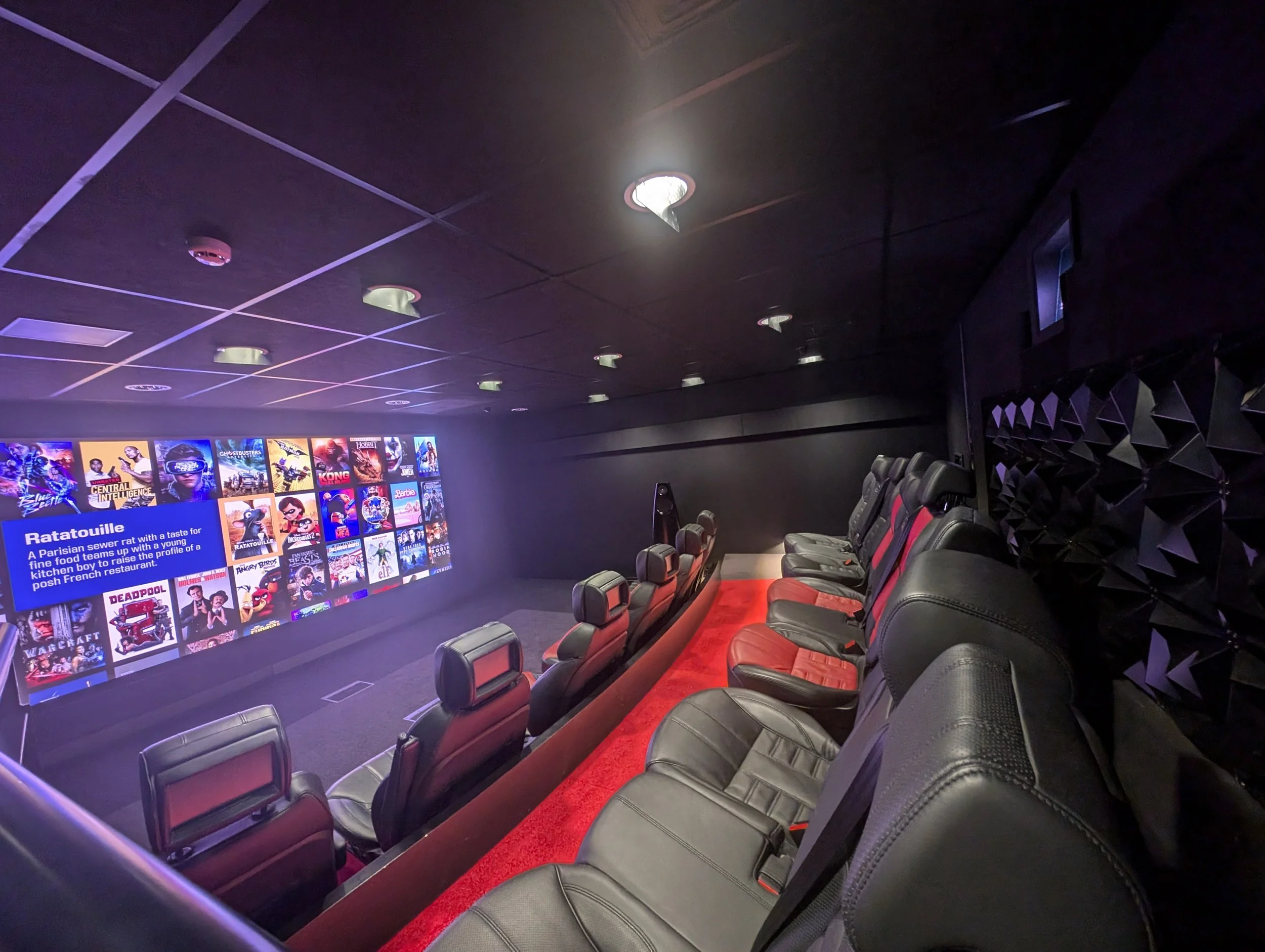
We recently visited Meridian’s headquarters in Huntingdon, sitting down in two of their home theatres that arguably outperform most commercial cinemas in the UK. Here, the use of three identical speakers — also known as an L-C-R setup — was demonstrated on a huge scale with Meridian’s flagship active speakers hidden behind an acoustically transparent screen.
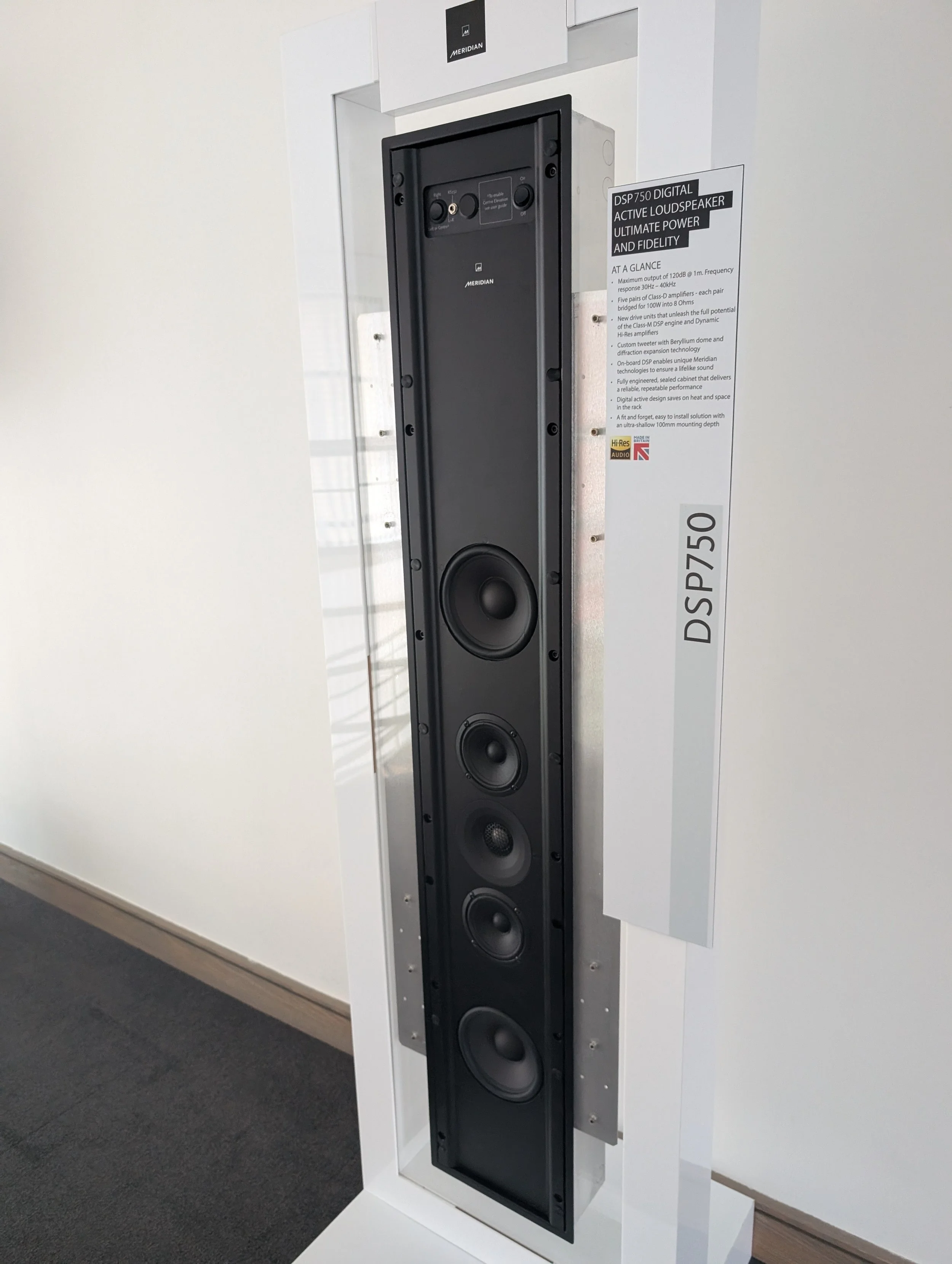
Meridian DSP750 Architectural In-Wall Speaker (For front, surround) for discrete Installs.
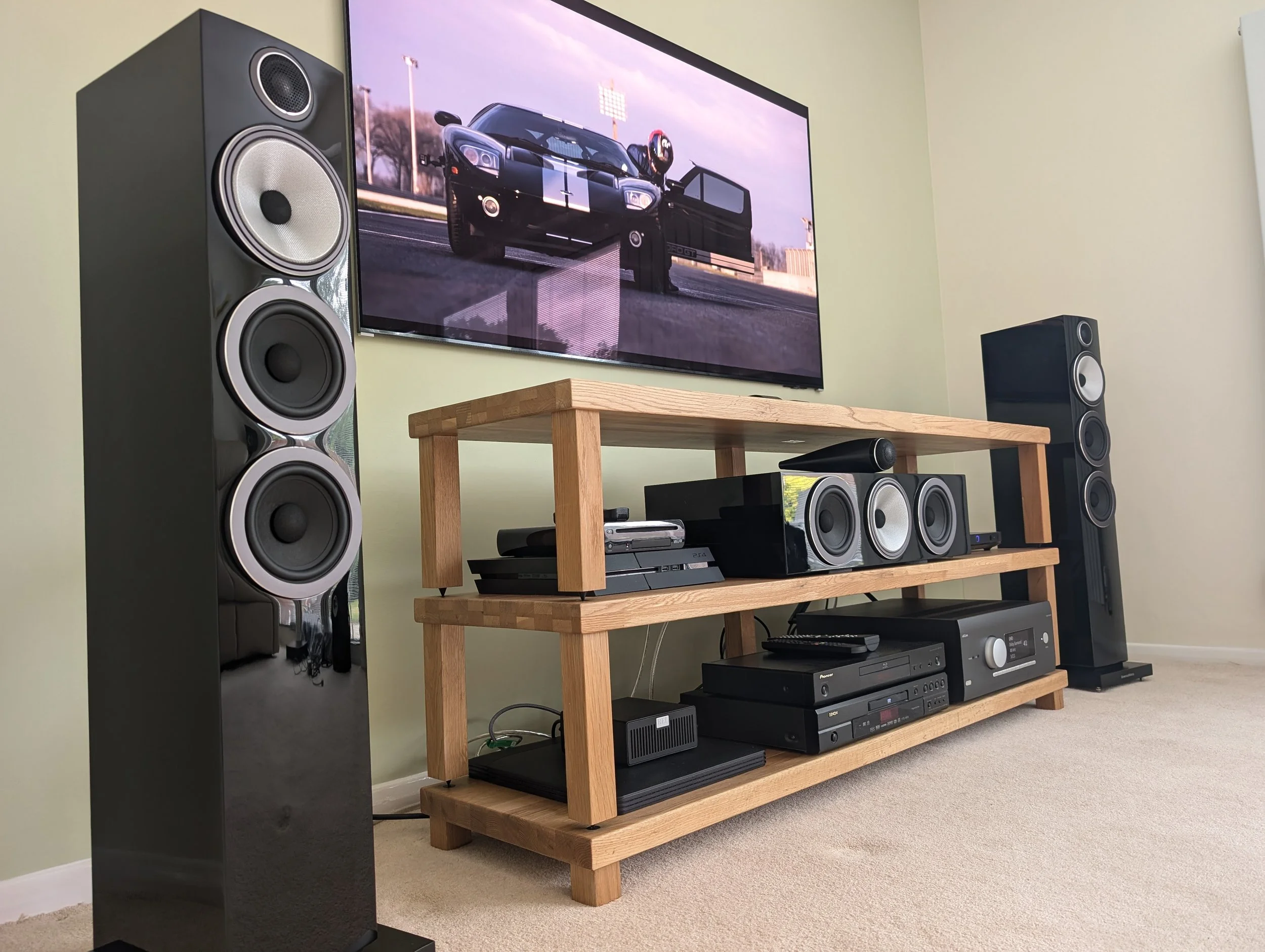
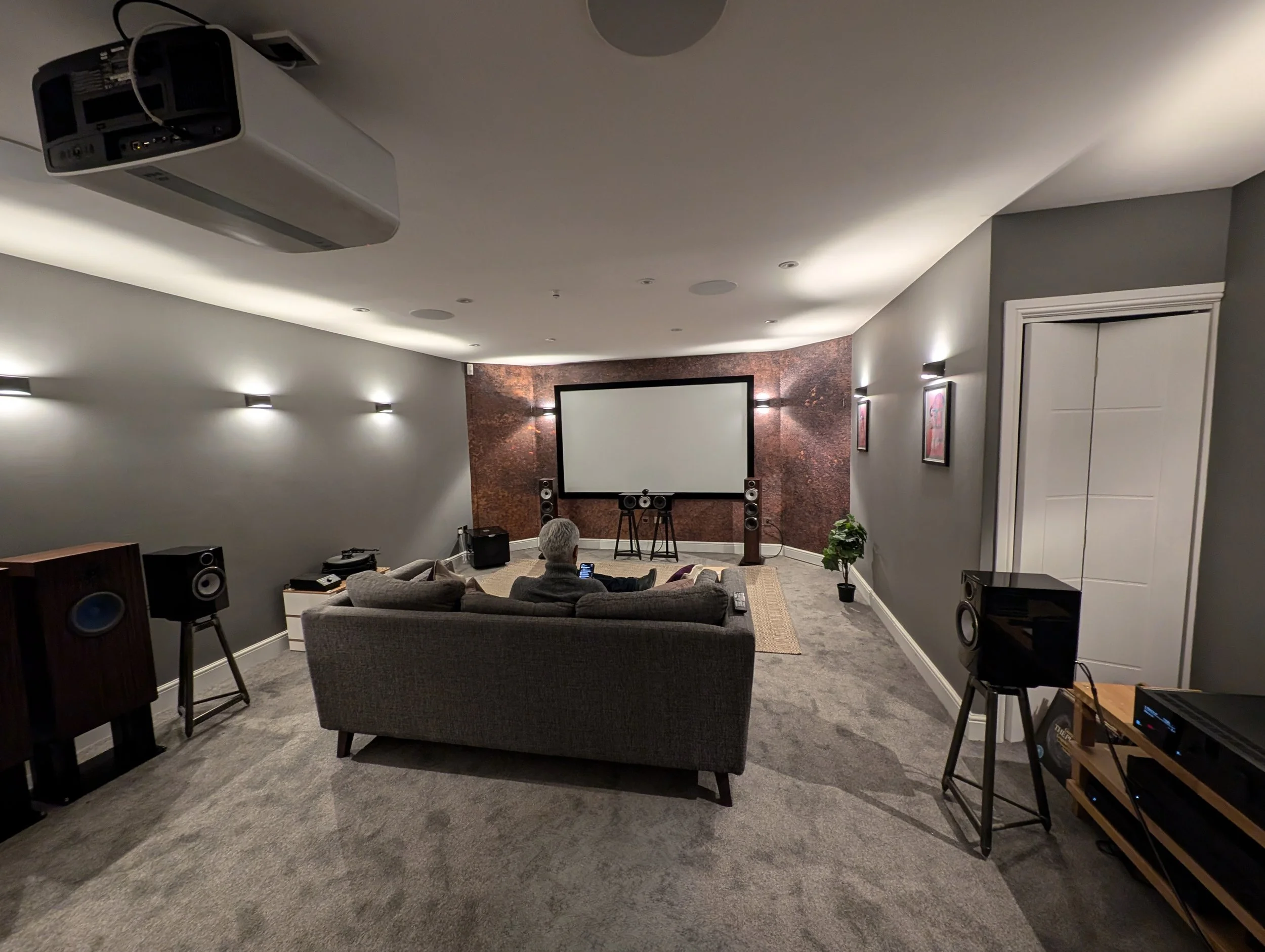
In reality, most people either don’t have the space or budget to run large floorstanders across the front and back. But keeping the centre and left/right as close as possible in voicing is critical. The centre channel (in our opinion) is the most important speaker in the system, as it accounts for most dialogue and focuses the centre of the image. A mismatched centre channel is one of the quickest ways to ruin dialogue clarity. A centre speaker that matches the rest of the system — and includes a great midrange driver and tweeter — becomes one of the best ‘hacks’ to make a sound system feel great and natural.
Height channels don’t need to be full-range (although they can be), but they should still be cut from the same sonic cloth — ideally from the same brand and series as the rest of the system.
• Bowers & Wilkins 700 S3 Series – A fantastic choice for home cinema, offering scale, detail, and drama. The HTM71 S3 centre is a standout, providing real authority and vocal clarity. The 700 S3 range tends to have an energetic voicing, with a lift in the treble and bass that makes them immediately exciting, especially for film soundtracks, action scenes, and immersive effects. Pairing them with slightly warmer electronics (like Marantz or Arcam) can help balance their enthusiasm, particularly in reflective rooms. (Around £5,000–£8,000 for a 5-speaker system)
B&W 700 S3 System
• Dynaudio Evoke Series – More natural and neutral in tone, the Evoke range excels in musicality and nuance. It doesn’t shout for attention like B&W, but rewards listeners with clarity, composure, and balance — especially in dialogue and subtle ambient effects. The downside? They’re less forgiving on amplification. A good AVR may not be enough to bring them fully to life — they shine with higher-end processors and quality power amps. But once properly driven, they’re astonishingly transparent and immersive. (Around £5,500–£7,300 for a 5-speaker system)
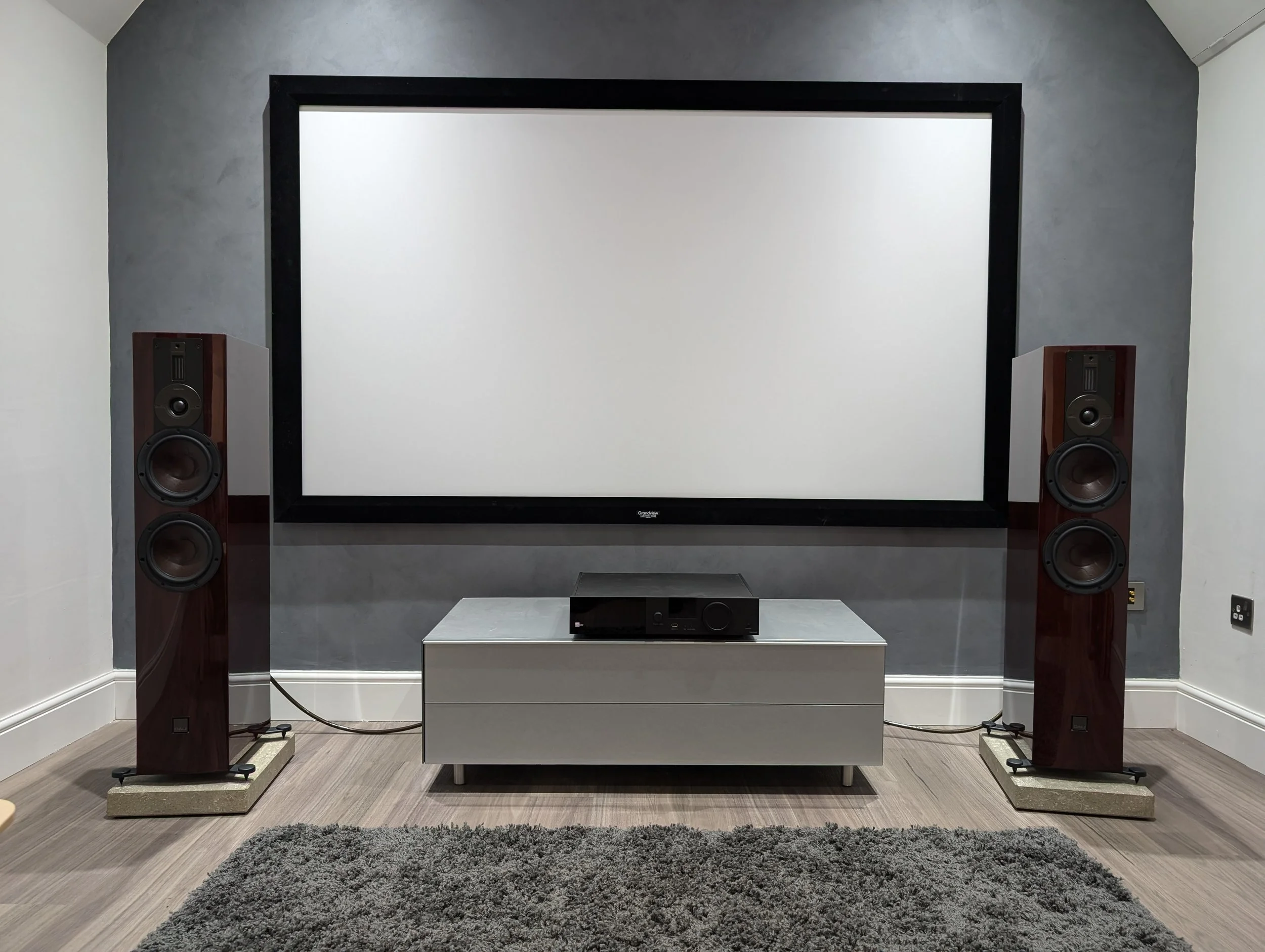
• DALI Rubikore Series – If B&W represents the cinematic “wow” and Dynaudio leans more toward refined musicality, DALI Rubikore lands somewhere in the middle. The sound is clean and precise but with a touch of sparkle on top, thanks to their hybrid soft dome and ribbon tweeter design. This also gives them excellent horizontal dispersion, meaning a wider sweet spot for listeners sitting off-centre. They’re controlled in the low end, articulate in the mids, and carry enough energy to suit both music and film — making them a flexible all-rounder in a multi-channel setup. (Around £8,500–£10,000 for a 5-speaker system)
Dali Rubikore 6
There are plenty of other great speaker options out there, whether you’re after compact cabinets, larger floorstanders, or something more discreet like on-wall or in-wall designs. Sadly, we can’t cover them all in one blog, so as always, your best bet is to speak with someone who’s spent time listening to a wide range of these systems — and pop into your local Audio T store and chat with the team.
That said, special mentions go to the Monitor Audio and DALI ranges in the AV sector, covering needs all the way from entry-level systems (with full packages starting at around £1,500 for a 5-speaker setup), up to mid and high-end tiers. Both brands offer flexibility and ranges ideal for more unique, discreet and architectural installations.
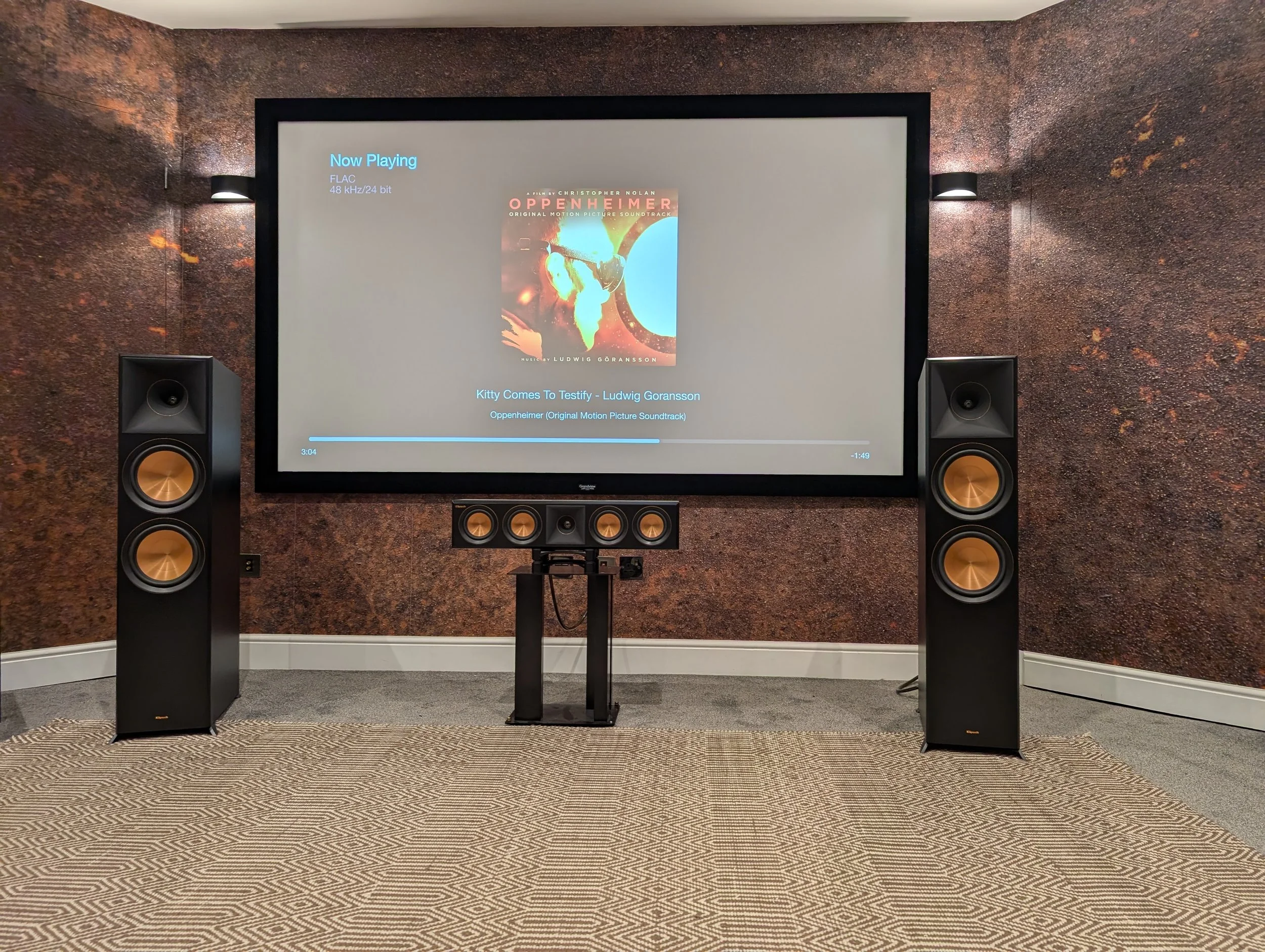
Klipsch Speakers with Built in Dolby Enabled Drivers in the top of the Left and Right speakers
Having a great speaker doesn't always guarantee great sound. What's equally important is the positioning of the speakers and how they work together — with and against the room. Getting this right takes a bit of knowledge and good listening skills.
Speaker positioning affects everything from soundstage and imaging to clarity and bass performance. One key element is the toe-in — the angle at which the front left and right speakers are turned toward the listening position. The goal is to have the sound from both speakers meet and “lock in” just in front of the listening spot. Too far inward and the soundstage can feel narrow and centre-focused; too wide and the image can become vague or diffuse.
Another often-overlooked factor is speaker rake — the backward tilt of the speaker — which can subtly adjust how the high frequencies reach your ears. This is particularly important for speakers that are tall, short, or placed well off ear height.
The centre channel also needs careful attention. It should sit at a height that keeps dialogue anchored to the screen — not floating above it or buried below. If the height isn’t ideal, a slight tilt (either upward or downward) can make a big difference in clarity and image placement.
Rear speakers (or surround and height channels) should work in harmony with the front to complete the soundstage. It’s not just about being behind you — they need to recreate ambience, movement, and spatial effects, so positioning and angle matter there too.
All of this takes a little patience. But once the system locks in, you’ll know — and you’ll hear the difference immediately. If you’re purchasing a new system and haven’t had much experience setting one up in depth, don’t worry — we’re here to help. Our staff are happy to assist with speaker positioning and calibration, and it’s something we take seriously.
It’s also worth noting that new speakers and electronics have a run-in period. When we install a system, we typically return after a few weeks to make final adjustments once the system has had time to settle. That’s when we revisit things like toe-in, balance, and room correction — because by then, you’re hearing and measuring the system in its true form.

Last but not least, let’s briefly discuss subwoofers. There’s a temptation to think of them as one-size-fits-all — just stick a big box in the corner and let it shake the room. But the truth is, a good sub (or two, sometimes even three) adds control, weight, and depth to a system — not just volume.

Some people stick with subs made by the same company as their speakers, which makes sense cosmetically and sometimes sonically too. But going with a dedicated brand like REL can give you more performance per pound, especially if your room is awkward. We often reach for REL when it comes to tackling low frequencies.
REL shines in dual-use systems where music and movies are both priorities. Their High-Level inputs let the sub track your main amp’s output, which means seamless integration with stereo playback — helping to support the low frequencies your main speakers can’t quite reach. They still offer standard LFE inputs, so you’re not missing out on that low-end impact during movies either.
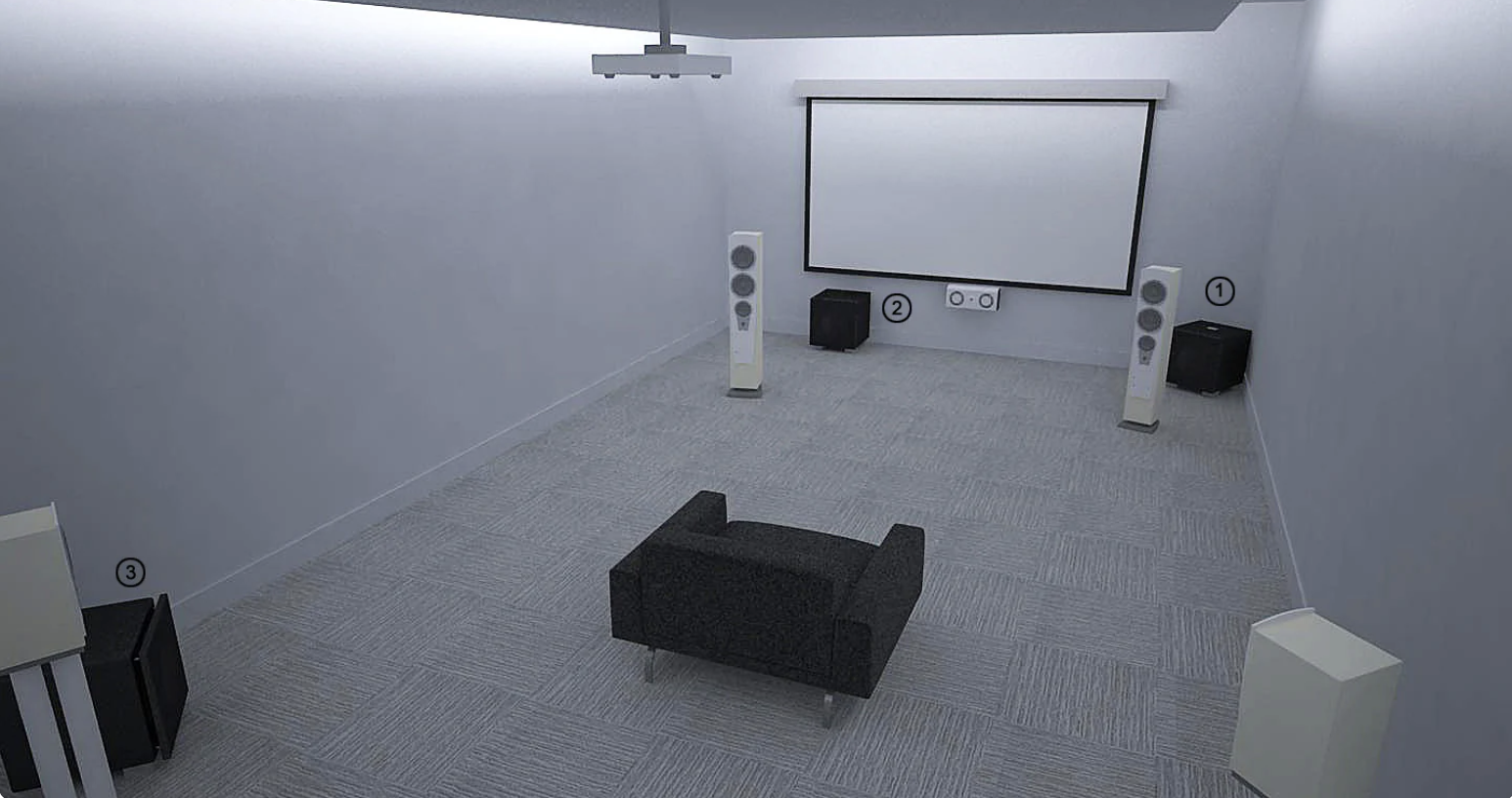
Great results can often be achieved by running two subwoofers instead of one. This not only smooths out bass across multiple seating positions — reducing dead spots and inconsistencies — but also provides a more immersive and controlled low-end. Placing a second sub at the rear helps complete the spatial picture. By reinforcing low frequencies from behind the listener, it improves the sense of realism, making effects like explosions, rumbling vehicles, or ambient textures feel like they’re truly happening around you, not just in front.
REL 3D Setup
The ‘final boss’ in a home theatre sub setup is adding a third subwoofer to support the centre channel. Since most centre speakers are smaller than full-range floorstanders, reinforcing them with dedicated low-frequency support can yield big benefits and bring them closer in performance to the Left and Right speakers — especially effective in improving dialogue clarity and mid-bass impact. This is the foundation of what REL calls a 3D system — a setup where front, rear, and centre channel subs work together to create a seamless, dimensional soundstage.
For a single-sub configuration, REL’s S-Series hits a sweet spot — giving great musicality alongside home theatre impact. Alternatively, the HT subwoofer range focuses more purely on cinema performance, and this can be further expanded with something like a T-Series connected via High-Level.
The world of home cinema is more accessible — and more advanced — than ever. Whether you’re starting with a modest 5.1 package in your living room or planning a reference-grade system like the Meridian theatre we visited, there’s a path for every space, budget, and ambition.
At Audio T, we work with systems at all levels: from compact, value-led setups that make a big difference without breaking the bank; through mid-sized installations that involve some structural or architectural planning and advanced calibration; all the way to bespoke six-figure cinema installations requiring architectural design, automation integration, and dedicated acoustic treatment. No matter where you’re starting from, it all begins with a conversation.
If you’re thinking about building or upgrading an AV setup, pop in for a chat. We’re always happy to walk through what’s possible and what’s practical for your space and budget. And if you’re unsure where to start, we’ve got systems running in a number of our stores — and in some cases, we can take customers directly to manufacturers’ dedicated cinema rooms.
Because once you’ve felt a good home cinema system — really felt it — you’ll never want to go back.
We highly recommend trying streaming Dolby Atmos music through services such as TIDAL, Apple Music, or Amazon Music.
Film to check out: Sound of Freedom — an action film with a dark theme, based on a true story.
Thanks for reading – Dan, Gareth & Rishi – Audio T Reading
If you have any questions about any of the equipment featured in this article, or any other Hi-Fi or home cinema enquiries, be sure to Contact Us.
If you’ve enjoyed this, why not go ahead and read more of our other blogs, and be sure to follow us on our social media channels below…
For any AV/Home Theatre or general audio related queries contact your local Audio T store -
*All prices, credit terms and interest rates quoted are correct at the time of going to press but may be subject to change. E&OE
Thinking of home cinema but don’t want the hassle of having a projector fitted into your ceiling? Fear not, Hisense and Audio T have you covered.
With many of us staying at home these days due to a global pandemic, the cost of petrol, or even the cost of going abroad we look to our own home entertainment, whether it’s your sound system or in this case your viewing pleasure.
100L5FTUK 100" Laser TV still image
Like a lot of you out there, I am a big film buff. Before COVID hit, one of my favourite things to do was going to the cinema, it always felt like a event. Sitting in a darkened room, popcorn in hand, seeing a movie for the first time on the silver screen… I know, sounds romantic doesn’t it? But with the turn of recent events, some of that romance has been lost.
As I say there’s nothing like the big screen, so how do we replicate that experience in our own homes?
For many people, they very quickly get put off by the expense and in some cases, the inconvenience of having a projector mounted to your ceiling and a massive retractable screen put in, not to mention having a surround sound system of amplifier and speakers etc. Fear not, those awesome people at Hisense have come up with the perfect solution. The 100 L5FT UK-A12, also known as the 100” laser TV. I know what you’re thinking, “ A 100 inch laser tv?!” Don’t worry, it’s a 100 inch screen with a short throw projector.
There is currently is a promotion until the end of March 2022 which can include the amazing people at Hisense delivering and professionally fitting all in the price of the projector and screen. Contact us for more details!
Hisense 100L5FTUK 100" Laser TV
The great thing about the 100 L5FT UK-A12 is that there is no need to have a projector hanging from your ceiling as this amazing piece of kit is a short throw and will sit quite neatly in front of the screen. Dare I say it, but I think it looks really cool too! This system could easily replace your TV as it has some rather good speaker built-in as well as TV tuners and all the current smart functions we’ve come to expect from our living room TVs. And for you concerned parents out there like myself, I'd normally be worrying about my kids going near the bright lights of the laser but this projector has a great safety feature where the laser cuts out when you get too close to it.
If you did want that full surround sound cinema experience, we at Audio T can certainly help. We have a wide range of systems to suit your needs.
Ambient Light Reflecting Screen
Let’s start with its state of the art laser engine, which is how the projector achieves its incredibly sharp focus, aided by its X-Fusion laser light. All of these components help when viewing even with ambient light in the room. In short, you don’t need a pitch black room to watch a film. This is also helped by the dedicated light reflecting screen. It has stunningly realistic 4K Ultra HD, giving you that pin-sharp clarity. It is also blue light certified, helping with less blue light that can put excessive strain on your eyes. As I mentioned before it has a great safety feature with its laser if you get too close to it the laser will turn off.
Hisense 100L5FTUK 100" Laser TV DOLBY ATMOS SPEAKER
Laser TV Smart functions on remote
As I’ve mentioned previously, the projector has a built in speaker system that gives you a surprisingly good immersive sound experience. This projector works really well as a smart TV with its Hisense inbuilt VIDDA U interface so you have access to all of your favourite apps such as YouTube and Netflix etc. If you’d like to read more on the specs of this truly amazing projector package, check out our website or give us a call at any of our stores. As we always say, music and film is our passion.
Levelling tool for fine adjustment
In this instance, we set-up the projector ourselves and believe it or not it was really easy to do this. Hisense has a guide which will take you through the set-up of the projector step by step using an alignment tool on your smartphone. (So, if you needed to move the projector it’s easy to do so).
The bracketry for the 100 inch screen is really straightforward to mount and there is lots of room for movement and adjustment, so if you need to hit a stud in the wall or have a small area that can take the fixings this is not a head scratcher. Even down to levelling the screen, once it is up it is so easy with the threaded adjustment as shown in the pic. Once levelled off correctly these metal loops will scoop up behind the screen and be available if any minor adjustment is needed in the future.
On the audio side we have a 4.1 surround sound set up with a Marantz NR 1711 slimline AV receiver and Panasonic DP-UB9000EB1 4K Blu-ray player. Speaker wise we have Acoustic energy AE 520 floor standing speakers on the front and on the rear we have Acoustic energy AE 500 stand mount speakers and of course not forgetting the subwoofer, we have the amazing REL Ht-1205 running as well. So, we have the perfect viewing and listening package here. Why not pop in and take a seat and experience it for yourselves.
Laser projector setup Hisense 100L5FTUK 100" Laser TV Marantz Panasonic & Acoustic Energy
Originally the Qingdao No.2 radio factory established in 1969, moving forward making television for China’s national defence office, through to making televisions for the general public. In the 70s they went on to manufacturing televisions of well known companies such as Hitachi NEC Sanyo and Toshiba. In 1992 the company was bought out by Zhou Houjian, the Hisense group emerged moving many years on in 2013 Hisense made the first type of transparent 3D televisions as well as making fantastic televisions in their range. Now turning their attention to short throw projectors, we have this fantastic projector package.
The Hisense 100 L5FT UK-12 is the perfect movie package or even if you want to watch the game or put on your favourite concert, as we say there’s nothing like live music especially when you can experience it in the comfort of your own room kick back relax and enjoy. If you’d like more information on this fantastic projector package, call us on 02920 228565 or email us at cardiff@audio-t.co.uk or why not pop in for a demo of this amazing projector package.
Thanks for reading.
Matt, Nick & Kerrin - Audio T Cardiff
Keep up to date with everything going on at Audio T Cardiff by following us on Facebook and Instagram.
Hisense can be found at the following Audio-T stores
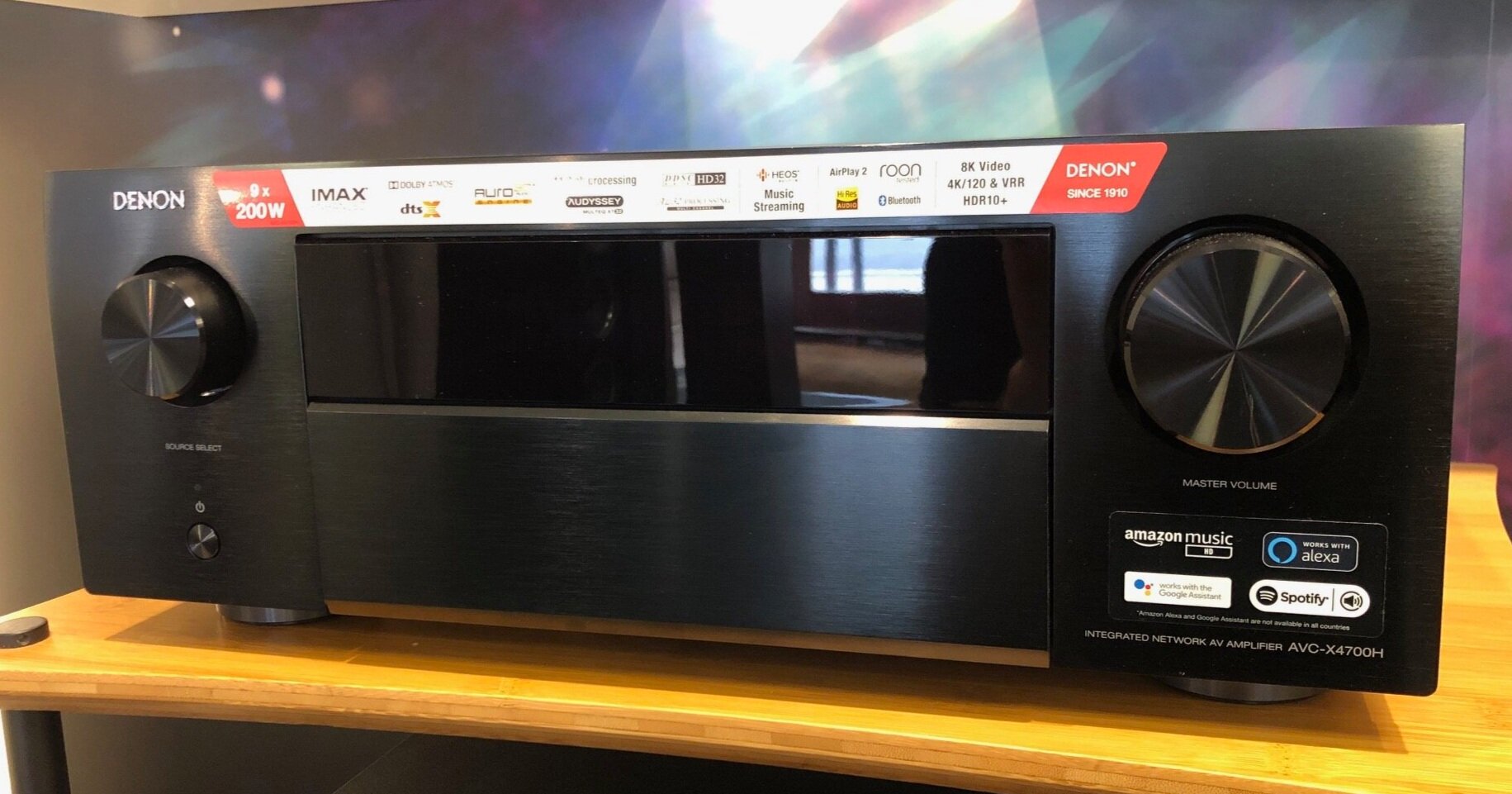
Here is the new Denon AVC-X 4700H, which offers a 9.2 200w per channel setup and gives you access to Dolby Atmos, DTS:X, IMAX Enhanced audio and 8K/60Hz 4K/120Hz visuals. HDMI 2.1 is also supported on one input. With a total of 7 hdmi inputs it is more than capable of supporting a larger setup of blu-ray players, games consoles and TV boxes. Dynamic HDR, HDR10+ and eArc mean you will get the excellent picture quality you want in order to enjoy the films you watch and the games you play.
Accessibility from a phone or tablet is easy and vast, with the inbuilt HEOS allowing you to stream high quality audio from services like Tidal or Amazon Prime Music. Airplay2 is a welcome feature for any Apple user, plus the 4700H is Roon tested and is compatible with Bluetooth. For the analogue music lovers the Denon has a phono input, a tuner input and 5 other assignable analogue inputs. Audyssey, helpful if you have a room with a less than ideal arrangement, works well and can help improve the sound quality when used correctly. The 4700H is also voice assistant compatible with Alexa, Google Assistant and Siri, so no matter which one you use the Denon will have you covered.
The design of the front panel is sleek and minimalistic, with just the input selection, volume, power button and screen visible. There are some quick select options, including USB and a headphone jack, hidden behind a front panel for easy navigation, for those times when you can’t seem to find the remote. The unit itself is solid and feels well built, but is a little lighter compared to other AV amplifiers, making installation and any future rearrangement a bit easier on the lower back.
Denon has a long history in Hi-fi dating back over a century, they pride themselves on the quality of their work, this shows in how their products improve year after year. They are usually among the first to implement new technology, as shown by the addition of 8k to their newest range of AV amplifiers, and having it work seamlessly straight out of the box.
The setup step by step guide is very helpful and straight forward and walks you through every aspect, even including how to strip the speaker cable. This makes it accessible to newcomers starting their very first home cinema. Speaker configuration, distances and levels are quick and easy to set, so you can be sure you get the best sound from all your speakers. Pretty much everything is customisable, from how bright the front display is, the names of each of the inputs, to the EQ of the speakers.
Listening to Tidal through the Heos app was not only simple but it also sounded really good. Without the need to drive a centre or surround speakers the 4700H becomes a very powerful stereo amp, capable of driving even some less than forgiving speakers. With a pair of Dynaudio Evoke 30’s attached, the price difference being a concern, I was expecting a sound that was lacking in cohesion and range, but I was delighted to hear that Solange’s ‘Don’t Touch My Hair’ had clear, melodic vocals and an impactful but controlled bass. The phono input is adequate, but add on an external phono-stage matched to your turntable and it will finish the package off beautifully. In terms of surround sound with movies, we set up a Monitor Audio Silver and Rel 5.1.4 system,and it sounded marvellous. Voices were clear, soundtracks weren’t overpowering and with the atmos speakers turned up slightly the overhead effects during action sequences were exciting and added so much to the overall experience. Finish it off with a good sub, or two, and you can have an excellent home cinema experience without breaking the bank or compromising on quality.
The Denon AVC-X 4700h and the other’s in the range are available at all Audio-T branches. If you would like a demo of this or any other of our selected products make sure to drop us an email or give a ring to book your appointment.
Jon and Luke - Audio-T Oxford
Make sure you keep up to date on what’s happening at the Oxford Store by following our social media on Instagram and Facebook
It was rather fortuitous recently to be approached by Mark Packham of Avant Home Technology, with a view to collaborating on Home Cinema, Custom Install and Home Automation, as we were looking for such a partner here in Brighton, to cover the City and wider area where we operate.
Indeed the first project Mark tackled was our Home Cinema Room in store, and what a fine job he has made of it!
The aim was to showcase a fully automated room offering outstanding sound quality with a projector and screen as well as 4K TV, and at a reasonable cost. This system can be scaled up or down in cost according to the customer requirements, with automation incorporating many aspects of the home if required, to the extent of lighting, CCTV cameras, electric gates, and much more besides.
To experience this system for yourself and explore the possibilities of Home Cinema, Custom Install and Home Automation please contact us on 01273 609431 or email us at: brighton@audio-t.co.uk where Julian, Paul and John will be pleased to help you.
We are able to visit you at home to discuss projects and in particular Mark Packham is available for these visits.
The Case Study below put together by Mark gives a general overview of the system.
HOME CINEMA & CONTROL SOLUTION
At the beginning of 2018 it was a privilege to work with the very capable team at Audio T in Brighton when we installed a designated home cinema room in an under-utilised area of the show room. Specialists in hi-resolution audio systems Audio T is accessible for anyone that would like to receive a demonstration on the latest quality home audio products on the market.
The 5.1.2 Dolby Atmos home cinema room at the back of the showroom represents a space that most people could find in their own home and is priced at a point which is affordable for those people looking to splash out on a good quality media room or home cinema system.
To push the boundaries a little further we were delighted to be able to offer a single room Control4 solution that helps to make the experience that little bit more magical. By integrating the lighting, the projector screen and the audio-visual devices together, movie night becomes that little more special as a single button press triggers a series of actions.
This room received a complete renovation. New cabling was chased into the walls and routed back to a central location before being plastered.
After over 50 years trading Audio T remain as relevant today as they always have been and for those clients that want to experience the very best in audio systems on the market there are very few alternatives. I believe they are unrivalled in the area for their knowledge, expertise and experience in the hi-resolution Hi-Fi audio domain.
Mark Packham - Avant Home Technology
At Audio T we're always excited to share with you our thoughts and musings on the latest and greatest Hi-Fi and home audio! Our blog features news and reviews from individual stores and occasional blogs from HQ; select your nearest store from the list below to find out what they've been up to.