Top Black Friday Hi-Fi Deals: High-End Audio & Heavy Reductions at Audio T Reading

Black Friday has landed at Audio T Reading, and we’ve lined up a handful of seriously compelling clearance offers. These aren’t random discounts — they’re standout pieces our team genuinely rate, each reduced to a level that makes upgrading hard to ignore. Whether you’re chasing deeper bass, a richer two-channel experience, or a top-tier pair of headphones, these staff-selected deals are well worth your attention. Stock is extremely limited, so if something catches your eye, now’s the moment.


Dan - Assistant Manager

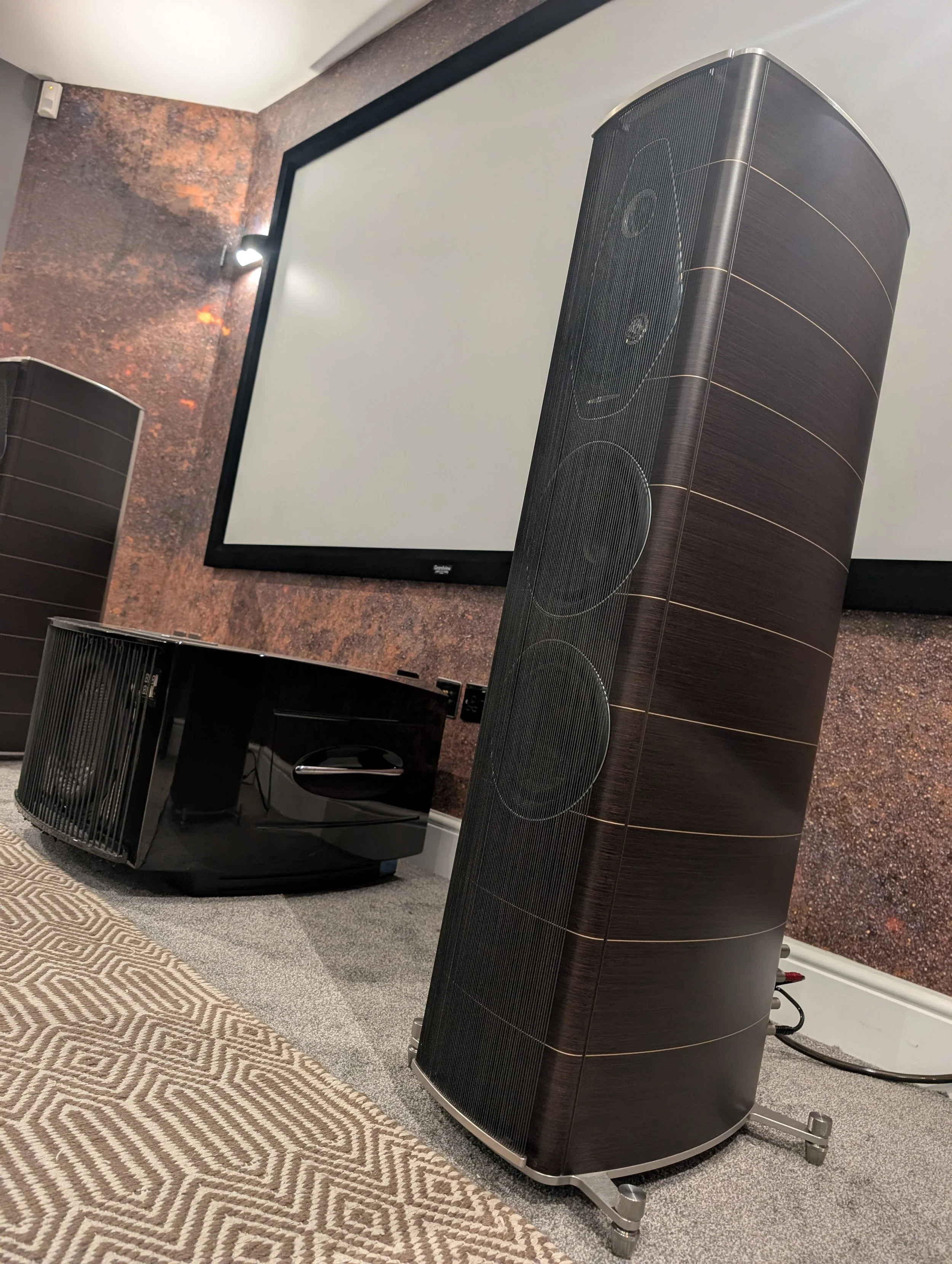
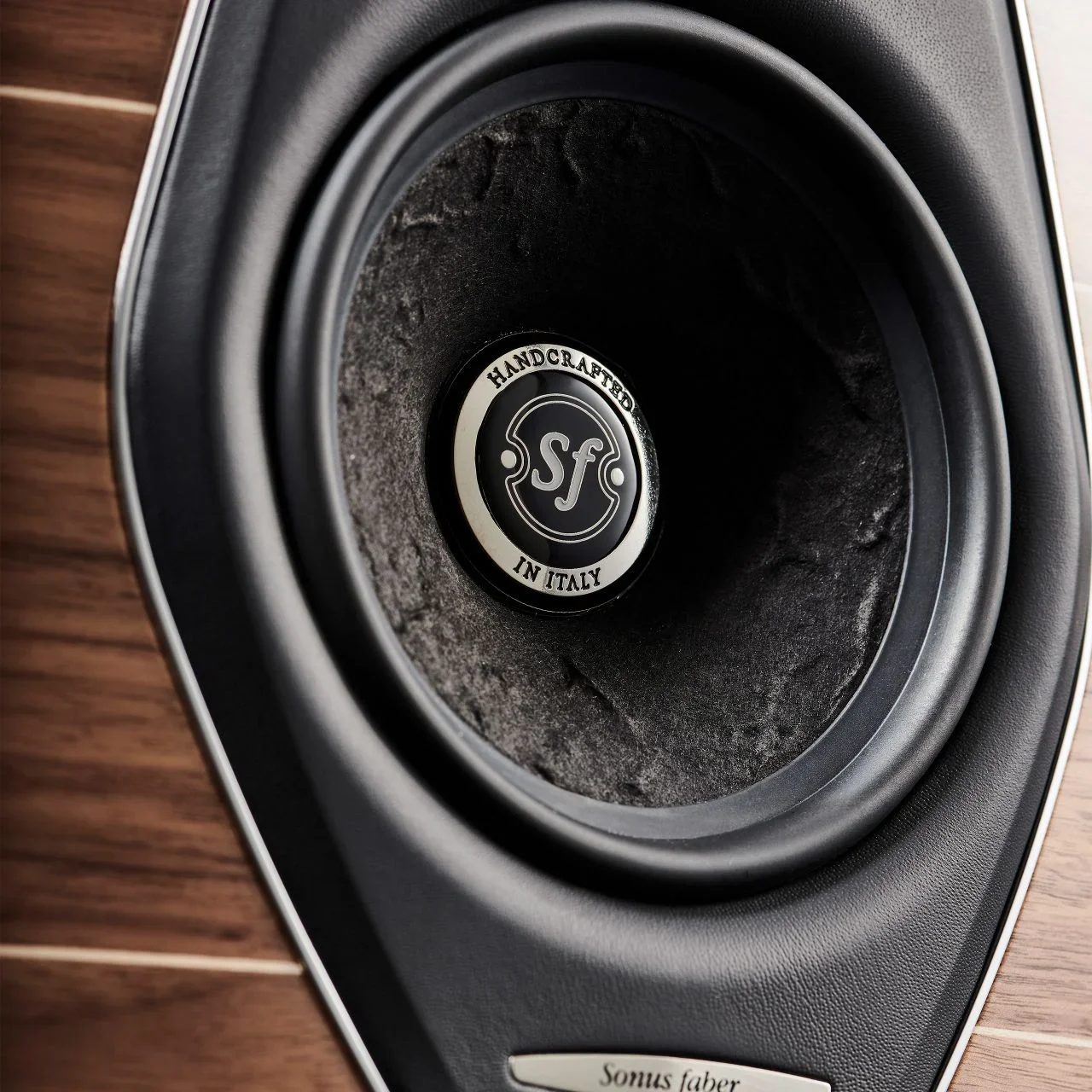
Sonus Faber Olympica Nova III in Wenge

Was £13,700 - Now £8,700 - Save £5,000

Sonus Faber is exclusive to our Swindon branch, and having worked there a little over a year ago, the Olympica Nova III was one of my personal go-to speakers for a long time. I was recently reunited with them when they became the speaker of choice for our training event, and it reminded me why Sonus Faber holds such a special place in high-end audio. They’re not explosive or showy for the sake of it — instead, they offer a beautifully natural presentation with real depth, texture, and that unmistakable rich tonality Sonus Faber is known for. It’s an easy speaker to fall in love with, simply because it makes music feel right. And of course, in true Sonus Faber fashion, the craftsmanship is absolutely stunning — a blend of Italian design and meticulous detail that looks every bit as special as it sounds.

They continue to be one of my favourite speakers, and now at such a hefty discount, it’s an absolute no-brainer. The smaller sibling, the Olympica Nova II, as well as the stand-mount Olympica Nova I, are also available at significant reductions.

For any additional information or queries about these or other Sonus Faber products, give the team in Swindon a shout.


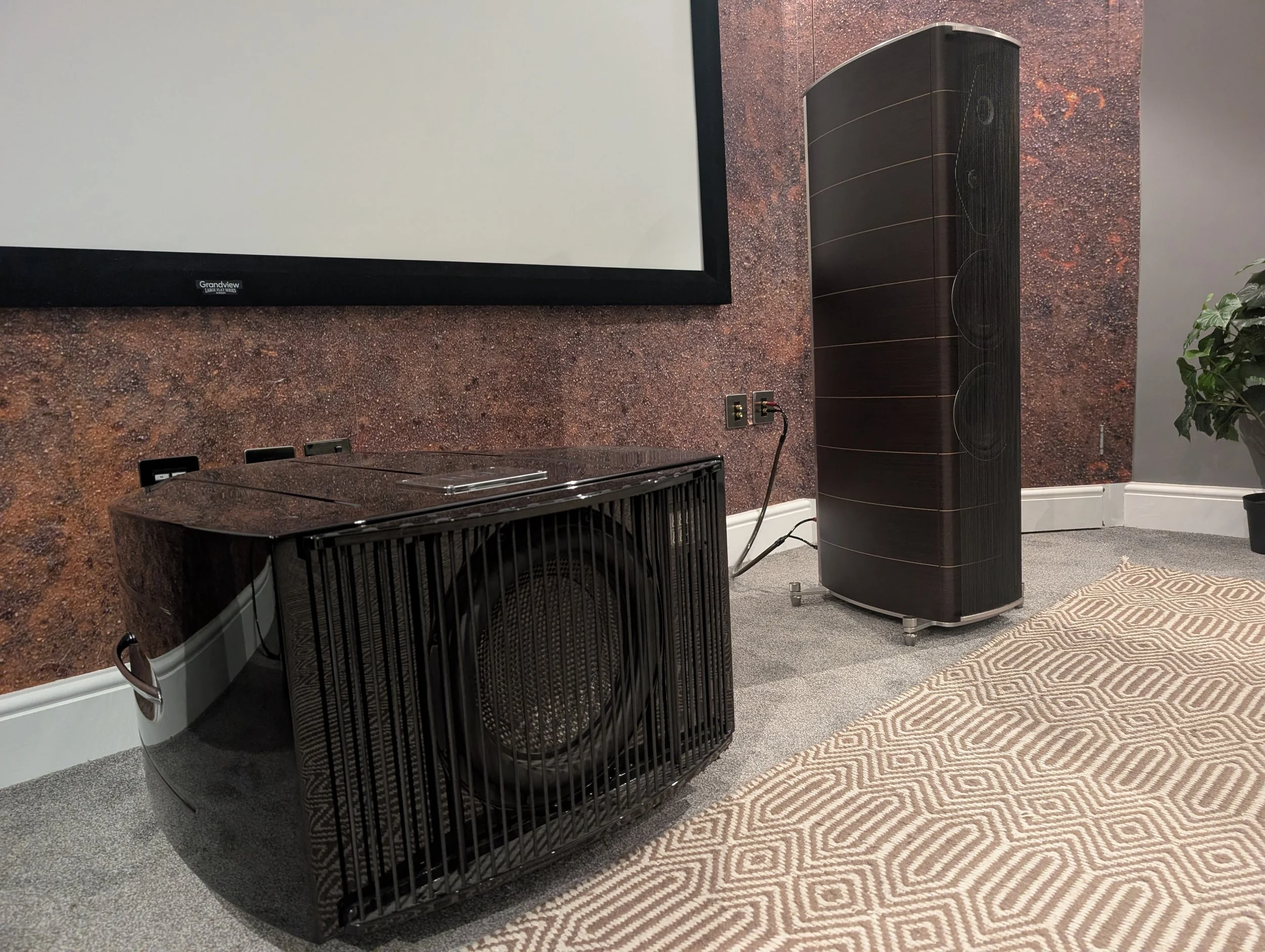
REL No.31 Reference Subwoofer

Was £7,000 - Now £4,000 - Save £3,000

The REL No.31 isn’t about sheer volume — it’s about control, timing, and musical truth. It’s versatile enough to work in a wide range of systems, but at this level, pairing it with an equally revealing set of speakers lets it really shine. Kick drums gain weight and punch without any overhang, double bass notes stop instantly and cleanly, and film soundtracks expand with a cinematic scale that can make the room feel twice as large. When dialled in correctly, the bass supports the music rather than smothering it — you don’t feel the subwoofer when it’s on, but you certainly feel it when it’s turned off — and that’s the beauty of a well-balanced REL subwoofer. It’s a lovely addition to any refined system.

The No.31 is cut from the same cloth as REL’s flagship No.32 at £10,000, but in a more compact cabinet designed for smaller spaces, with surprisingly little compromise in performance. It’s a genuine slice of REL’s reference engineering for far less. Speak to your local branch for help getting it set up and integrated perfectly into your system. Whether it’s your first step into high-end bass, an upgrade from a smaller unit, or a second sub to create a stereo pair, the No.31 will not disappoint.

Together – A System With Real Soul and Scale

Pair the REL No.31 with Sonus Faber’s Olympica Nova III, and you’ve got something truly special. The Nova III already delivers that warm, organic, beautifully layered Sonus Faber sound, but the No.31 adds a deeper foundation and sense of scale without disturbing the speaker’s natural balance. The combination feels effortless — rich, emotionally engaging, and capable of both intimacy and full cinematic sweep. It’s a system that brings music and film to life in a way that feels genuinely immersive.

Together, these items would normally cost just shy of £20,000, but this Black Friday they come in at a remarkable £12,700. Of course, these ex-demo deals don’t need to be purchased as a set, and each item comes with a full manufacturer’s warranty.

Get in touch with your local branch to check availability, as these are likely to sell out quickly.


Gareth - Store Manager

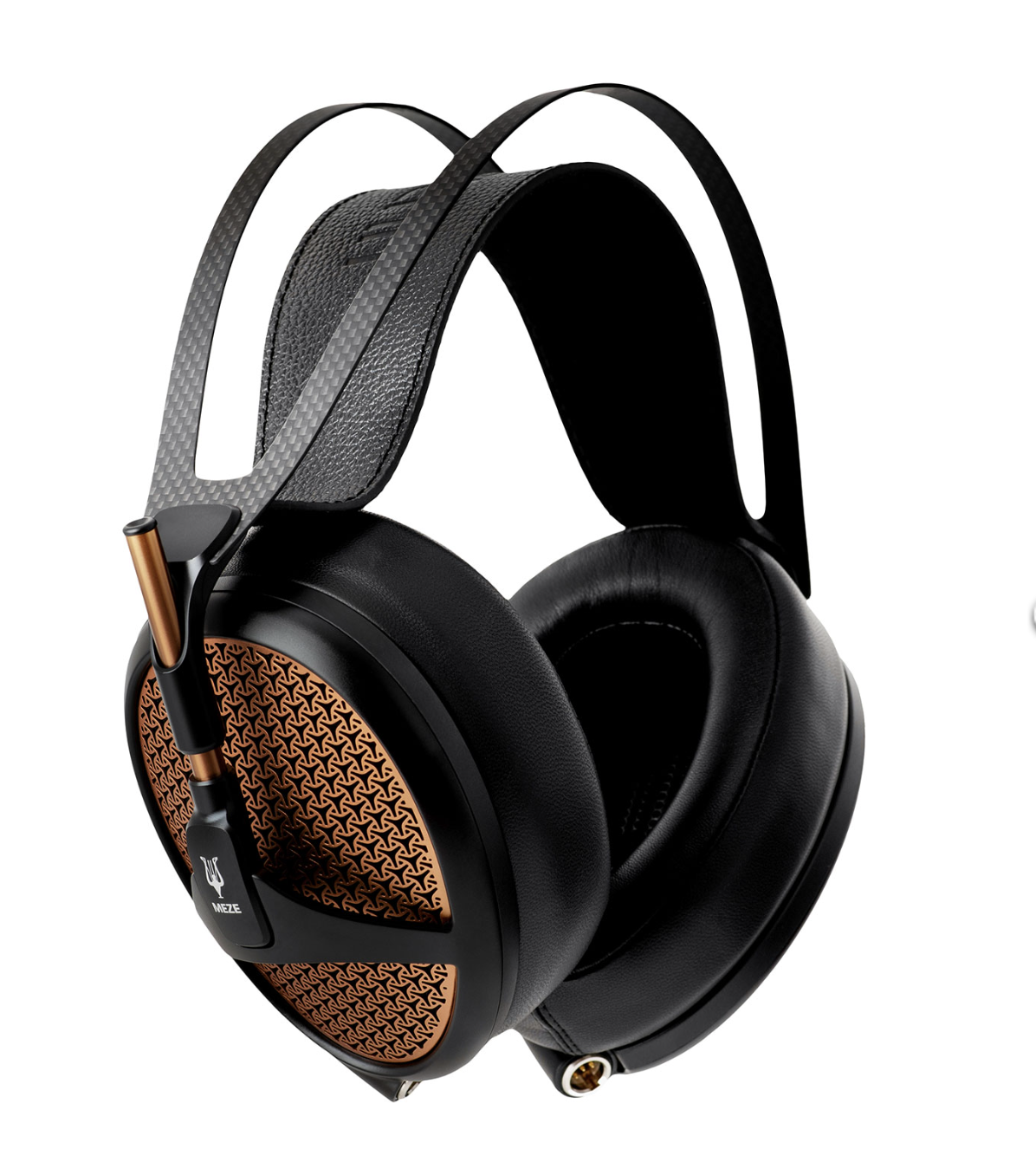
Meze Empyrean Headphones

Was £2,749 - Now £1,849 - Save £900

Headphones are a big deal these days, and one of our favourite brands is Meze from Romania. Since arriving on the scene around 15 years ago, they’ve produced a range of models beloved by the Head-Fi community — from the budget-friendly 99 Classics up to the astounding Elites, they cover all the bases. Meze combine superb design, construction, and comfort with a mature and sophisticated sound signature that’s won them fans worldwide.

We have a very tempting deal on a pair of the fabulous Empyrean headphones in the stunning Black and Bronze finish. Not so long ago, the Empyrean was their flagship model and, even though they’ve since been succeeded by the Elites and the revised Empyrean II, the original Empyrean is still one of the finest headphones out there. Despite the bulky appearance, they’re incredibly comfortable and can be worn for hours without fatigue. Sonically, they’re warm, full, detailed, and easy to listen to — not as forensic as some more excitable designs, but beautifully balanced. With a 32-ohm impedance and around 100 dB efficiency they’re not difficult to drive, though they certainly reward a high-quality source. They also arrive with a first-class accessory kit, including a metal attaché case and a high-quality removable cable.

You may never need another set of headphones.


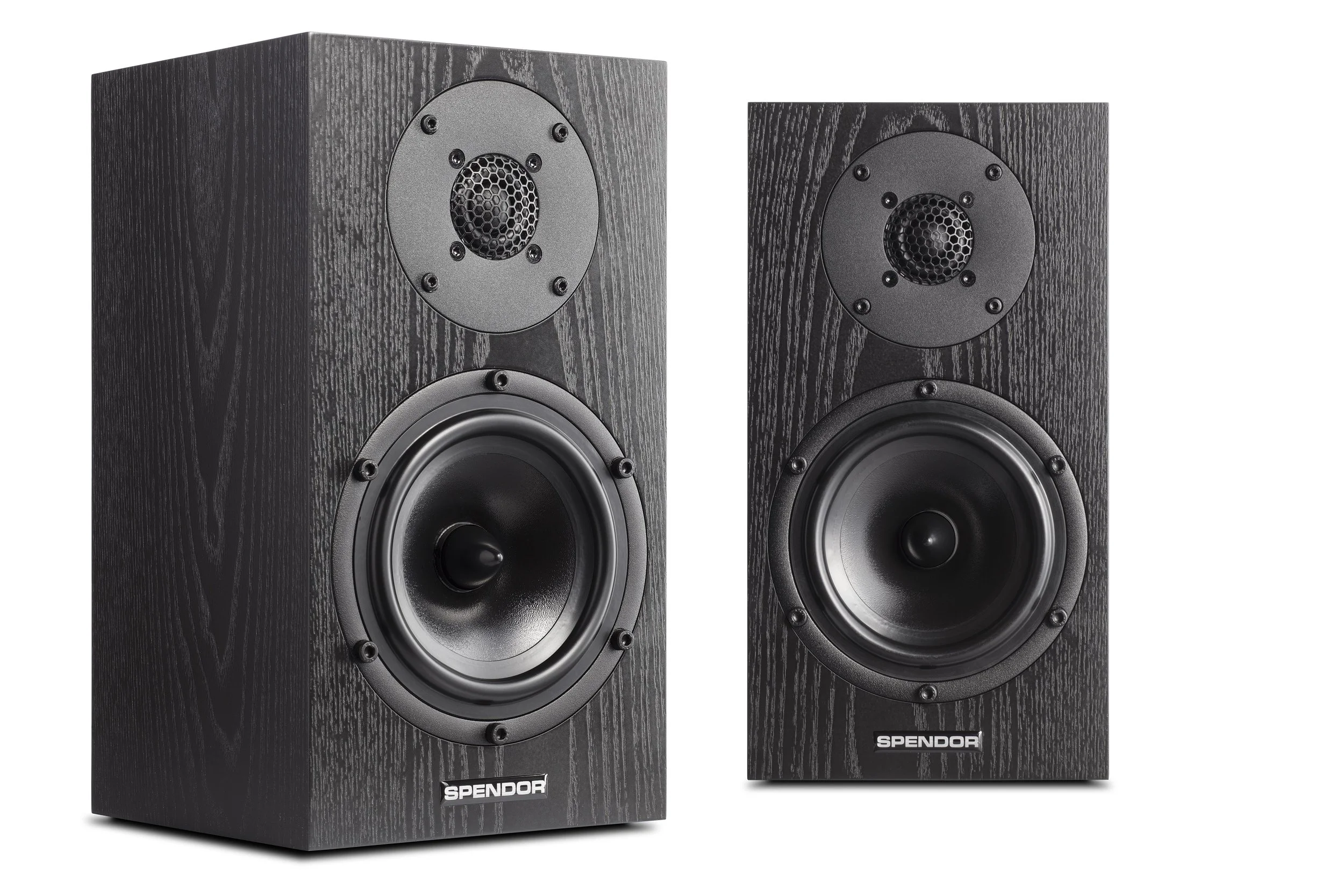
Spendor A1 in Black Ash

Was £1,550 - Now £999 - £551

It’s fair to say that speakers are the most subjective part of any Hi-Fi system. Swap the speakers and you can change the entire character of a setup — not to mention how differently each design interacts with a room. With such a huge variety of shapes, sizes, and finishes available, choosing the right one can feel a little overwhelming.

Back in the 1970s, the boffins at the BBC spent years developing the LS3/5a — a compact monitor for outside broadcast work. Several companies were licensed to build it to strict BBC standards, and one of those manufacturers was Spendor (founded by Spencer Hughes, who was part of the original BBC research team). Although the LS3/5a is no longer used by the BBC, the design lives on. Original examples fetch strong money, and many of the original licensees still produce modern interpretations today.

One such modern variant is the Spendor A1 — a very compact stand-mount speaker with a fabric dome tweeter and polymer mid/bass driver. They offer that magical BBC-style midrange that’s wonderful with vocals: natural, realistic, and thoroughly engaging. There isn’t much output below around 90 Hz, so bass-heads may want to add a subwoofer — but if you do, the A1 integrates beautifully. You might not even need one; I regularly use a pair of Rogers LS3/5a in my own system, and the midrange purity and superb soundstaging mean I rarely miss the bottom octaves. They communicate music in a remarkably engaging way and are easy to drive — tube amps in particular sound lovely with them.

If you fancy a taste of Hi-Fi history that will make you fall in love with your music all over again, try the Spendor A1.


Rishi - Sales Assistant

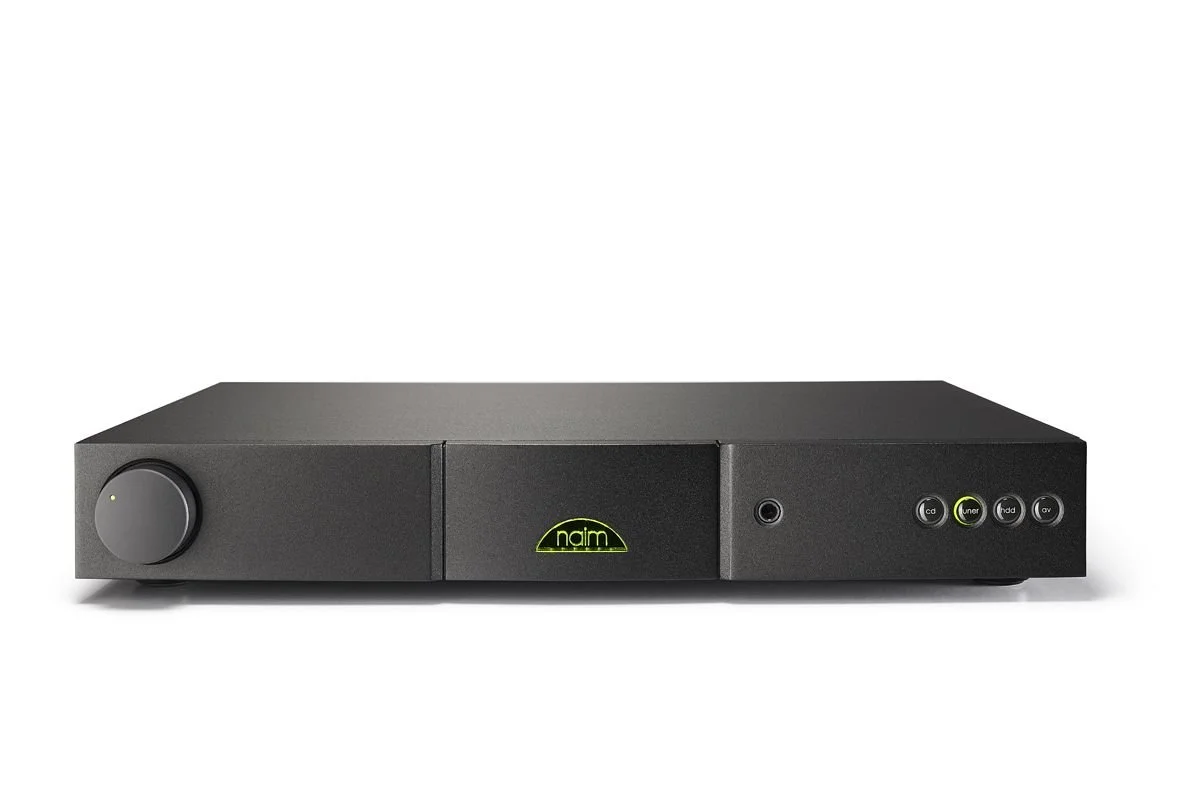
Naim Nait 5si Amplifier

Was £1,699 - Now £849 - Save £850

A couple of weeks ago Dan and I had the great pleasure of visiting Naim’s headquarters in Salisbury.

The legend that is Jason Gould — a stalwart at Naim since the early 2000s and now esteemed Brand Ambassador — personally took us around the factory where we got to witness and learn more about Naim's incredible manufacturing techniques, as well as the principal practices that underpin their preservation of the reproduced audio signal. While Naim continue to evolve as a company, their HQ is steeped in rich history. And as someone who has grown up with Naim equipment, especially amplification, I felt truly humbled to be there.

No other series of Naim product line-up encapsulates their reputation for infectious and enthusiastic reproduction of music quite like the NAIT line of amplifiers, dating right back to the original Nait 1 in 1973 all the way up to the current Nait 5si. NAIT stands for Naim Audio InTegrated, but it may as well have stood for Naim Audio Induced Toe-tapping, as never before had an amplifier product or line infiltrated its listeners in such an intoxicating manner. I recall being knocked off my socks when I heard and felt the sheer dynamics and exuberance of the Naim Nait 3 in the mid-90s.

Fast forward to 2023, when I learned that Naim were to celebrate their 50th anniversary with the release of the Nait 50, I dreamt of having one for myself. Upon a first listen to the Nait 50, the dream became a reality — I bought one immediately! And it makes me smile to this very day with each and every audition.

It could only be a NAIT that could entirely do justice to, and serve as a rightful celebration of, Naim's iconic history... which brings me at pains to point out that the very last of Naim's NAIT amplifiers, the Nait 5si, is now discontinued and perhaps marks the end of a glittering NAIT era. We have literally only a handful of Naim Nait 5si left within the Audio T group, including a last one here at Audio T Reading. It’s a cracking amp at its full retail price, but now on clearance it's being offered at half the price — a simply ridiculous bargain. Just beyond its unassuming front fascia, the Nait 5si is a thoroughbred, fully analogue class AB amplifier that sounds clear and neutral, with that Naim dynamic performance that belies its modest power rating of 60 watts per channel.

Those who know Naim are well aware that a “Salisbury watt” is more powerful and meaningful than most watts by any other name. With an ideal speaker pairing — something that we can happily assist with — this amp will bring your music to life in that true NAIT spirit. Can I make a suggestion, friends?

Why not get your hands on one of our Naim Nait 5si while you still can? At the same time, you'll also be securing a veritable slice of British hi-fi history, as the curtain draws on one of the finest integrated amplifier lines there has ever been. Hey Naim, could you at least pass us some Salisbury tissues?


So there you have it — the top picks from the Reading team, straight from the people who know the kit best. That’s just the tip of the iceberg: we’ve got bargains across speakers, headphones, streaming devices, TVs, amplifiers, AV receivers, and more. Click below to explore the full list — but don’t hang around. Once these items are gone, they’re gone!

VIEW ALL BLACK FRIDAY CLEARANCE DEALS

Spotted something you like but it’s not at your local Audio T? Don’t worry — just get in touch with your nearest store, and we’ll do our best to get it to you.


Thanks for reading.

Dan, Gareth & Rishi - Audio T Reading

If you have any questions about any of the equipment featured in this article, or any other hi-fi or home cinema enquiries, be sure to Contact Us

If you’ve enjoyed this, why not go ahead and read some more of our other blogs, and be sure to follow us on our social media channels below…


*All prices, credit terms and interest rates quoted are correct at the time of going to press but may be subject to change. E&OE

Bringing the Cinema Home: What to Know Before Building an AV System

There’s something special about experiencing a well put-together home theatre system. Whether that’s watching a film, immersing yourself in a gripping series, or enjoying a live music or sporting event with a few friends. It’s not just about loud sound or a big picture — it’s about scale, immersion, and feeling like you’re inside the story.

But putting together a home theatre system isn’t always as simple as grabbing a soundbar and sticking some speakers around the room. While this may be sufficient — and most cost-effective — in some cases, as there are some great soundbars out there, some want to reap the full benefits and experience sound and picture as they’re meant to be heard and felt, getting all the minute details that the film producers and sound engineers intended us to hear.

To build a balanced AV system that’s capable of doing the small things as well as the big things, a number of considerations need to be taken into account.

This month, we’re running through some of the key areas when it comes to building surround audio systems. Whether you’re planning a full-blown 7.3.4 Atmos install or just looking to add some rear speakers to your lounge setup, this guide should help point you in the right direction for how to add scale to your system.


Start With What You Want the System to Do

The best AV systems start with a simple question: What do you want this system to do?

Some people are chasing that big, cinematic feeling — explosions, deep rumbling bass, voices that float across the room. Others want something that complements their two-channel hi-fi system without becoming overwhelming. Then there are setups that need to be family-friendly, easy to use, or discreet and hidden within cabinets — all of which require a slightly different approach.

So the main questions are: how are you planning to use the system, and how immersive do you want it to be?

Knowing this upfront can save you a lot of time (and money) down the line.


Room Shape, Construction & Acoustic Gremlins

It’s easy to overlook, but the room itself is just as much a component as the amplifier or speakers.

Rooms with solid walls (brick or stone) tend to reflect and trap bass differently from stud walls. A suspended wooden floor can amplify low-end vibrations in a way that can either help or hinder — especially if the floor isn’t well-isolated. Even the ceiling plays a part: is there a void for in-ceiling speakers, or is it solid plasterboard with no access?

Also think about cable routing. Will you be lifting floorboards? Hiding speaker wire in the walls? Or are you happy to save a chunk of cash and use simple trunking to keep things neat?

In open-plan spaces or oddly shaped rooms, we often find bass nodes (hot or dead spots), flutter echo, or just general muddiness that affects dialogue clarity. It’s not always fixable with gear alone — sometimes a well-placed rug, some thick curtains or a bookshelf full of irregular items can make more difference than a new speaker.

Ceiling height also plays a role, particularly with Atmos. Lower ceilings tend to reflect sound too quickly, reducing the ‘overhead’ sensation, while very high ceilings may require more power or speaker directionality to get proper vertical impact. Sloped ceilings can cause their own directional quirks too, often leading to imaging being pulled off-centre or uneven surround balance.

Another thing worth checking is what’s above and below the room. Is it a suspended floor with cavity space beneath (which could cause bass to travel and resonate)? Is there a bedroom above, and do you need to consider soundproofing or isolation? For those in flats or terraces, neighbour-friendly bass might be a consideration.

Lastly, the listening position can make or break a setup. Sitting too close to a back wall can exaggerate bass; sitting directly between speakers can hollow out the soundstage. Even just nudging the sofa forward a foot or two can improve clarity and lock the system in place.


The Beauty in Dolby Atmos

Before diving deeper, I think it’s a good idea to explain what the Dolby Atmos sound format is and what it does for a home theatre system.

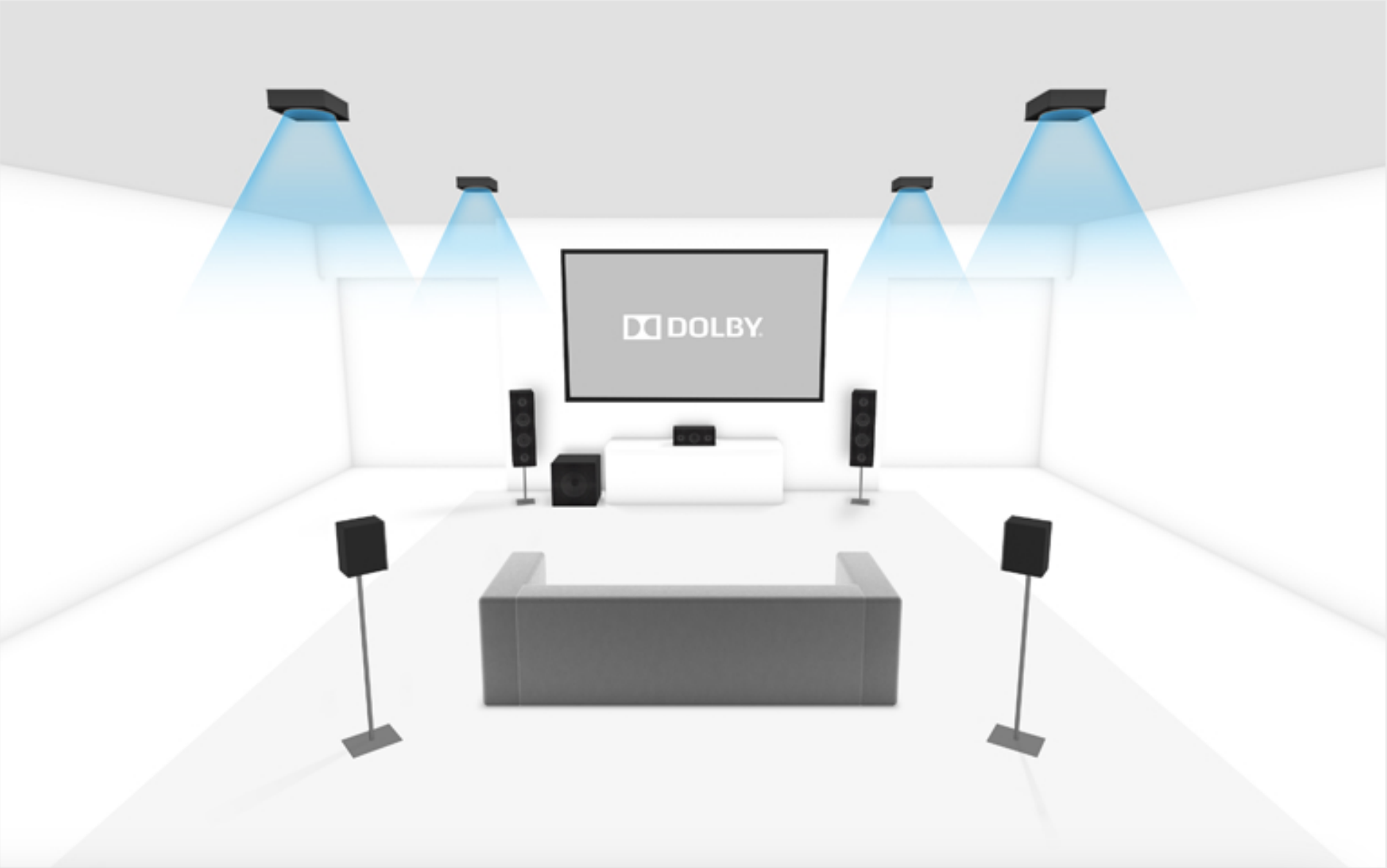
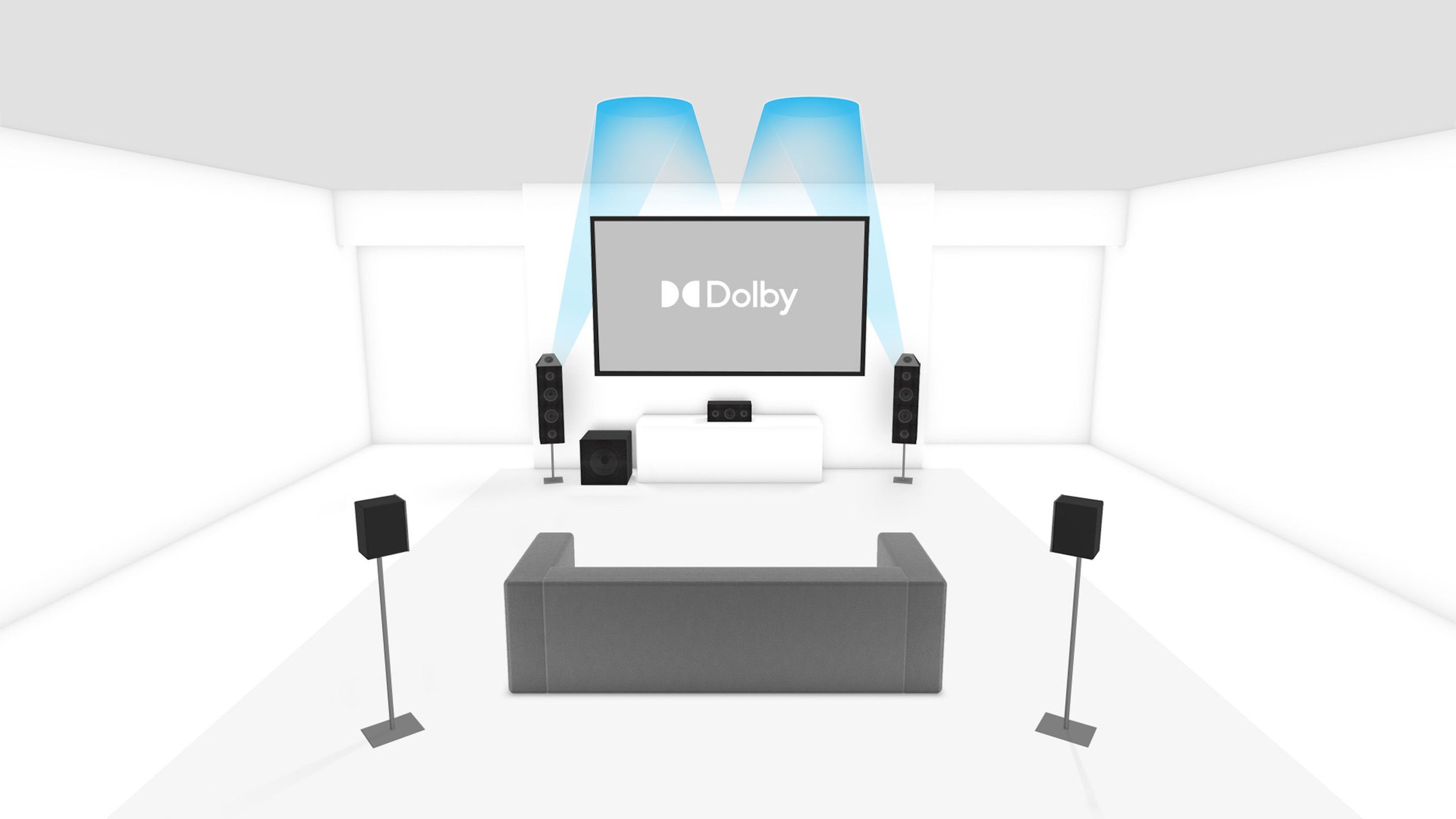
In short, a Dolby Atmos system adds height to surround sound by placing speakers above in the ceiling or using upward-firing drivers to create a 3D soundfield. Instead of just hearing sounds around you (like in 5.1 or 7.1), Atmos lets you hear effects above you.

5.1.4 - DOLBY ATMOS WITH OVERHEAD SPEAKERS

But it’s not just about more speakers or hearing a helicopter fly overhead. Standard 5.1 or 7.1 systems are channel-based, meaning sound is mixed and assigned to fixed speaker positions. Here, each speaker plays a dedicated audio track mixed specifically for that position — nothing moves outside of those predefined channels.

5.1.2 - Dolby Atmos with Dolby Enabled Speakers (sitting on top of front L & R speakers)

Atmos, by contrast, is object-based — meaning sound elements can move anywhere in a 3D space or ‘bubble’, making the experience more immersive and lifelike. Sound engineers are able to manoeuvre sounds with a lot more precision, transcribing that into a much more expansive sound experience, with sound flowing around the listening position and not restricted by the positioning of the speakers.

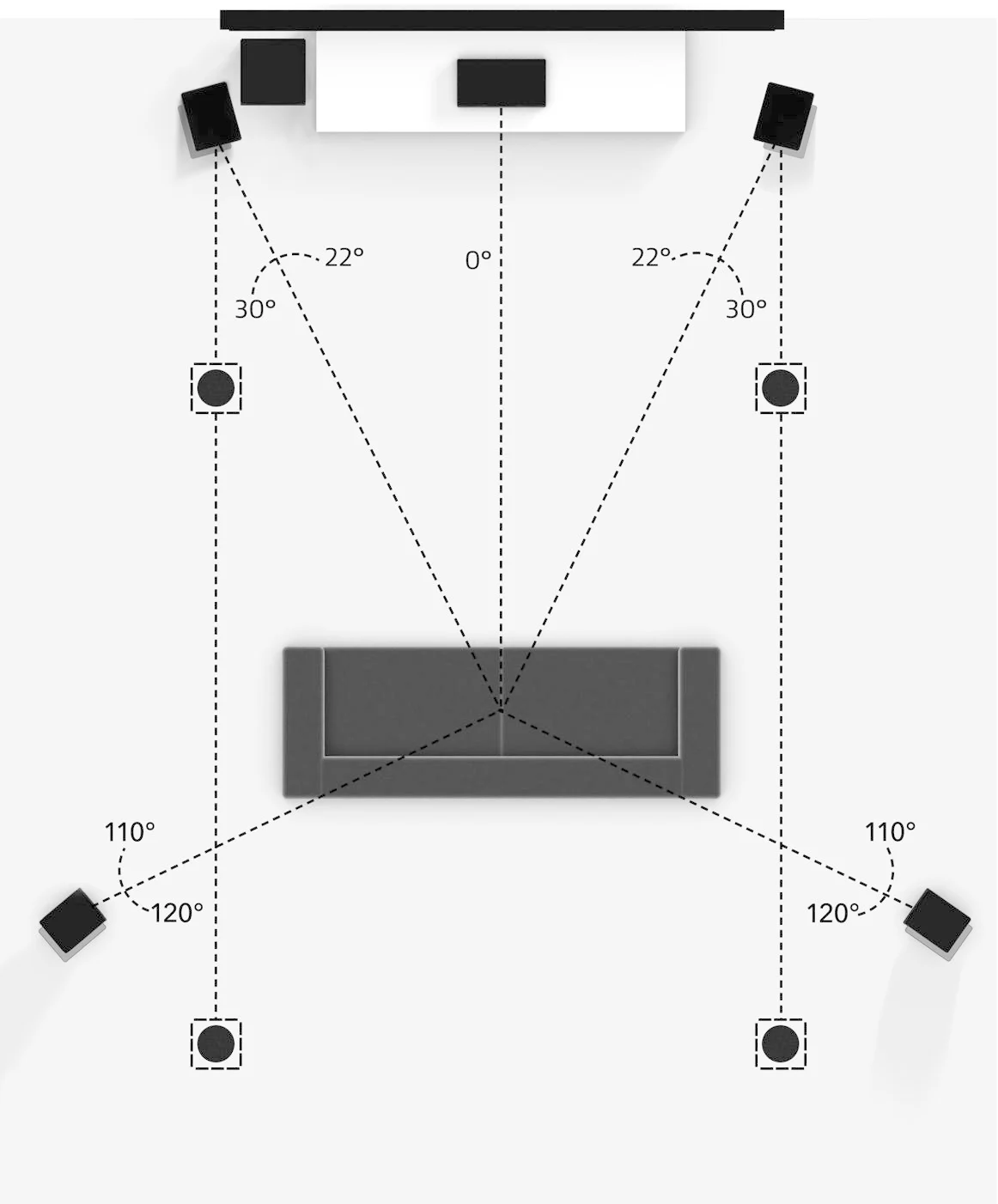
5.1.4 Dolby Atmos - Top view

While Dolby Atmos is a great tool, it’s not critical — you can still get a great surround experience with a well-positioned and correctly balanced 5.1 (or other non-height) configuration. Adding Atmos can also become expensive depending on the room design, and it can be tricky to get right. It’s always worth speaking to one of our staff to help plan the project properly before starting to cut holes in your ceiling and avoid any unwanted pitfalls.

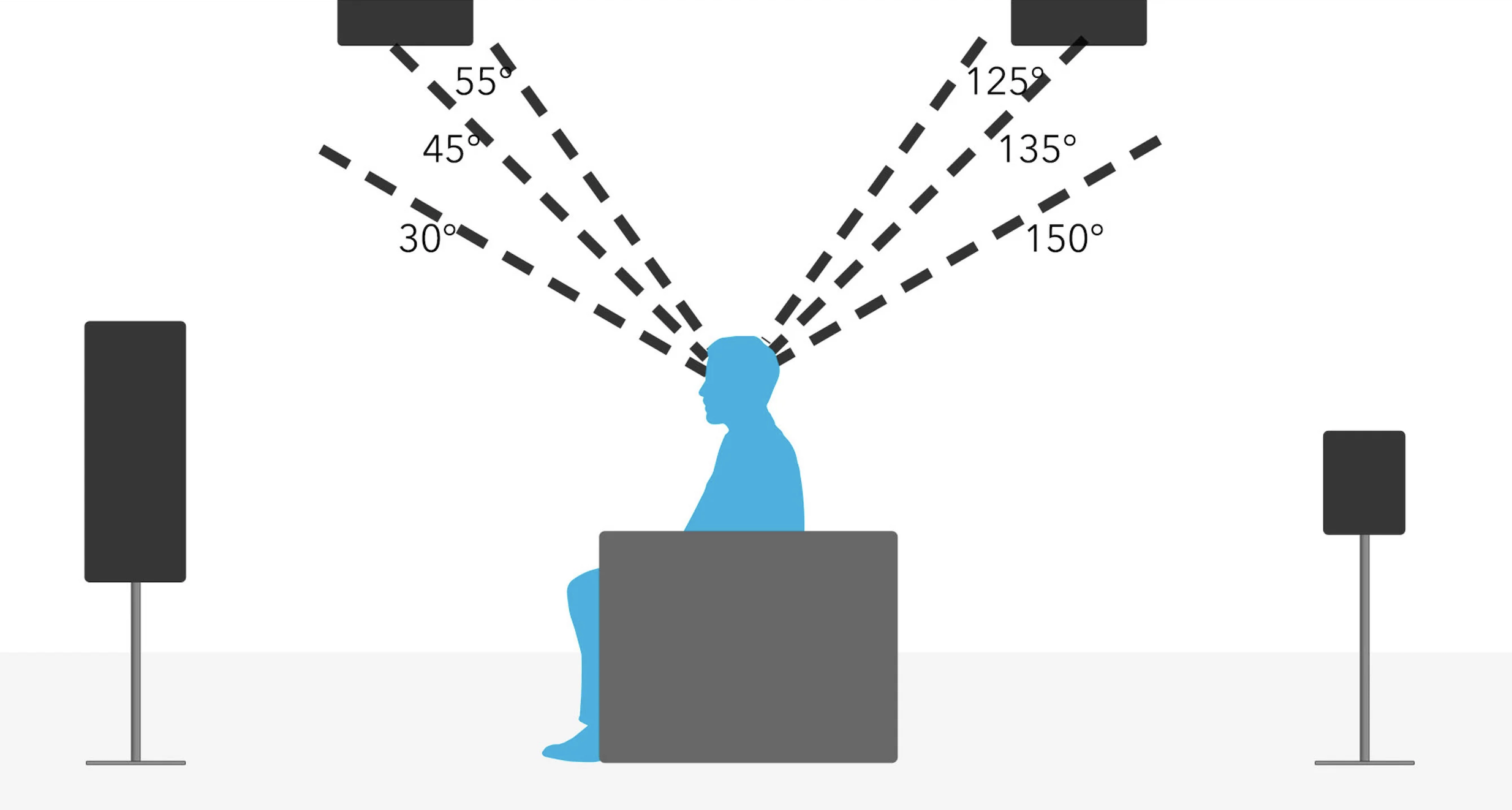
Dolby Atmos recommended Height Speaker positioning


AVR vs Processor + Power Amps?

One of the first gear decisions you’ll face is what to choose as the brain and the heart of the system. You can opt for an all-in-one AV Receiver (AVR), or split the system out into a dedicated processor and separate power amplification.

An AVR (Audio Video Receiver) is a single box that does it all: it takes in audio and video signals from your sources (like Blu-ray players, streamers, or game consoles), decodes the surround formats (like Dolby Atmos or DTS:X), processes the sound, converts the digital signal into analogue via built-in DACs, applies room correction (optional), and finally powers the speakers through its internal amplifiers.

In short: it switches, decodes, processes, converts, and amplifies — all in one box.

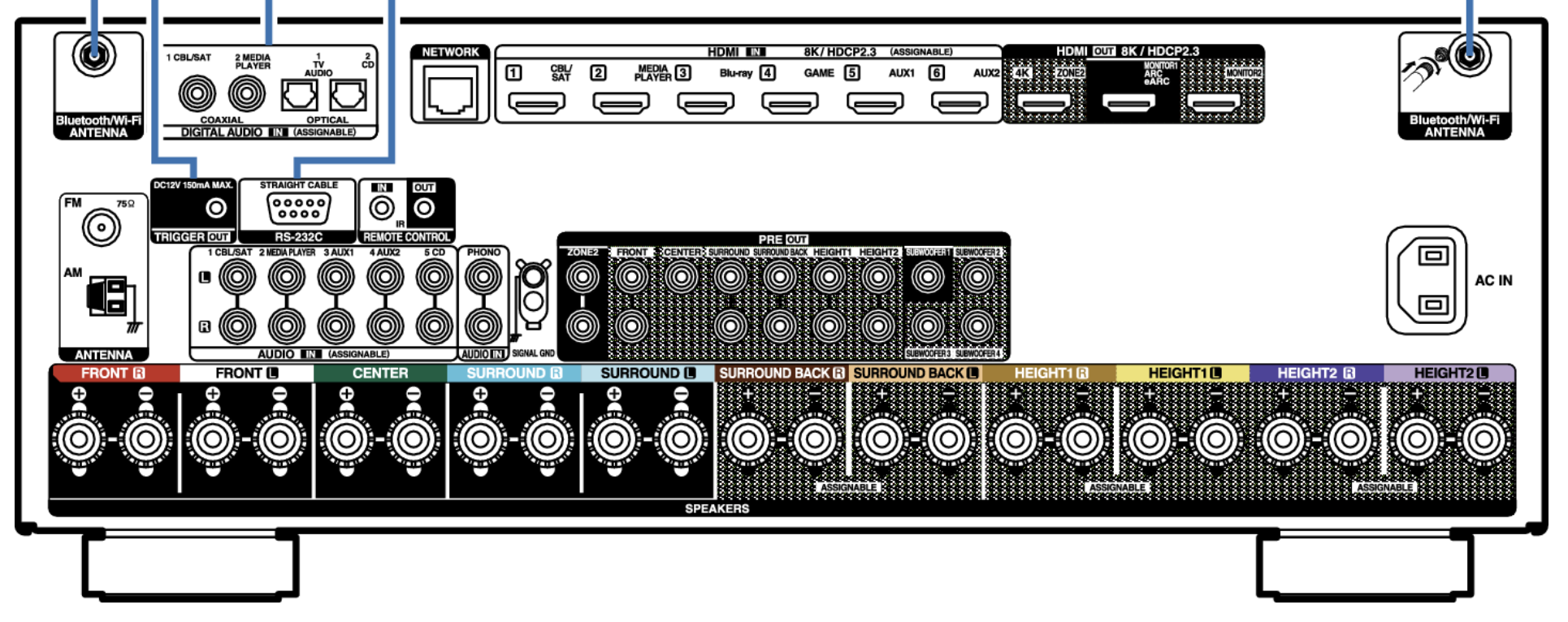
Rear Panel of a Denon AVC-X3800H AVR. Speaker outputs found at the bottom as well as pre-amp outputs IF WANTING TO RUN EXTERNAL AMPLIFICATION. ALL THE RELEVANT HIGH QUALITY VIDEO INPUT AND OUTPUTS FOUND AT THE TOP.

Most AVRs will handle standard 5.1 or 7.1 layouts out of the box, with mid-to-high-end models extending to 9.1 or even 11.2 configurations. They’re compact, cost-effective, and relatively straightforward to install and operate — perfect for most living rooms and mid-size home cinema setups.

If you’re building a higher-end system, want the flexibility to scale up later, or have more demanding speakers, then separates come into their own.

A dedicated AV processor (also called a pre-amp or pre-processor) handles everything mentioned above except amplification. It takes care of all the heavy lifting: surround decoding, bass management, digital-to-analogue conversion, room correction, and video passthrough — but it sends the signal out to external power amps, which do the actual work of driving the speakers.

The main advantages of going this route?

  • Cleaner signal paths (no shared power supply between processing and amplification)

  • More headroom and control over amplification

  • Better DACs and internal architecture, particularly in high-end models

  • Advanced room calibration systems (like Dirac Live or RoomPerfect)

  • Modular flexibility: you can upgrade amps or processors separately as the system evolves

The trade-offs? Separates cost more, take up more space, and require more cabling and setup time — but if performance is the goal, especially in dedicated cinema rooms, they’re often worth it.


Room correction

Most AVRs and processors have built-in room correction technologies. In simple terms, it’s the process of measuring how your speakers interact with your room, and then automatically adjusting the sound to compensate for the room’s acoustic quirks. It goes beyond just EQ, by analysing things like early reflections, reverb time, speaker distance, and phase alignment.

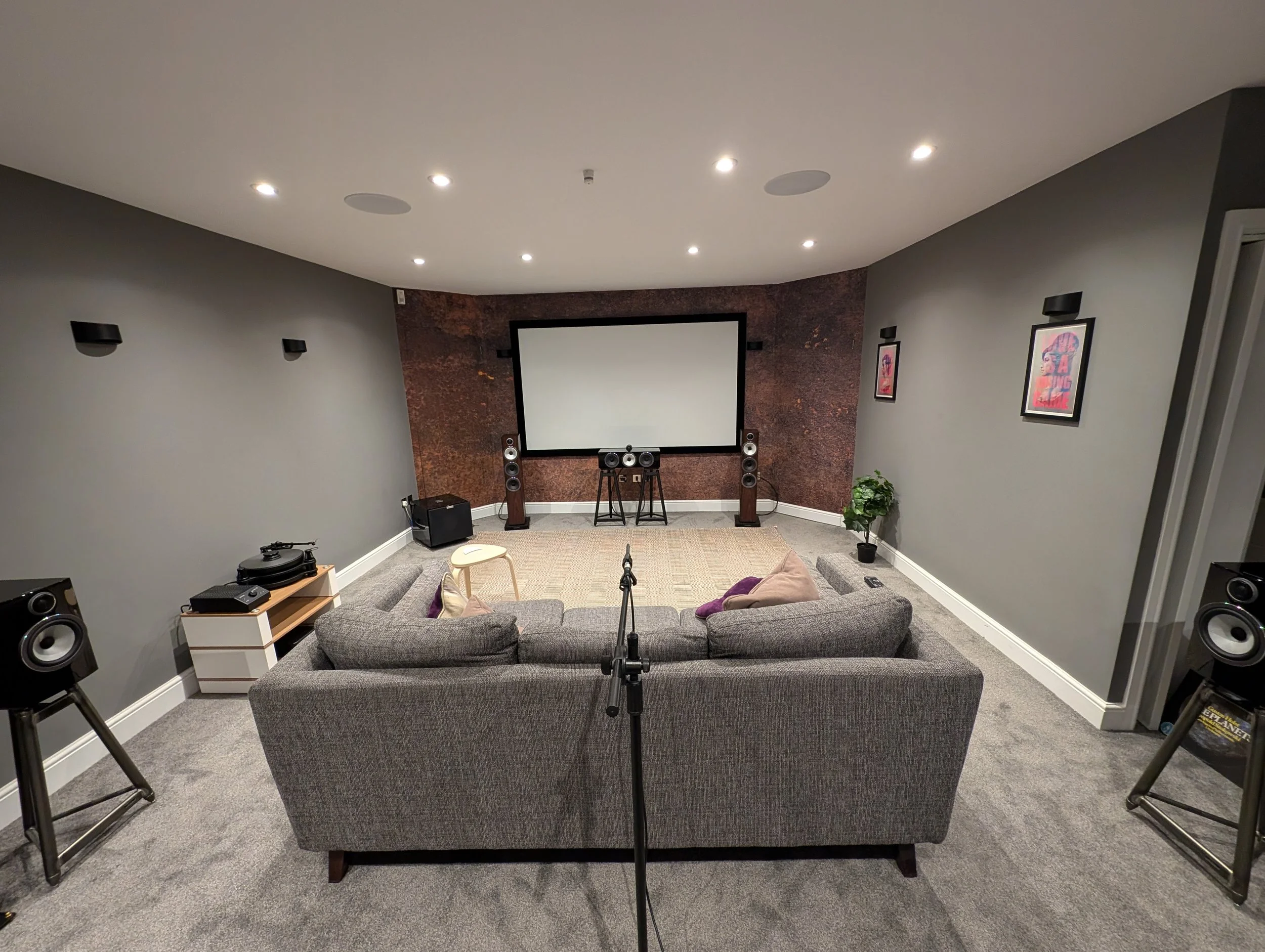
Room Perfect from Lyngdorf measuring a B&W 700 Series system in Audio-T Reading

Using a calibrated microphone (sometimes included with the equipment), the system sends test tones around your space and builds a profile of how the room affects the sound. It then applies precise digital filters to fix timing issues, tighten up bass response, and ensure all speakers are working together cohesively.

Systems like Audyssey, Dirac Live, and RoomPerfect vary in depth and approach, but all aim to give you more accurate, balanced sound — even if your room isn’t acoustically ideal. In many cases, it can be a very important factor in making a system sound right.


Current Brand Options and Their Qualities

Denon – Denon AVRs are very capable, straightforward to use, and packed with features that are great for the money. Audyssey room correction is included on most models and offers a solid starting point for tailoring sound to your room. Prices start around £1,000, with models like the AVC-X3800H being a popular sweet spot. At the top of the range sits the AVC-A1H at £4,999, delivering more power, channels, and headroom for larger and more ambitious setups.

Marantz – Shares much of its platform with Denon but is tuned with a warmer, more musical voicing. A great choice for those wanting strong cinema performance with a hint of two-channel finesse. The Cinema series starts at £649 for the slimline Cinema 70s, and stretches to £3,799 for their highest-end AVR. For those going fully down the separates path, the flagship AV10/AV20 processors and AMP10/AMP20 power amps (yet to be fully tested by me) aim to take things to a new level, both in performance and price, around £10,000–£12,000 for the pair.

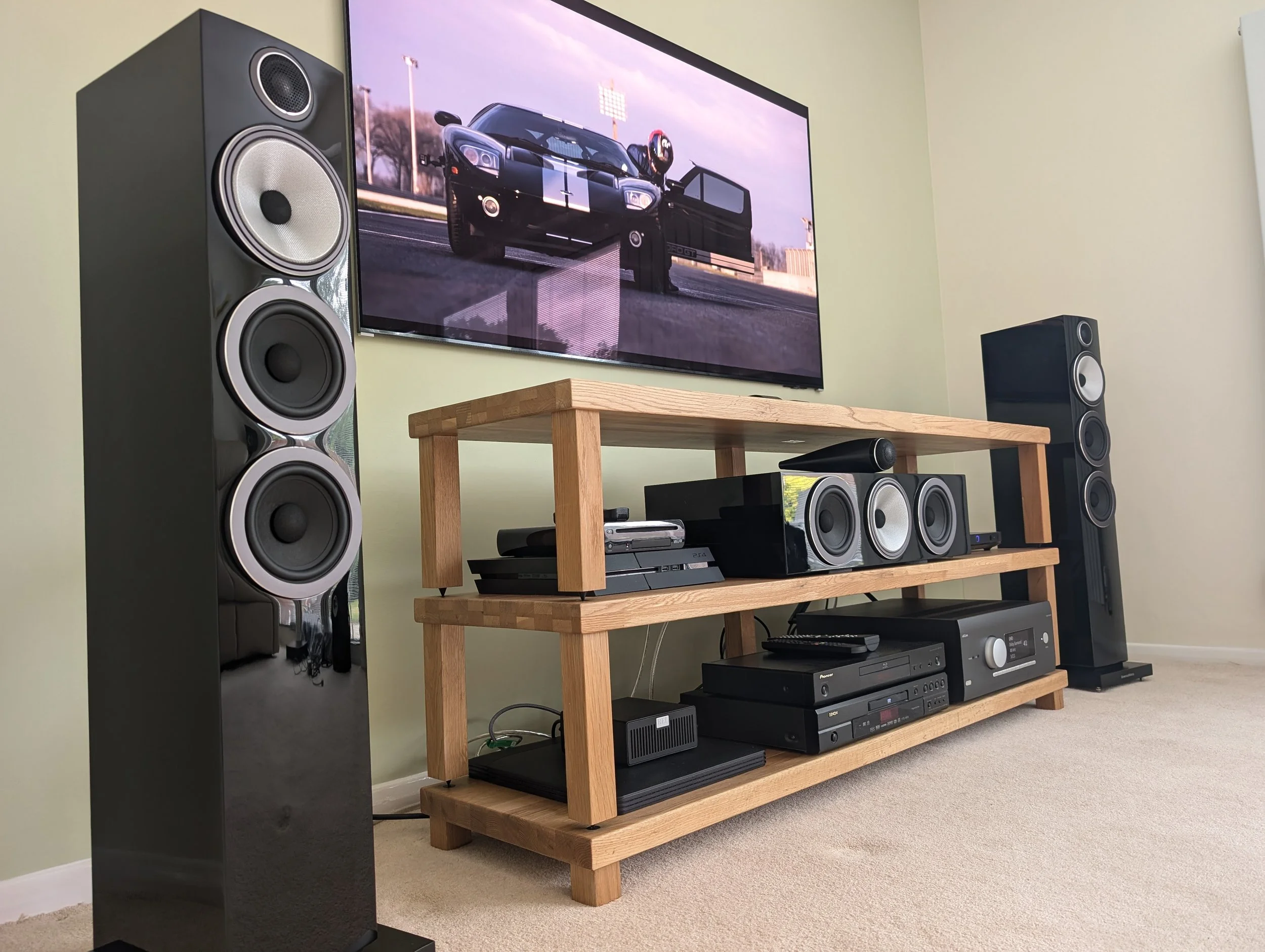
Customer Install - Arcam AVR21 Driving B&W Speakers

Arcam – More “Hi-Fi-first” in character. Sound is rich, analogue-like, and unforced. Once the initial setup is dialled in, the units are easy to use and don’t require any further tinkering. All models include Dirac Live room correction, giving precise control over the sound in difficult rooms. The AVR11, AVR21, and AVR31 range from £2,499 to £5,499, with the top-tier AVR31 using Arcam’s Class G amplification for added clarity and dynamic control.

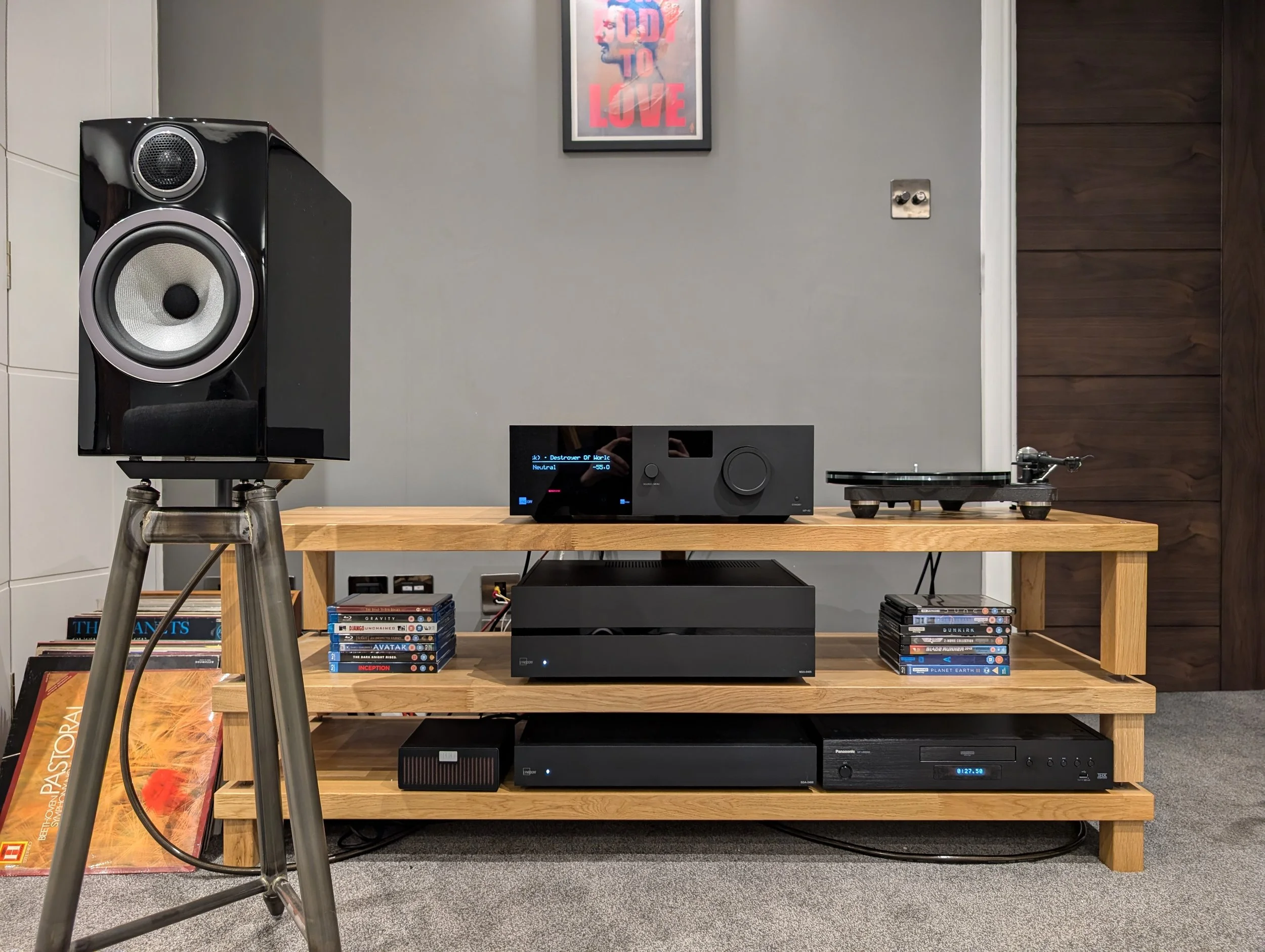
Lyngorf MP-40 Processor + Lyngorf MXa-8400 & SDA-2400 Power Amps

Lyngdorf – A different league altogether. Sound is ultra-clean, open, and deeply immersive. Lyngdorf’s RoomPerfect remains one of the most effective room correction systems we’ve ever used. When we talk about Atmos and the 3D soundstage, Lyngdorf handles it with remarkable subtlety, where the sound seems to “live” in the space around you rather than being tied to individual speakers, making you just sit back and enjoy the experience rather than think about where the sound is coming from. The MP-40 processor starts at £9,350, with the flagship MP-60 coming in at £14,995, both requiring external amplification and a well-matched speaker system.


The Power Options

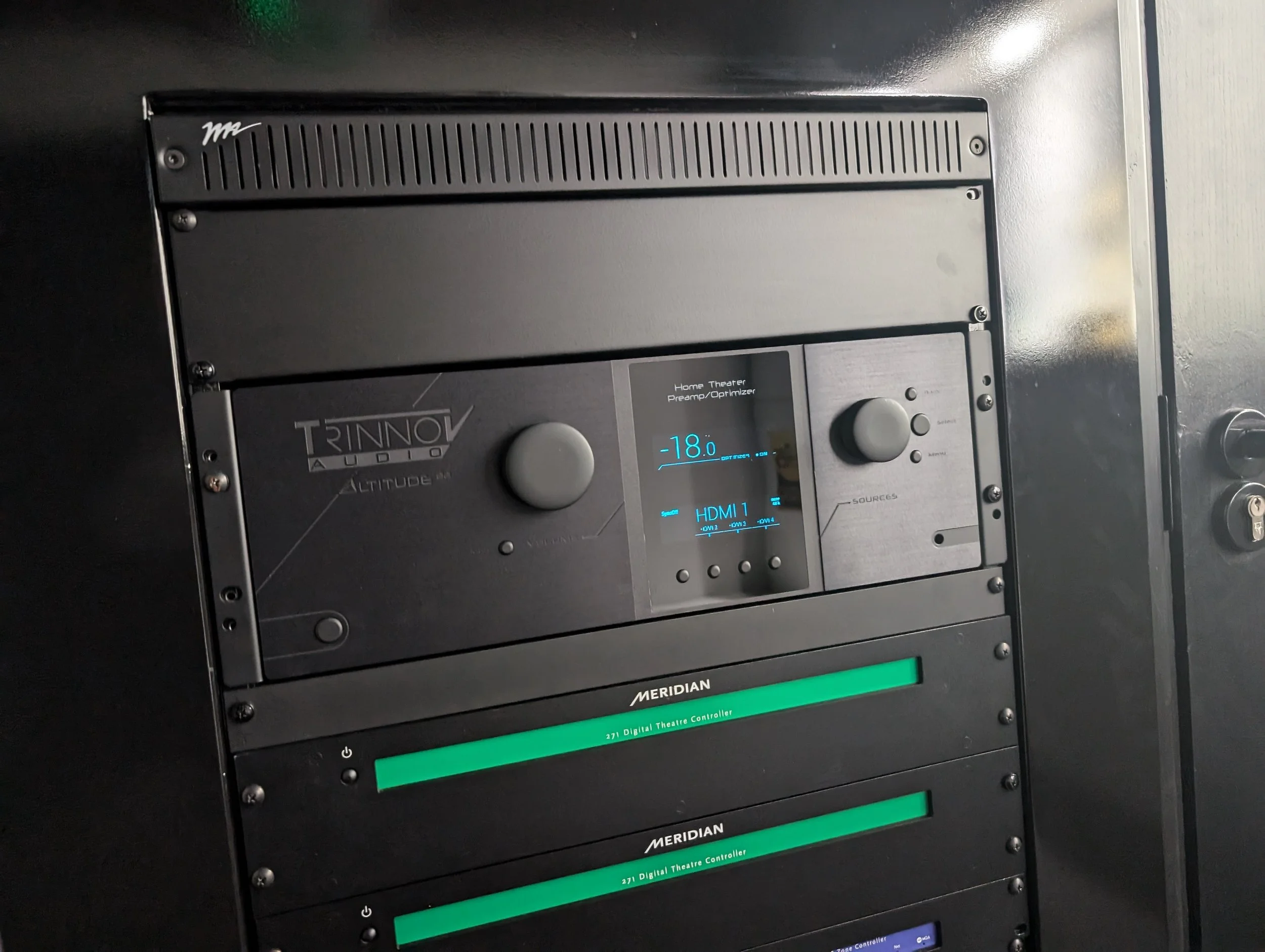
Trinnov Altitude 32 Processor

If you’re going down the separate amplification route, the choices are vast and often come down to what processor you’re using, what speakers you’re driving, and what kind of sonic character you enjoy.

For example, the spacious and open nature of a Lyngdorf processor pairs beautifully with Dynaudio speakers when powered by the MXA-8400, Lyngdorf’s own ultra-clean 8-channel power amplifier. On the other hand, Denon’s more neutral and slightly drier presentation can benefit from a warmer amp, like the Arcam PA720, which adds some richness and musicality.

There’s no one-size-fits-all solution here. Power amps vary massively in tone, dynamics, and synergy with different speakers. This is why we always recommend speaking with your local dealer and, more importantly, auditioning combinations in person. Trust your ears — your ideal sound signature may not be what the spec sheet suggests.


Stereo Integration for Music Lovers

If music is just as important as movies in your system, another great option is to run a dedicated stereo hi-fi amplifier alongside your home cinema setup. Some stereo amps feature AV Bypass (also known as Home Theatre Bypass) — a fixed-level input that allows the amp to be part of your surround system without interfering with its stereo performance.

This means you can enjoy true hi-fi sound for music playback via your stereo amp, and still use the same front speakers as part of your surround setup for films. It’s a great way to blend two-channel performance with multi-channel convenience.

That said, if you are using front left and right speakers from a brand that doesn’t manufacture a dedicated centre channel, it can lead to a disjointed soundstage during films — especially if speakers from two different brands operate in different frequency ranges. This brings us to the next important part of a surround system…


Speakers: Consistency Is Key

In an ideal world, you’d use the same speaker model across your front left, centre, right, and surrounds. That way, when a voice or a sound effect pans from one side of the screen to the other, it doesn’t change in character or tone. More so, when listening to concerts, musicals, high-quality films or dedicated Dolby Atmos music — where surround speakers play a more prominent role — having a full-range set of speakers throughout will create a more captivating and balanced experience.

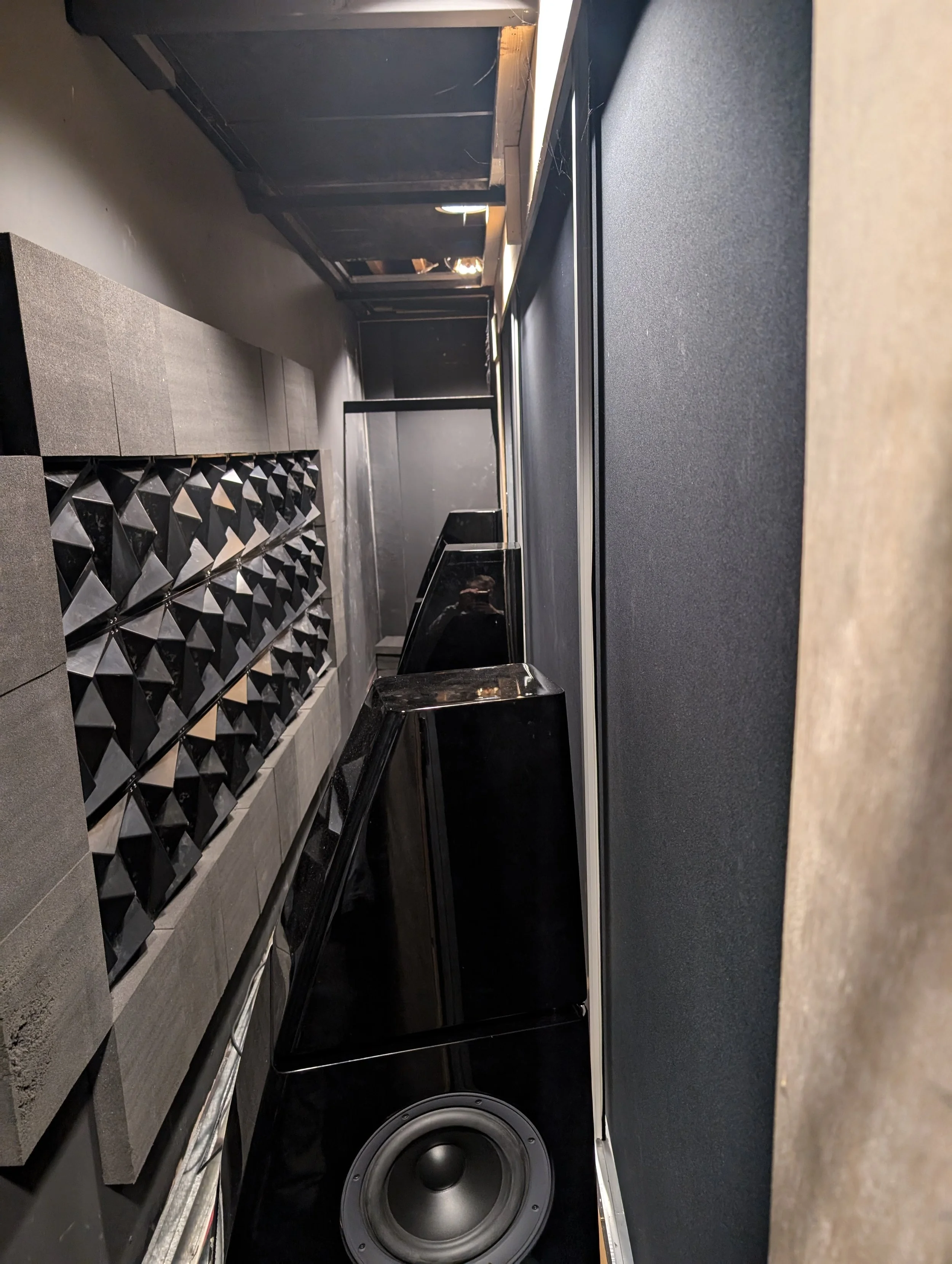
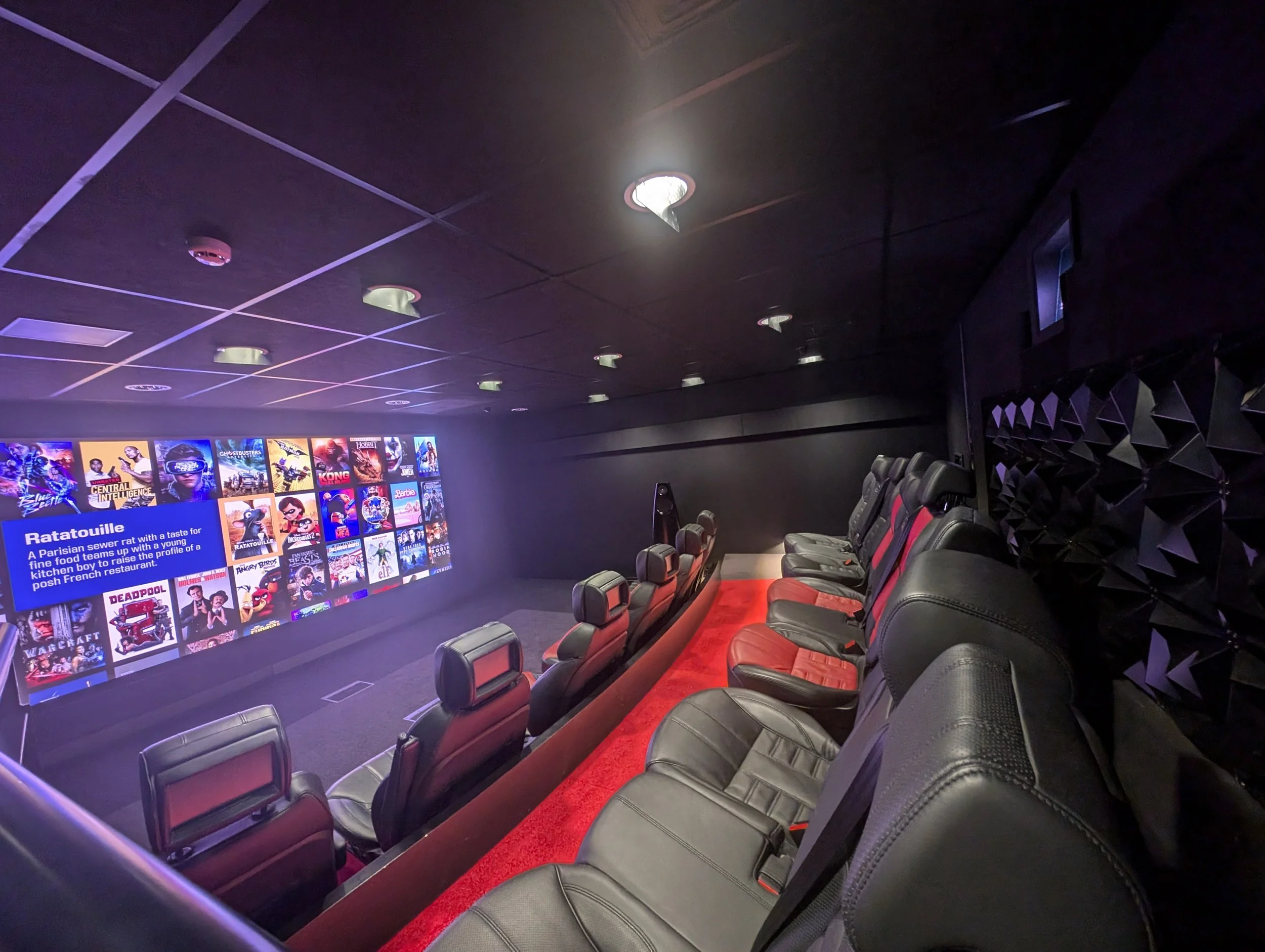
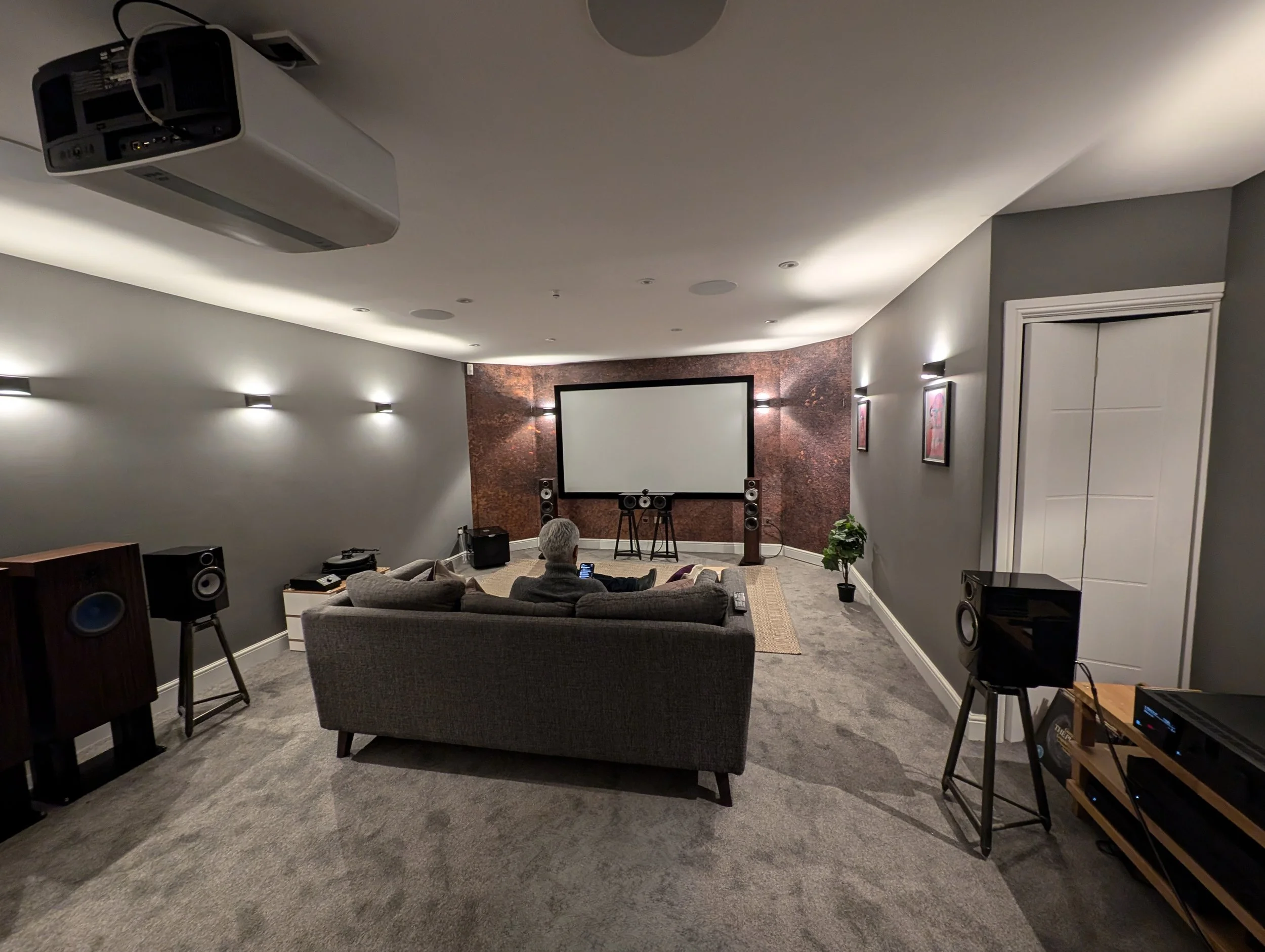
We recently visited Meridian’s headquarters in Huntingdon, sitting down in two of their home theatres that arguably outperform most commercial cinemas in the UK. Here, the use of three identical speakers — also known as an L-C-R setup — was demonstrated on a huge scale with Meridian’s flagship active speakers hidden behind an acoustically transparent screen.

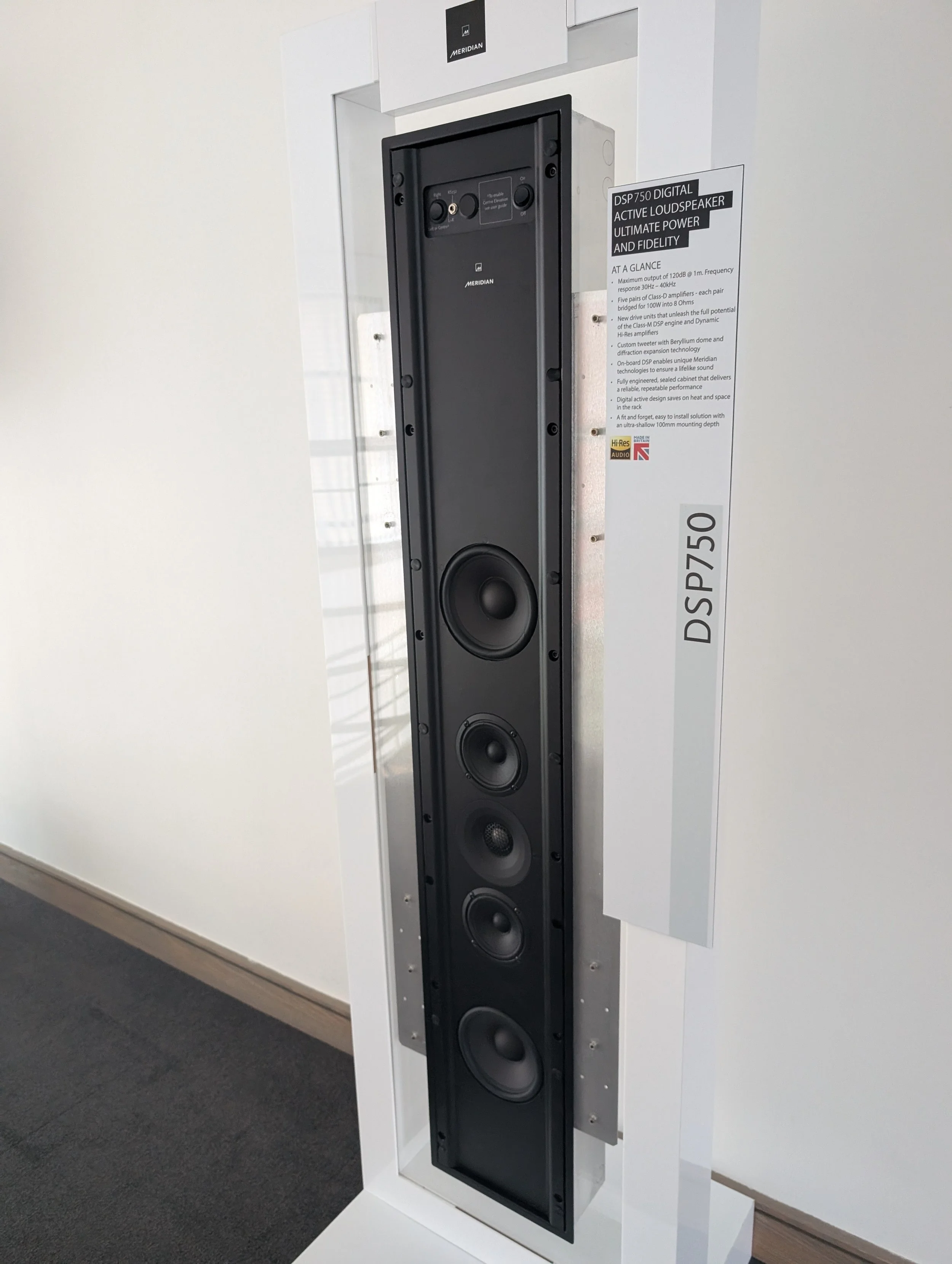
Meridian DSP750 Architectural In-Wall Speaker (For front, surround) for discrete Installs.

In reality, most people either don’t have the space or budget to run large floorstanders across the front and back. But keeping the centre and left/right as close as possible in voicing is critical. The centre channel (in our opinion) is the most important speaker in the system, as it accounts for most dialogue and focuses the centre of the image. A mismatched centre channel is one of the quickest ways to ruin dialogue clarity. A centre speaker that matches the rest of the system — and includes a great midrange driver and tweeter — becomes one of the best ‘hacks’ to make a sound system feel great and natural.

Height channels don’t need to be full-range (although they can be), but they should still be cut from the same sonic cloth — ideally from the same brand and series as the rest of the system.


Current Brand Options and Their Qualities

Bowers & Wilkins 700 S3 Series – A fantastic choice for home cinema, offering scale, detail, and drama. The HTM71 S3 centre is a standout, providing real authority and vocal clarity. The 700 S3 range tends to have an energetic voicing, with a lift in the treble and bass that makes them immediately exciting, especially for film soundtracks, action scenes, and immersive effects. Pairing them with slightly warmer electronics (like Marantz or Arcam) can help balance their enthusiasm, particularly in reflective rooms. (Around £5,000–£8,000 for a 5-speaker system)

B&W 700 S3 System

Dynaudio Evoke Series – More natural and neutral in tone, the Evoke range excels in musicality and nuance. It doesn’t shout for attention like B&W, but rewards listeners with clarity, composure, and balance — especially in dialogue and subtle ambient effects. The downside? They’re less forgiving on amplification. A good AVR may not be enough to bring them fully to life — they shine with higher-end processors and quality power amps. But once properly driven, they’re astonishingly transparent and immersive. (Around £5,500–£7,300 for a 5-speaker system)

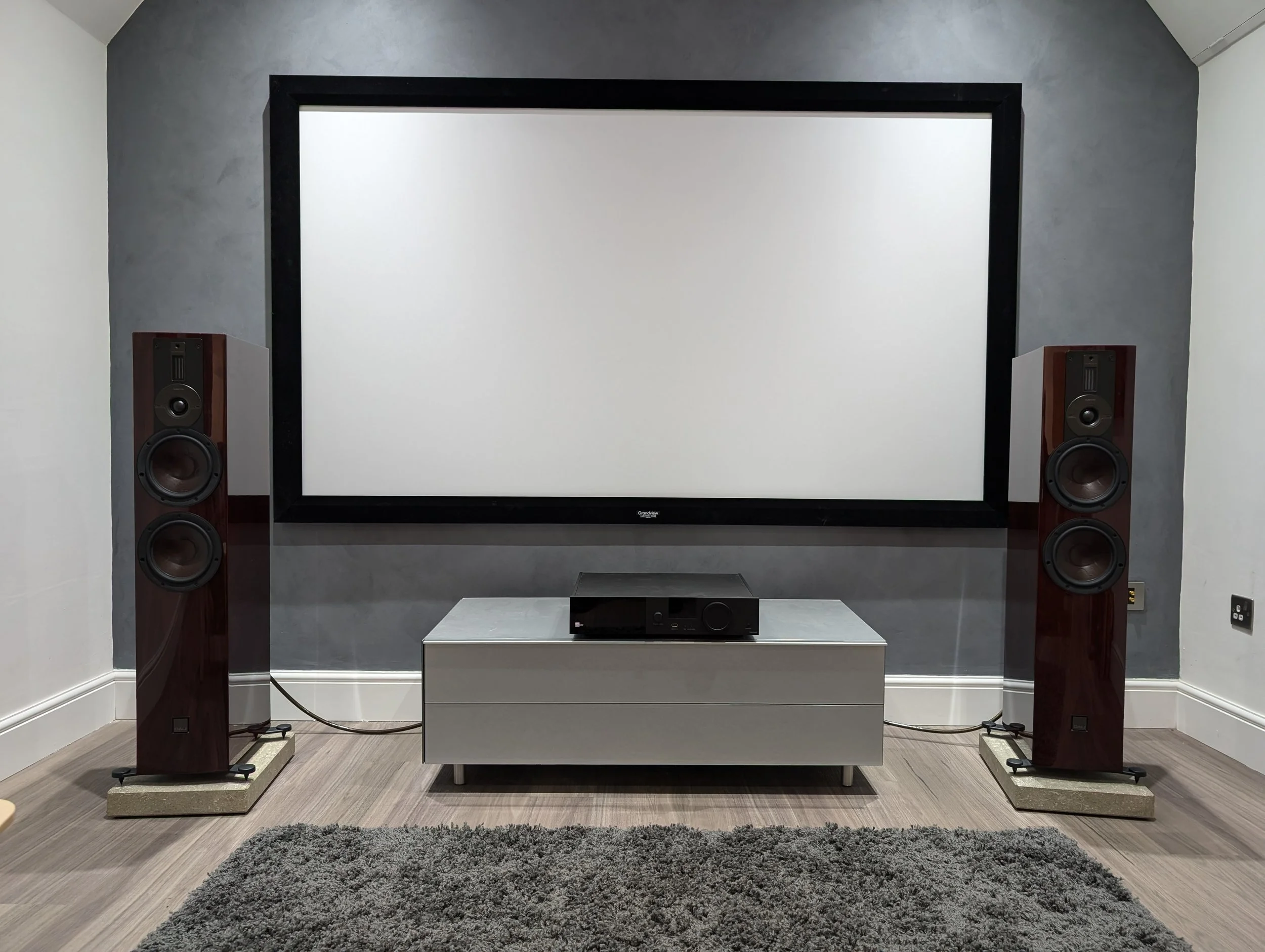
DALI Rubikore Series – If B&W represents the cinematic “wow” and Dynaudio leans more toward refined musicality, DALI Rubikore lands somewhere in the middle. The sound is clean and precise but with a touch of sparkle on top, thanks to their hybrid soft dome and ribbon tweeter design. This also gives them excellent horizontal dispersion, meaning a wider sweet spot for listeners sitting off-centre. They’re controlled in the low end, articulate in the mids, and carry enough energy to suit both music and film — making them a flexible all-rounder in a multi-channel setup. (Around £8,500–£10,000 for a 5-speaker system)

Dali Rubikore 6

There are plenty of other great speaker options out there, whether you’re after compact cabinets, larger floorstanders, or something more discreet like on-wall or in-wall designs. Sadly, we can’t cover them all in one blog, so as always, your best bet is to speak with someone who’s spent time listening to a wide range of these systems — and pop into your local Audio T store and chat with the team.

That said, special mentions go to the Monitor Audio and DALI ranges in the AV sector, covering needs all the way from entry-level systems (with full packages starting at around £1,500 for a 5-speaker setup), up to mid and high-end tiers. Both brands offer flexibility and ranges ideal for more unique, discreet and architectural installations.

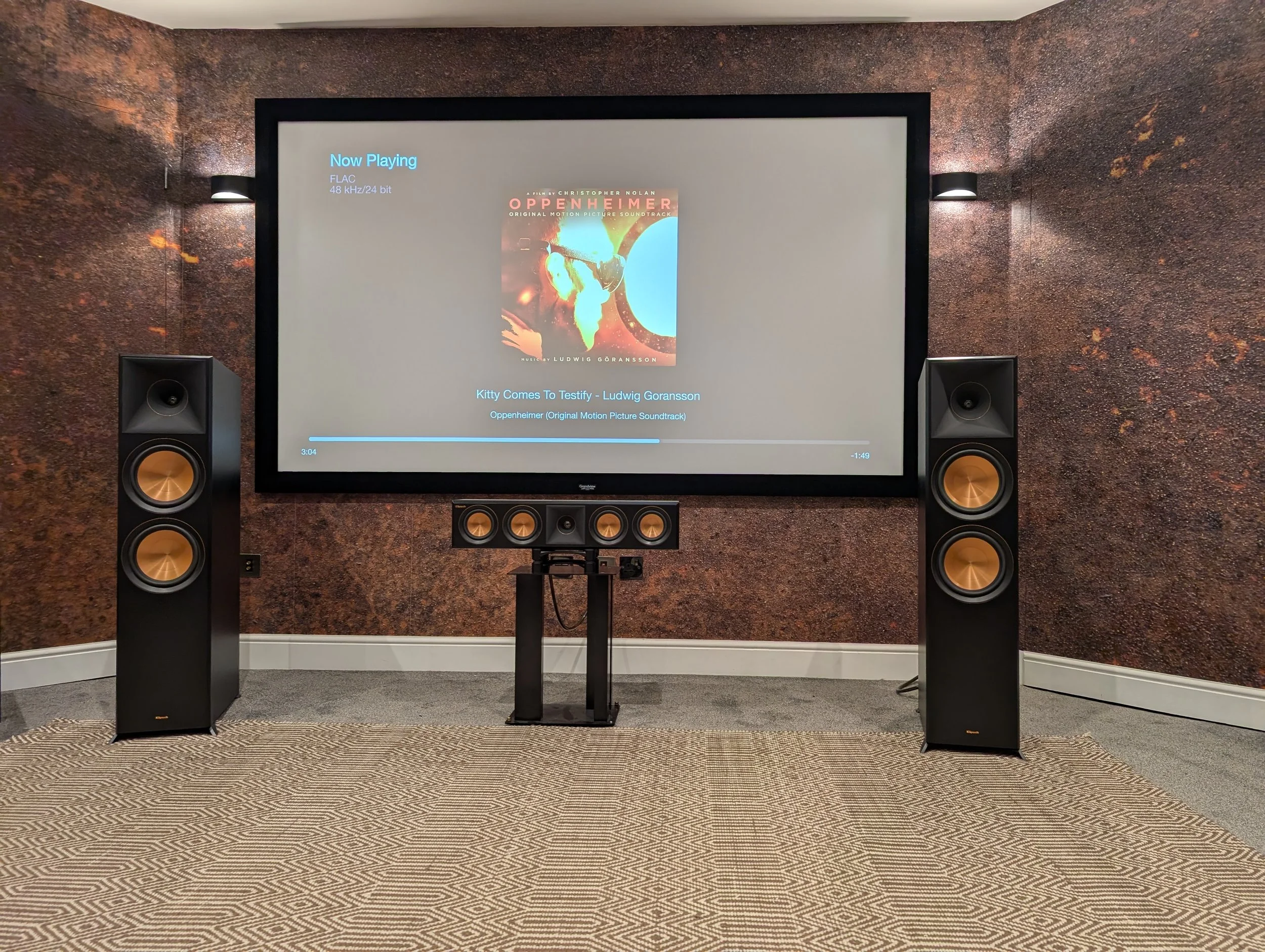
Klipsch Speakers with Built in Dolby Enabled Drivers in the top of the Left and Right speakers


Speaker Positioning

Having a great speaker doesn't always guarantee great sound. What's equally important is the positioning of the speakers and how they work together — with and against the room. Getting this right takes a bit of knowledge and good listening skills.

Speaker positioning affects everything from soundstage and imaging to clarity and bass performance. One key element is the toe-in — the angle at which the front left and right speakers are turned toward the listening position. The goal is to have the sound from both speakers meet and “lock in” just in front of the listening spot. Too far inward and the soundstage can feel narrow and centre-focused; too wide and the image can become vague or diffuse.

Another often-overlooked factor is speaker rake — the backward tilt of the speaker — which can subtly adjust how the high frequencies reach your ears. This is particularly important for speakers that are tall, short, or placed well off ear height.

The centre channel also needs careful attention. It should sit at a height that keeps dialogue anchored to the screen — not floating above it or buried below. If the height isn’t ideal, a slight tilt (either upward or downward) can make a big difference in clarity and image placement.

Rear speakers (or surround and height channels) should work in harmony with the front to complete the soundstage. It’s not just about being behind you — they need to recreate ambience, movement, and spatial effects, so positioning and angle matter there too.

All of this takes a little patience. But once the system locks in, you’ll know — and you’ll hear the difference immediately. If you’re purchasing a new system and haven’t had much experience setting one up in depth, don’t worry — we’re here to help. Our staff are happy to assist with speaker positioning and calibration, and it’s something we take seriously.

It’s also worth noting that new speakers and electronics have a run-in period. When we install a system, we typically return after a few weeks to make final adjustments once the system has had time to settle. That’s when we revisit things like toe-in, balance, and room correction — because by then, you’re hearing and measuring the system in its true form.


Subwoofers: It’s Not Just About the Boom

Last but not least, let’s briefly discuss subwoofers. There’s a temptation to think of them as one-size-fits-all — just stick a big box in the corner and let it shake the room. But the truth is, a good sub (or two, sometimes even three) adds control, weight, and depth to a system — not just volume.

Some people stick with subs made by the same company as their speakers, which makes sense cosmetically and sometimes sonically too. But going with a dedicated brand like REL can give you more performance per pound, especially if your room is awkward. We often reach for REL when it comes to tackling low frequencies.

REL shines in dual-use systems where music and movies are both priorities. Their High-Level inputs let the sub track your main amp’s output, which means seamless integration with stereo playback — helping to support the low frequencies your main speakers can’t quite reach. They still offer standard LFE inputs, so you’re not missing out on that low-end impact during movies either.

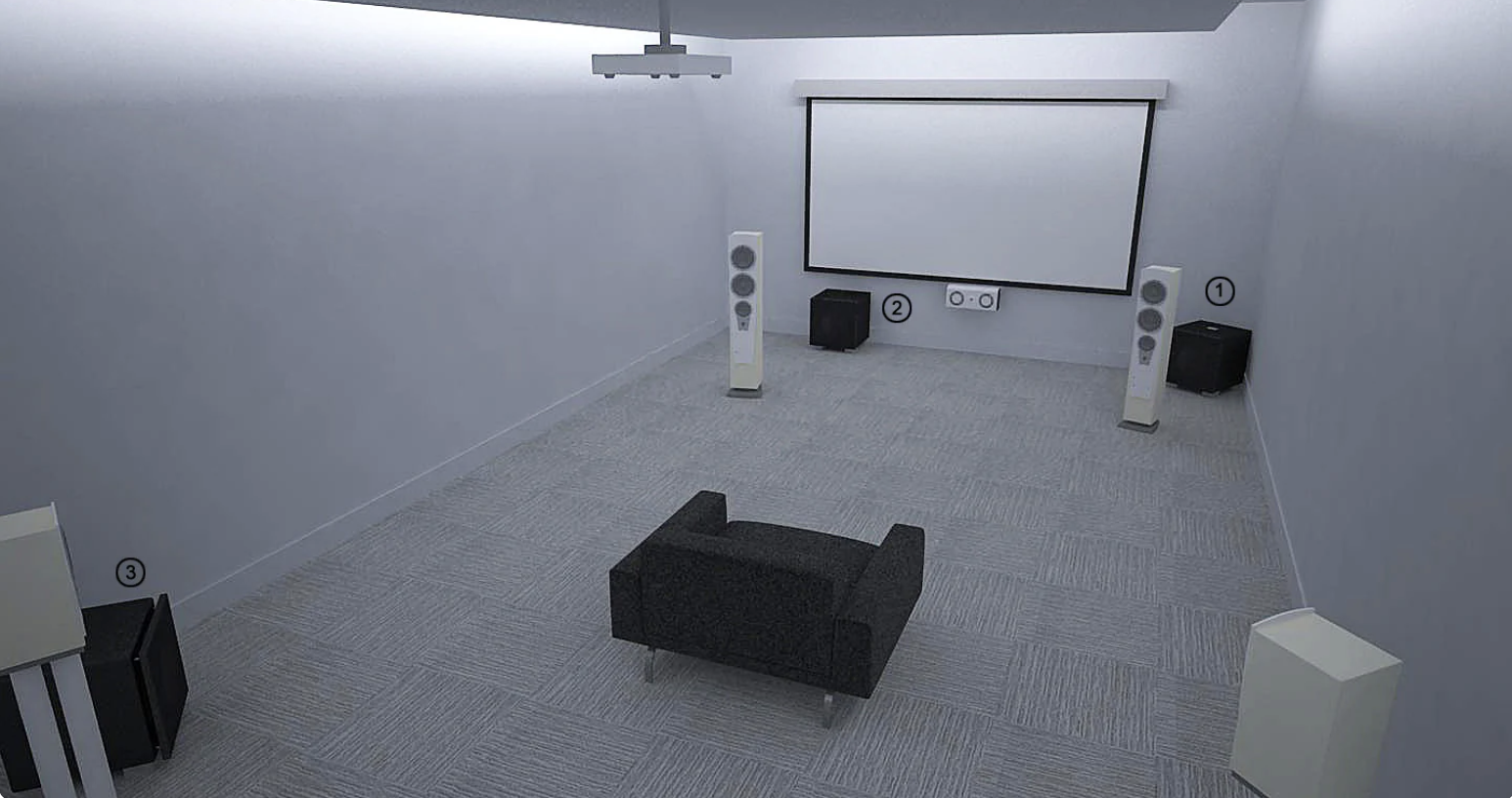
Great results can often be achieved by running two subwoofers instead of one. This not only smooths out bass across multiple seating positions — reducing dead spots and inconsistencies — but also provides a more immersive and controlled low-end. Placing a second sub at the rear helps complete the spatial picture. By reinforcing low frequencies from behind the listener, it improves the sense of realism, making effects like explosions, rumbling vehicles, or ambient textures feel like they’re truly happening around you, not just in front.

REL 3D Setup

The ‘final boss’ in a home theatre sub setup is adding a third subwoofer to support the centre channel. Since most centre speakers are smaller than full-range floorstanders, reinforcing them with dedicated low-frequency support can yield big benefits and bring them closer in performance to the Left and Right speakers — especially effective in improving dialogue clarity and mid-bass impact. This is the foundation of what REL calls a 3D system — a setup where front, rear, and centre channel subs work together to create a seamless, dimensional soundstage.

For a single-sub configuration, REL’s S-Series hits a sweet spot — giving great musicality alongside home theatre impact. Alternatively, the HT subwoofer range focuses more purely on cinema performance, and this can be further expanded with something like a T-Series connected via High-Level.


Wrapping It Up

The world of home cinema is more accessible — and more advanced — than ever. Whether you’re starting with a modest 5.1 package in your living room or planning a reference-grade system like the Meridian theatre we visited, there’s a path for every space, budget, and ambition.

At Audio T, we work with systems at all levels: from compact, value-led setups that make a big difference without breaking the bank; through mid-sized installations that involve some structural or architectural planning and advanced calibration; all the way to bespoke six-figure cinema installations requiring architectural design, automation integration, and dedicated acoustic treatment. No matter where you’re starting from, it all begins with a conversation.

If you’re thinking about building or upgrading an AV setup, pop in for a chat. We’re always happy to walk through what’s possible and what’s practical for your space and budget. And if you’re unsure where to start, we’ve got systems running in a number of our stores — and in some cases, we can take customers directly to manufacturers’ dedicated cinema rooms.

Because once you’ve felt a good home cinema system — really felt it — you’ll never want to go back.


Final Thoughts

  • We highly recommend trying streaming Dolby Atmos music through services such as TIDAL, Apple Music, or Amazon Music.

  • Film to check out: Sound of Freedom — an action film with a dark theme, based on a true story.


Thanks for reading – Dan, Gareth & Rishi – Audio T Reading

If you have any questions about any of the equipment featured in this article, or any other Hi-Fi or home cinema enquiries, be sure to Contact Us.

If you’ve enjoyed this, why not go ahead and read more of our other blogs, and be sure to follow us on our social media channels below…


For any AV/Home Theatre or general audio related queries contact your local Audio T store -


*All prices, credit terms and interest rates quoted are correct at the time of going to press but may be subject to change. E&OE