

Moving Magnet vs Moving Coil Cartridges: What’s the Difference?
/
If you've spent any time looking at turntables or cartridges, you've probably come across two little abbreviations that seem to crop up everywhere: MM and MC.
Moving Magnet and Moving Coil.
At first glance, it can feel like another one of those Hi-Fi choices where you're somehow expected to know which camp you belong to before anyone lets you through the door.
Thankfully, it isn't.
Both are simply different ways of doing the same fundamental job: taking the incredibly small movements of a stylus as it follows a record groove and turning them into an electrical signal that eventually comes out of your speakers as music.
The differences are in how they do it, how much signal they produce, what equipment they need around them and, ultimately, whether one makes more sense in your system than the other.
And before we go any further, let's get one thing out of the way.
Moving Coil is not automatically better than Moving Magnet.
There. I've said it. Now we can get on with things.
The quick answer: MM or MC?
If you want the abbreviated version, Moving Magnet cartridges generally produce a higher output, are easier to match with phono stages and, in many cases, allow the stylus to be replaced or upgraded separately.
Moving Coil cartridges tend to produce a much lower output and require a compatible MC phono stage, but their lighter moving generator is one of the reasons they have become so closely associated with more ambitious vinyl systems.
There are, naturally, exceptions to pretty much all of that.
Because Hi-Fi wouldn't be Hi-Fi if somebody hadn't found a way of making a simple answer slightly more complicated.
If you're choosing your first cartridge, MM is often the easiest place to start. If you're building a more ambitious vinyl setup and have the turntable, tonearm and phono stage to support it, MC becomes very interesting indeed.
First, what does the cartridge actually do?
It's easy to overlook the cartridge because it's tiny, but there's quite a lot happening down there.
The stylus sits in the record groove and moves as it encounters the information cut into the vinyl. That movement travels through the cantilever and into the cartridge's generator, which converts the mechanical movement into an electrical signal.

A microscopic view of a stylus in the grooves of a record
When you actually stop and think about it, it's still fairly miraculous.
You're dragging a tiny diamond through a plastic groove containing microscopic variations and somehow Mr. Brightside comes out the other end.
Not bad.
The main difference between MM and MC is essentially which part of that generator moves.
How does a Moving Magnet cartridge work?
In a Moving Magnet cartridge, small magnets attached to the cantilever move in relation to fixed coils inside the cartridge body.
As the stylus traces the groove, those magnets move and generate an electrical signal in the coils.
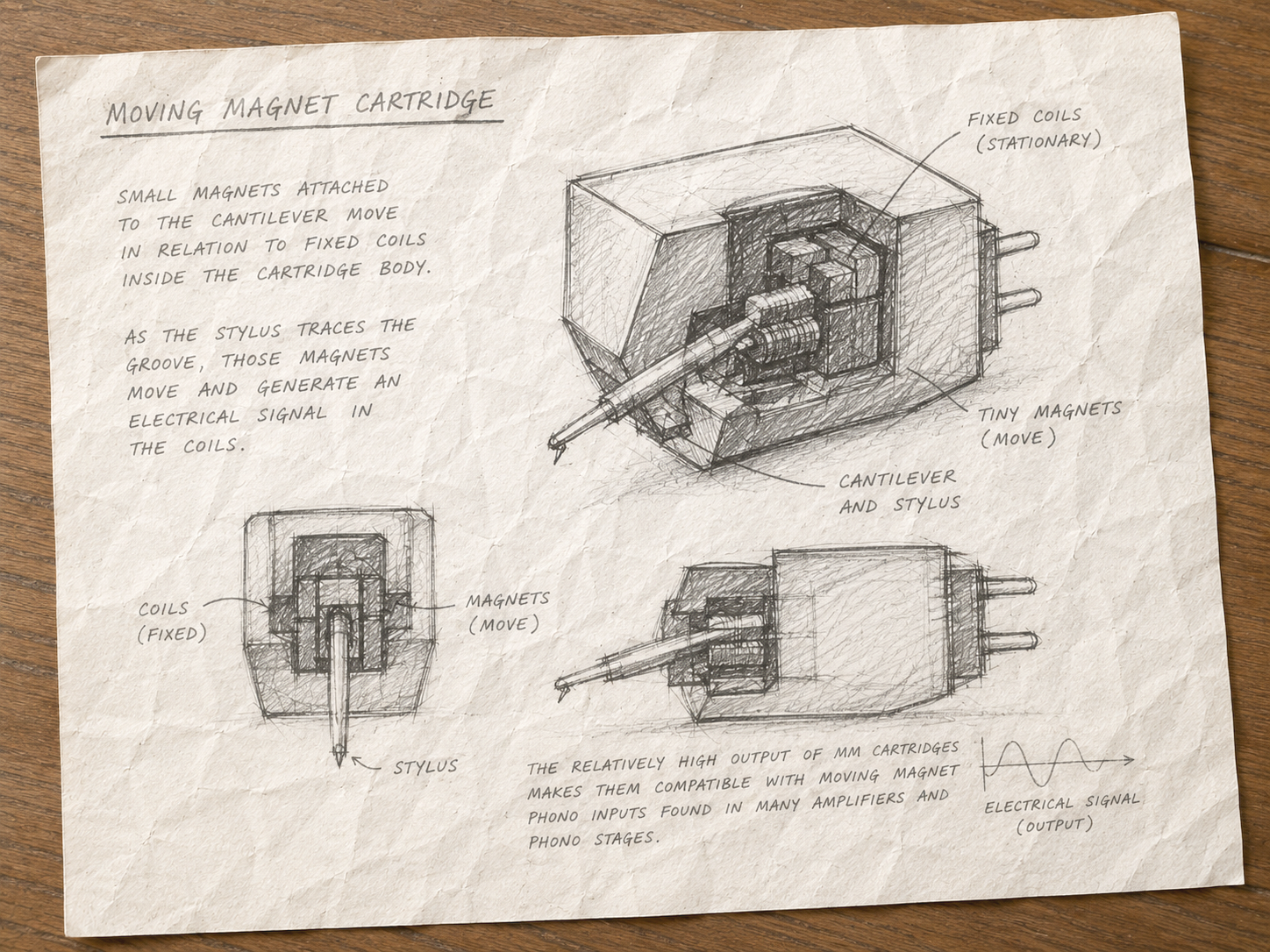
One of the main advantages is output. MM cartridges generally produce a relatively healthy signal, which makes them compatible with the Moving Magnet phono inputs found in a huge number of amplifiers and standalone phono stages.
They're also available at a very broad range of prices and performance levels, which is where I think the phrase "entry-level cartridge" can become a little misleading.
Moving Magnet might be where many people start, but it certainly isn't where the technology stops.
Moving Magnet doesn't mean basic
You only have to look through the cartridges we stock at Audio T to see how varied MM designs can be.
The Audio-Technica VM95 Series is a particularly good example. The same basic cartridge platform can take you from a simple conical stylus through elliptical, nude elliptical, MicroLinear and Shibata options.
That's useful because you don't necessarily have to throw the entire cartridge away every time you want to improve things. In many cases you can simply change the stylus assembly and move further up the range.
Ortofon does something similar with its hugely popular 2M family. Something like the 2M Blue uses a Nude Elliptical stylus, while the 2M Black takes things considerably further with a Nude Shibata profile.
Both are still Moving Magnet cartridges.
Then you've got cartridges such as the Sumiko Amethyst, which uses a line-contact stylus and a more sophisticated generator.
So if anybody tells you MM is only for inexpensive turntables, things have moved on a bit.
How does a Moving Coil cartridge work?
A Moving Coil cartridge turns the principle around.
Instead of moving magnets in relation to fixed coils, tiny coils attached to the cantilever move within a magnetic field.
Those coils can be made extremely small and light, reducing the moving mass at the business end of the cartridge. In a suitably capable system, that can allow the stylus and cantilever assembly to respond exceptionally quickly and accurately to what's happening in the groove.
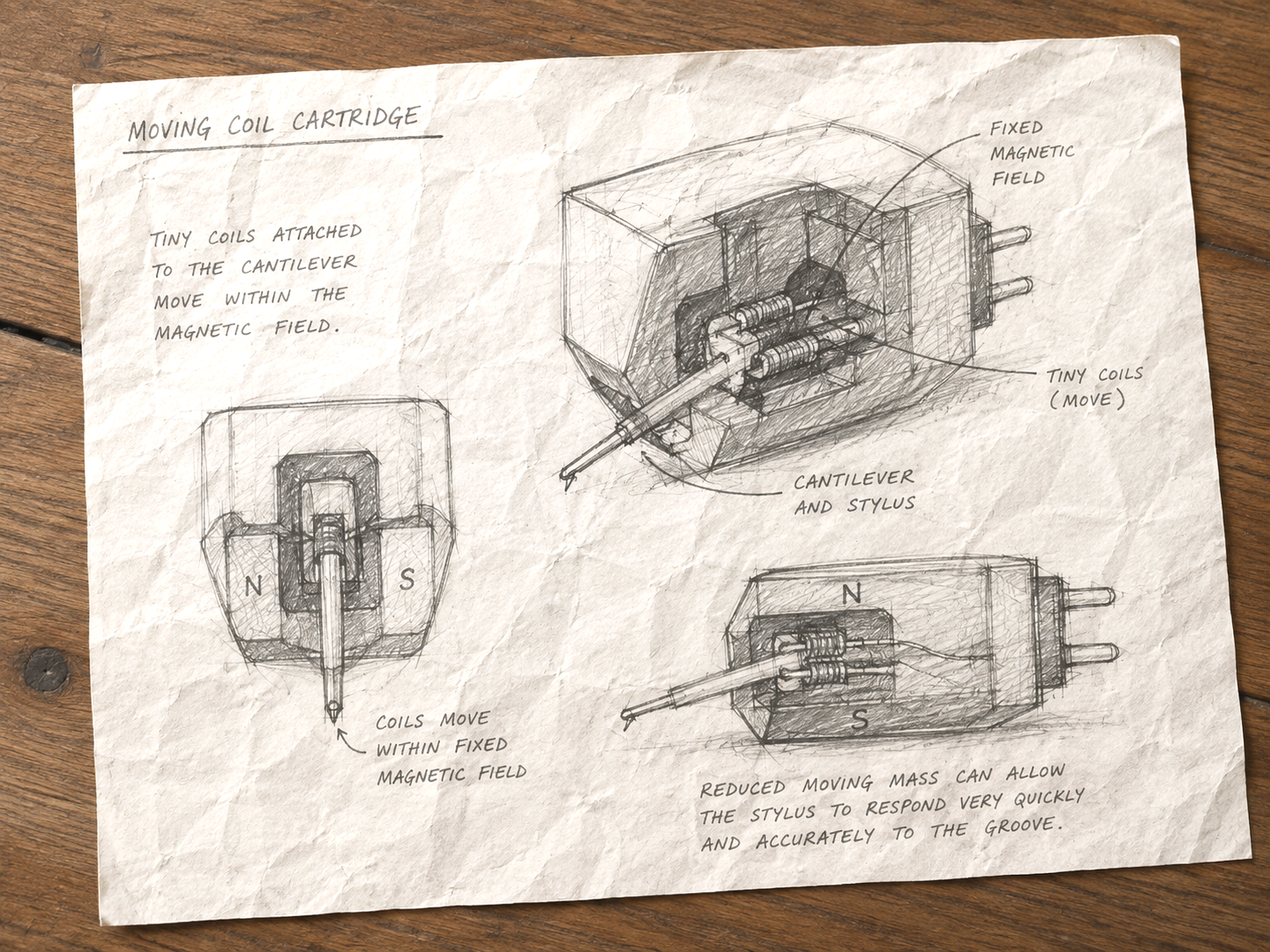
That's one of the reasons MC designs have become so closely associated with high-performance vinyl replay.
But there is a catch.
Those tiny coils don't generate very much electricity.
A conventional low-output Moving Coil cartridge may produce only a fraction of a millivolt, while a typical MM produces several millivolts.
Which brings us neatly to probably the most important practical difference between the two.
Your phono stage matters
A lot.
If you've already read our How to Choose a Turntable guide, you'll know that a turntable cartridge can't simply be connected to any old amplifier input.
It needs a phono stage, and with MM versus MC the type of phono stage becomes particularly important.
A Moving Magnet phono stage is designed around the relatively strong output of an MM cartridge. A low-output Moving Coil cartridge requires significantly more gain, and better MC phono stages may also allow you to adjust things such as loading to suit the cartridge more precisely.
So if you've spotted an MC cartridge, fallen in love with the idea of it and are hovering over the Buy button, check your phono stage first.
Buying the cartridge and then discovering your amplifier only has an MM input is a slightly irritating way to spend an afternoon.
Some phono stages support both MM and MC. Others are dedicated to one type, so system matching matters just as much here as it does with the turntable itself.
And then there are high-output Moving Coils…
Remember when I said Hi-Fi likes making things complicated?
Some Moving Coil cartridges are designed with a higher output so they can be used with the sort of phono amplification normally associated with Moving Magnet cartridges.
The Dynavector 10X5 MkII is a great example. Its high-output version produces considerably more signal than a conventional low-output MC and is specifically designed to work into an appropriate MM-type phono input.
Hana takes a similar approach with the S Series MKII. The SL MKII is a conventional low-output MC intended for suitable Moving Coil amplification, while the SH MKII is a high-output version designed to work with an appropriate Moving Magnet phono stage.
Same basic cartridge family. Different electrical requirements.
This is why I wouldn't buy any cartridge based purely on the letters printed on the box.
Does MM mean the stylus can always be replaced?
No. It's another one of those generalisations that is mostly useful until it suddenly isn't.
On many Moving Magnet cartridges, the stylus assembly can be removed and replaced without changing the whole cartridge. That's useful because styli wear out, but it also gives manufacturers such as Audio-Technica and Ortofon the opportunity to build very sensible upgrade paths.
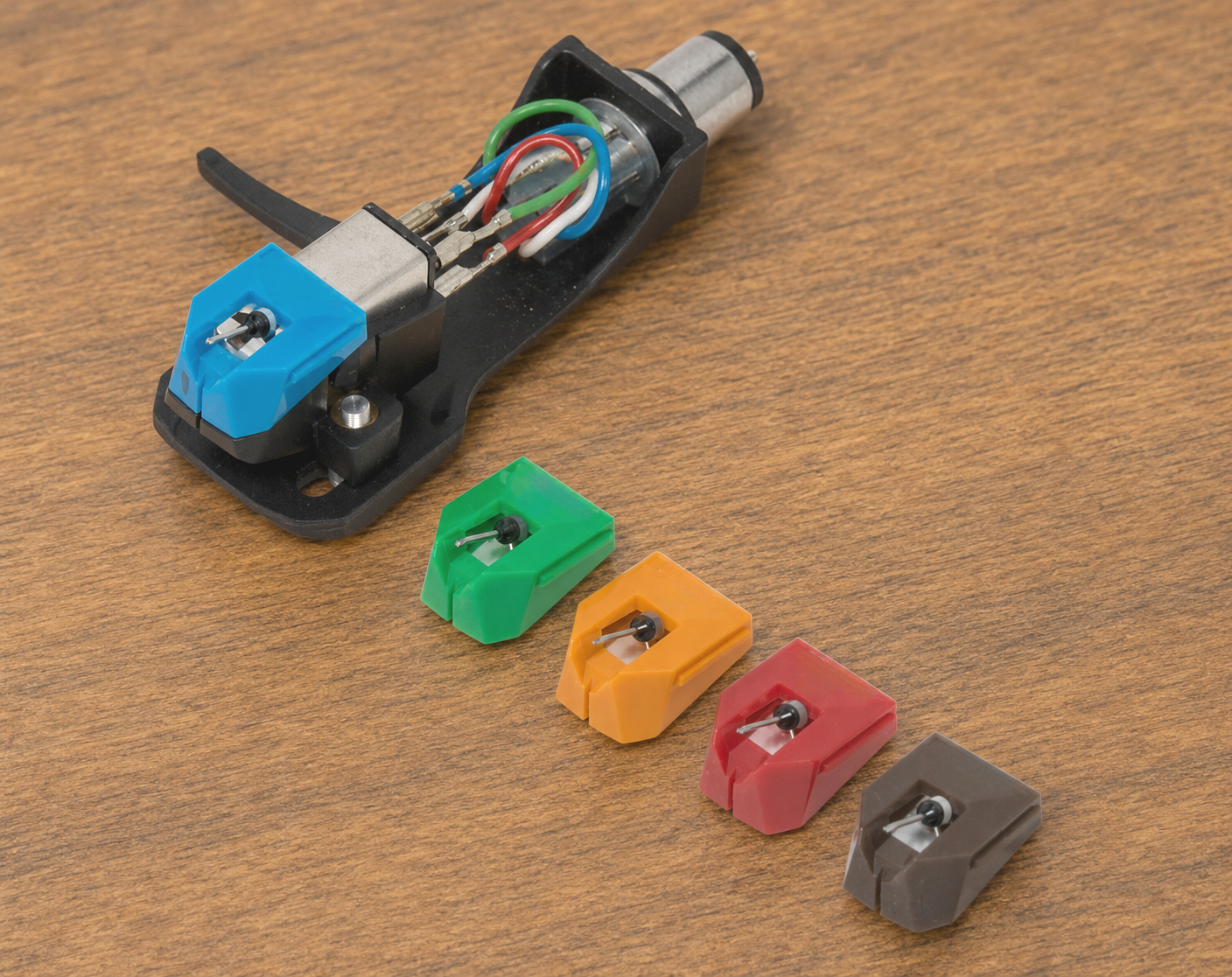
Audio-Technica offer one of the easiest upgrades with their At-VM95 series
If you've got an AT-VM95 body, for example, you can move through several different stylus profiles without replacing the generator itself. Likewise, an owner of an Ortofon 2M Bronze can move to a 2M Black stylus without necessarily replacing the complete cartridge.
But not every MM cartridge works that way.
Rega's current Nd range is a useful example. The Rega Nd5 and Nd7 are Moving Magnet designs, but their styli aren't intended to be swapped by the user. Instead they have to be returned to Rega to be rebuilt.
So don't choose MM solely because somebody has told you, "You can always replace the stylus." Usually isn't the same as always.
Moving Magnet or Moving Coil isn't the whole story
This is probably one of the most important points in the whole article.
MM or MC tells you how the cartridge generates its electrical signal. It doesn't tell you everything about the stylus that's actually touching the record.
You'll also encounter stylus descriptions such as conical, elliptical, nude elliptical, Fine Line, MicroLinear, Shibata and other line-contact profiles.
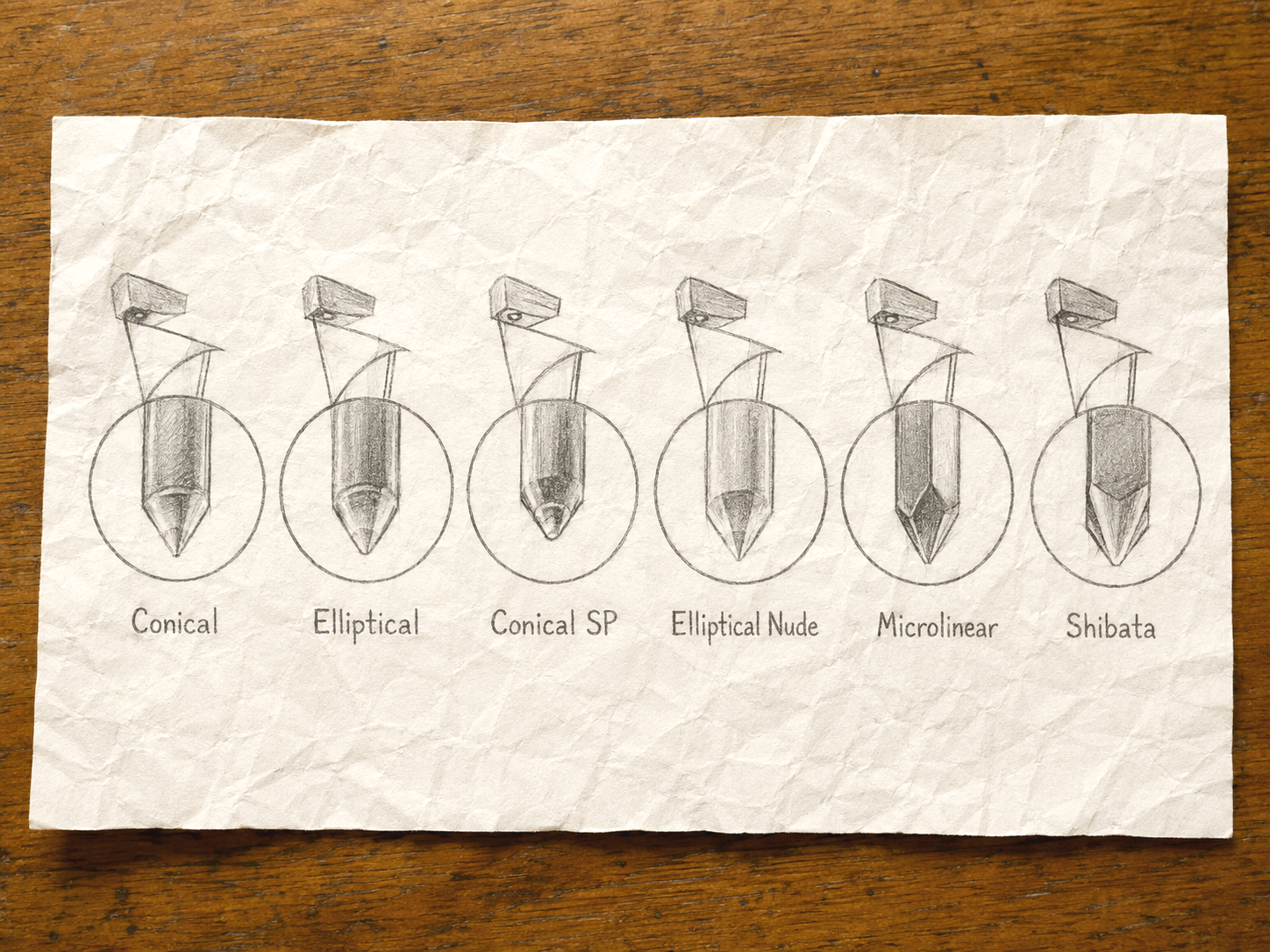
These shapes affect how the stylus contacts and traces the groove, and increasingly sophisticated profiles can retrieve very fine information when they're properly aligned.
That's why an advanced Moving Magnet cartridge such as the Ortofon 2M Black or Rega Nd7 shouldn't be dismissed simply because it isn't Moving Coil.
Equally, an MC cartridge isn't automatically brilliant simply because somebody has fitted tiny coils to it.
You have to look at the complete design: generator, stylus, cantilever, cartridge body, tonearm, phono stage and setup.
There's that whole-system thing again. Hi-Fi does love ruining a beautifully simple answer.
So does Moving Coil sound better?
Sometimes. (Helpful, I know).
A good Moving Coil cartridge in a properly matched system can be wonderful. There's a reason manufacturers put so much effort into reducing moving mass and refining these incredibly small generators.
But simply fitting an MC cartridge doesn't unlock a secret layer of information that's been hiding on every record waiting for you to spend more money.
A well-chosen MM cartridge on the right turntable, feeding a good MM phono stage, can make considerably more sense than buying an expensive MC and then compromising everything around it.
This is something that gets forgotten whenever Hi-Fi gets reduced to hierarchies. More expensive must be better. Moving Coil must beat Moving Magnet. Bigger number wins. It really isn't that simple.
I've heard systems where changing the cartridge has transformed the whole presentation, but I've also heard expensive cartridges fitted to turntables where you can't help thinking the money would have been rather better spent somewhere else.
Balance matters.
Don't forget the tonearm
Cartridge matching goes beyond checking whether your phono stage says MM or MC on the back. The cartridge also needs to work mechanically with the tonearm.
Cartridge weight, compliance, tracking force and the effective mass of the arm can all come into play.
I'm deliberately not going to turn this into a cartridge compliance mathematics lesson. You've got records to listen to and I've got a word count to think about.
The important thing is simply to understand that not every cartridge is automatically an ideal match for every tonearm.
The physical dimensions can matter too. Ortofon, for example, offers its lower-profile 2MR versions for turntables and tonearms where the height of the standard 2M body isn't ideal.
So if you're replacing a cartridge on an existing turntable, it pays to check before assuming anything with two screws in the top will work perfectly.
Cartridge setup isn't the place for "that looks about right”
A cartridge is trying to trace incredibly tiny variations in a record groove, so positioning it several millimetres out and thinking, "Yeah, that'll probably do" isn't really the ideal approach.
Correct setup can involve cartridge alignment, tracking force, anti-skate or bias, tonearm height, azimuth and, with some MC systems, phono-stage gain and loading.

Some cartridges and tonearms make installation beautifully simple. Others make you wonder whether a third hand might have been a useful evolutionary development.
But it matters.
A cartridge that's badly aligned or incorrectly adjusted isn't just unlikely to sound its best. Poor setup can also affect tracking and increase wear.
If you're not comfortable fitting one yourself, there is absolutely no shame in getting somebody else to do it.
I've spent enough of my life fiddling around with turntables to know there are occasions when "I'll let someone with the right tools do that" is an entirely sensible decision.
When would I choose Moving Magnet?
For me, MM makes a great deal of sense if you're buying your first proper cartridge, your amplifier already has a good MM input, you value simplicity, or you'd like an easy stylus upgrade path.
But none of those things mean it has to be a stepping stone to something else.
A cartridge such as the Ortofon 2M Black, Rega Nd7 or Sumiko Amethyst can sit perfectly happily in a serious vinyl system.
You don't eventually have to "graduate" from Moving Magnet. There is no ceremony. No certificate arrives in the post. If you've got an MM cartridge you love, enjoy it.
When would I choose Moving Coil?
MC becomes particularly appealing when the turntable and tonearm are capable enough to justify the investment, you've got appropriate phono amplification, and you're looking to push more performance from an already well-balanced vinyl system.
It doesn't necessarily mean jumping straight into a low-output design either. Products such as the Dynavector 10X5 MkII, Hana SH MKII and Sumiko Songbird High demonstrate that high-output Moving Coils can give you another route, particularly if you've already invested in a good MM phono stage.
Ultimately, though, the deciding factor should still be the same.
Listen.
If you prefer one cartridge to another and it works properly in your system, the badge on the front matters considerably less.
Don't upgrade the cartridge just because you can
Cartridges are tempting upgrades because changing one can produce a very noticeable difference, but before spending the money it's worth looking at the rest of the system.
Is your existing cartridge actually worn? Could you upgrade the stylus instead? Would the turntable itself benefit from attention first? Would a better phono stage make more sense?
And is the turntable sitting on something resembling a trampoline?
There's rarely only one route.
If you're still at the stage of choosing the deck itself, start with our How to Choose a Turntable guide before disappearing too far down the cartridge rabbit hole.
Before you buy…
Is my phono stage MM or MC compatible? A conventional low-output MC needs much more gain than a typical MM cartridge.
Will the cartridge suit my tonearm? Electrical compatibility is only half of the equation.
Can the stylus be replaced or upgraded? Many MM cartridges allow it, but not all do.
Does it need professional setup? A great cartridge badly installed is still a badly installed cartridge.
Have I actually listened to one? Specifications can narrow the choice. Your ears should finish the job.
So, Moving Magnet or Moving Coil?
If you've made it this far hoping I'd finally declare a winner, I'm afraid I'm going to disappoint you.
There isn't one.
Moving Magnet offers enormous choice, straightforward compatibility and potentially superb performance across a huge range of systems.
Moving Coil can take things considerably further in the right setup, but it usually asks more of the turntable, tonearm, phono stage and installation around it.
The best choice is the one that makes sense as part of your system.
Not the one with the more impressive initials.

You can browse our full range of turntable cartridges here, but if you're thinking about replacing or upgrading yours, I'd strongly recommend speaking to your local Audio T store first.
Tell us what turntable and tonearm you're using, what phono stage or amplifier you've got and what you're hoping to improve. We can help narrow down the options, make sure everything is properly matched and take care of fitting and setup where required.
Because whether it's MM or MC, there's really only one thing the cartridge ultimately needs to achieve.
Make you want to turn the record over and play side two.
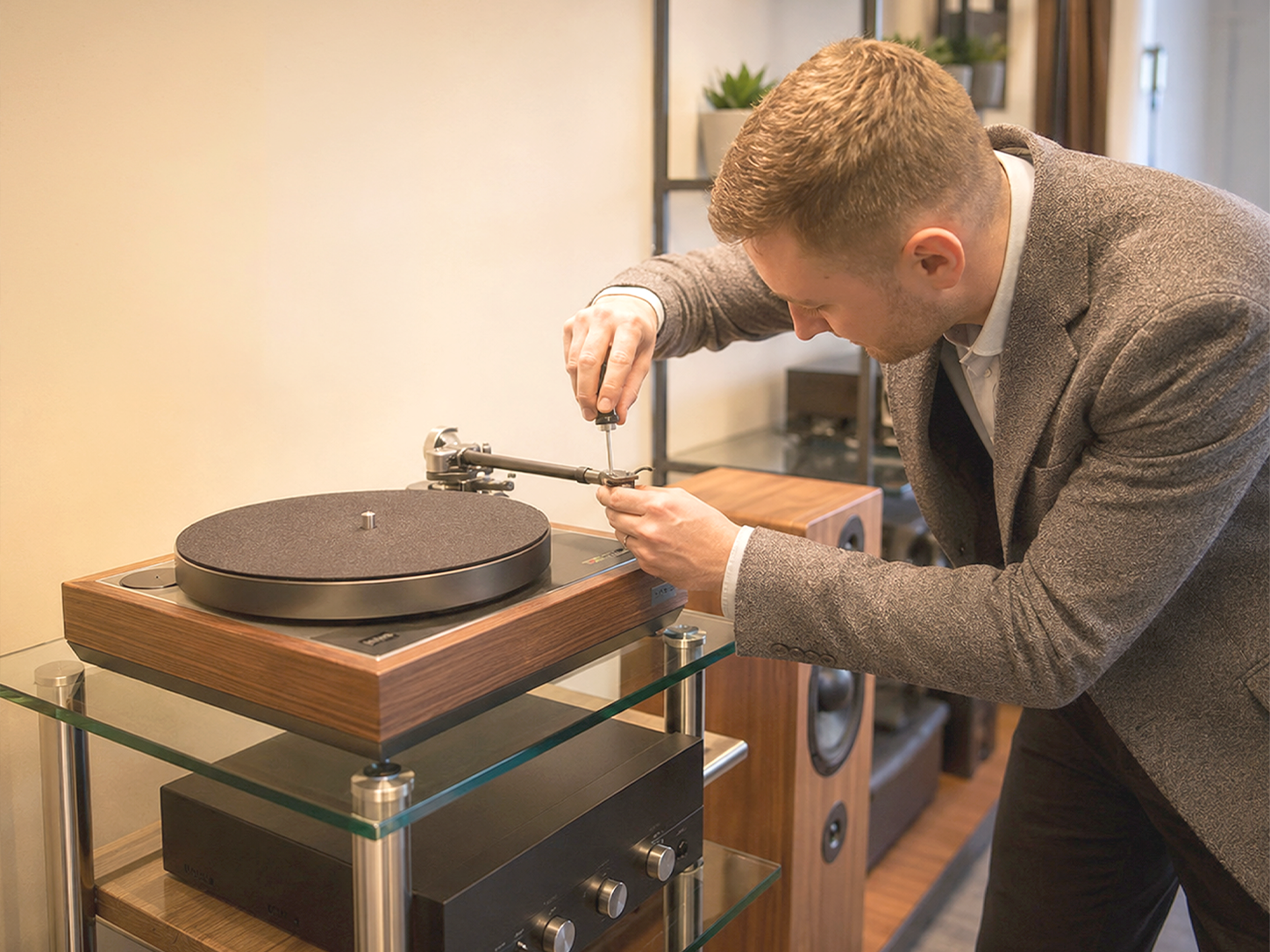
And as a little side note, if you buy a cartridge from your local Audio T store, we'll fit and set it up on your turntable free of charge. So if the thought of alignment protractors, tracking force and tiny screws fills you with dread, you can happily leave that bit to us.
Thanks for reading.
Brad Tyler – Head of Marketing at Audio T
If you have any questions about any of the equipment featured in this article, or any other Hi-Fi or home cinema enquiries, be sure to contact your local Audio T.
If you’ve enjoyed this, why not go ahead and read some more of our other blogs, and be sure to follow us on our social media channels below…
Cartridges and Styli from varying brands can be found at all Audio T stores: