

Three Levels of Vinyl Excellence: Comparing Rega’s Moving Coil Phono Stages
/With a fifty-year history of manufacturing turntables, it should come as little surprise that Rega also make some brilliant phono preamplifiers. Whilst they also produce versions for moving magnet cartridges, this blog is going to concentrate on the moving coil models.

from top to bottom: Fono MC, Aos, Aura
Why Phono Stages Matter
The function of a phono preamplifier is to match the output from a pickup cartridge to the input of a line-level amplifier. It is required to amplify the very low level signals produced by the cartridge and also equalise the sound in accordance with the RIAA record cutting standard. Low-output moving coil and moving magnet cartridges require different types of phono preamplifiers to achieve optimum performance.
Three versions populate the Rega range:
Rega Fono MC – £290*
Rega AOS MC – £1,500*
Rega Aura MC Reference – £4,620*
Rega Fono MC
Let’s start with the Fono MC. This paperback-sized product is the essence of simplicity. There is a power switch on the front, whilst at the rear there are loading/gain dip-switch selectors, phono inputs and outputs, a grounding post, and a connection for the external power supply.
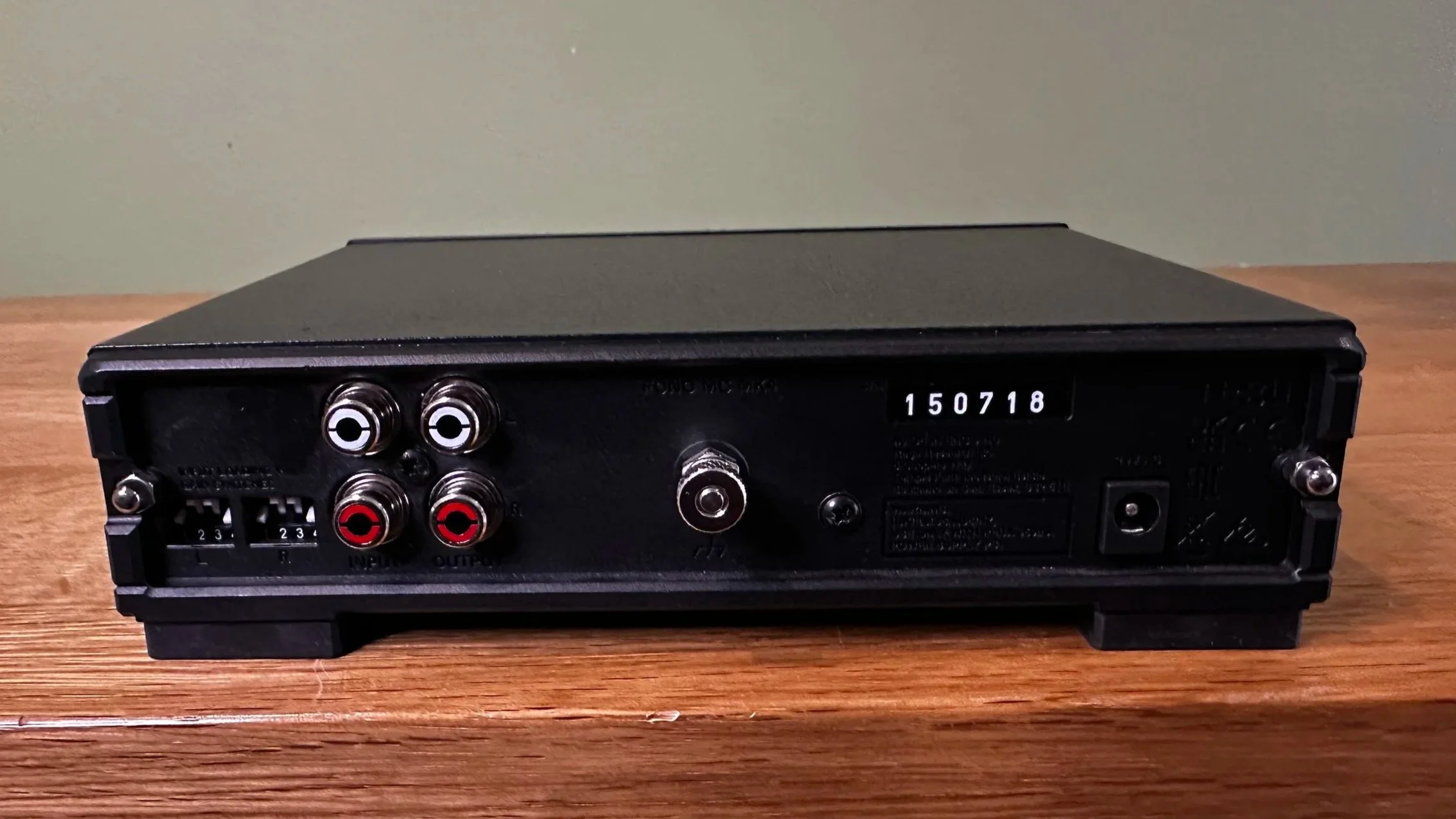
Fono MC back panel
The Fono MC uses the Linear Systems low-noise LSK389 FET in an all-discrete input stage, where low noise and linearity are vitally important to get the best from an MC cartridge. Because of the high input impedance of the FET, the loading effects of the amplifier circuit are minuscule and do not affect the performance of the cartridge
Rega AOS
Replacing the now-discontinued Aria, the AOS has a larger half-width case and a much more substantial build. Again, we have only a power switch on the front, with a similar selection of adjustments on the rear.
The AOS MC is a dedicated, no-compromise adjustable moving coil preamplifier using a circuit design based heavily on the award-winning reference MC phono stage, the Aura. Designed to work with a wide range of moving coil cartridges, it has plenty of gain for low-output MCs and extensive load adjustability, making it the perfect partner for whichever moving coil you are using.
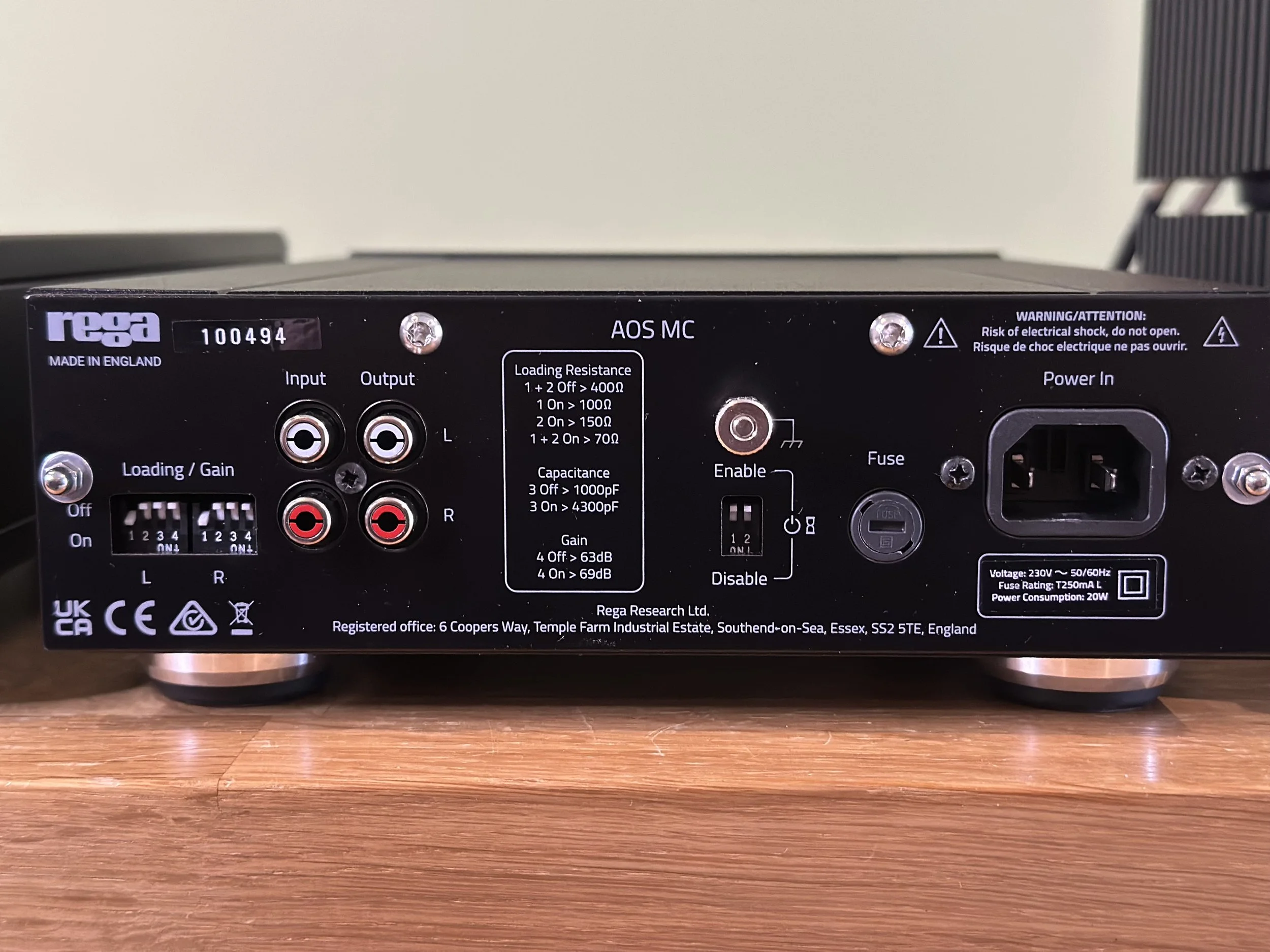
Aos back panel
The AOS MC is an all-analogue amplifier with no digital control circuitry. The fully aluminium case screens the internal circuit from stray RFI signals, and Rega have avoided including unnecessary components or circuits that may degrade the signal path.
The AOS MC incorporates many innovative design ideas, including a self-adjusting servo control which compensates for variations in ambient or operating temperature. It utilises low-noise FETs (Field Effect Transistors) configured as a compound pair. The use of FET transistors ensures there is no bias current flowing in the cartridge coil, so as not to upset the delicate magnetic geometry of the cartridge.
The MC input has provision for selecting resistive input loading from 70Ω to 400Ω and capacitive loading from 1000pF to 4300pF. The input sensitivity can also be changed by 6dB via the back panel.
Rega Aura
The flagship phono preamplifier is the Aura. This is a full-width design and is built like a battleship. The controls are now positioned on the front and are ergonomically delightful, whilst the rear connections are of exceptionally high quality.
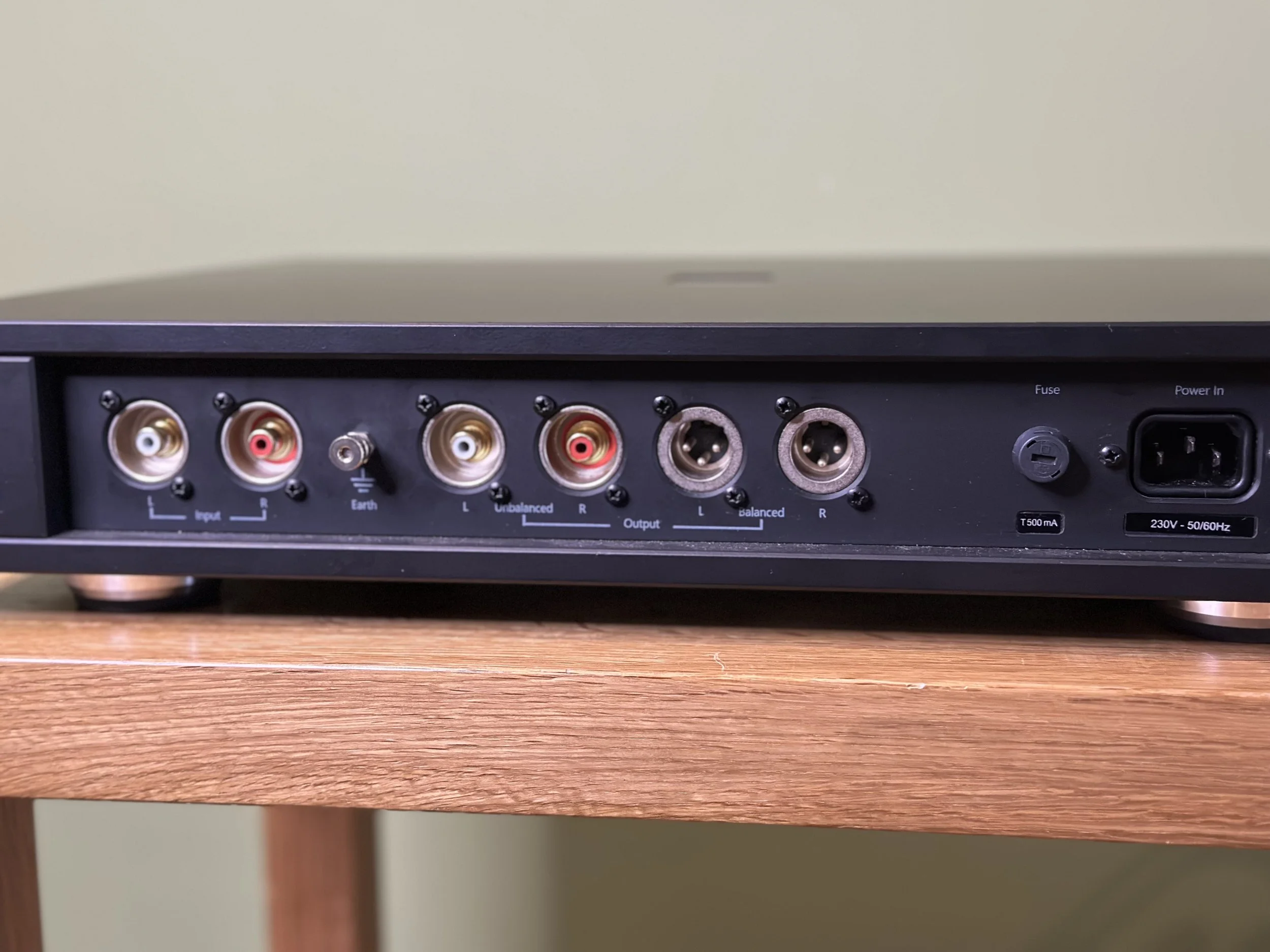
Aura back panel
The Technical Bit…
The Aura is dedicated to moving coil cartridges and stays clear of compromise. With no superfluous functions to obstruct the signal path or degrade sound quality, the Aura phono preamp incorporates some remarkable and innovative design ideas.
The Rega Aura is a three-stage, fully symmetrical preamplifier. The first stage is a symmetrical complementary Class A amplifier using parallel-connected Linear Systems ultra-low-noise FET transistors configured as a symmetrical compound pair input stage.
The input circuit configuration also alleviates the need for coupling components between the cartridge output and the input stage FET transistors, which would otherwise degrade the sound. The complementary ultra-low-noise FET transistors are carefully graded and matched for optimum performance. This stage drives the passive high-frequency section of the RIAA equalisation stage.
The second stage is a symmetrical Class A differential amplifier with a common base driver stage. This is also used as the active amplifier in the low-frequency section of the RIAA equalisation stage.
The third stage inverts the signal to provide the balanced output alongside the output of the second stage, using the same circuit topology.
The power supply is a symmetrical discrete tracking design using fast diodes and a low-noise voltage reference. Each stage has its own localised power supply and LED-referenced current generators.
To maximise headroom, the Aura has a power supply voltage approximately 60% higher than normally found in such a phono preamplifier. Very high-quality polypropylene capacitors have been used throughout the signal path. One percent tolerance polypropylene capacitors are used in the RIAA EQ stages, whilst audio-grade capacitors are used throughout the rest of the circuit.
Gain, mute, and mono switching are all implemented using high-quality relays.
Earth Grounding
The Aura uses a Class I earth system, where the case metalwork is connected to the mains safety earth by means of the mains lead. The internal signal earth is linked to this earth through a network designed to eliminate the risk of earth/ground loops.
This grounding method provides a safe and efficient discharge path for any static charge generated by the cartridge.
Listening Comparisons
I set up a system consisting of the Rega Planar 8 with Ania Pro cartridge, Rega Aethos amplifier, and Acoustic Energy Corinium loudspeakers, and grabbed a handful of LPs.

Rega Fono MC vs Rega Aos
The sonic differences are less about a complete change to Rega’s in-house sound and more about a refinement of Rega’s established presentation.
The Fono MC is fast, rhythmic, punchy, and highly engaging. It is energetic and immediate, with strong timing and attack.
The newer Aos MC pushes that character further upscale toward the much more expensive Aura, with a lower noise floor, greater refinement, improved soundstaging, and a smoother yet more dynamic presentation.
Rega Aos vs Rega Aura
I had the opportunity to use the flagship Naia/Aphelion 2 turntable combination as well as the Planar 8 for this comparison, and it was with the former that the Aura really started to extend its advantages — perhaps not surprisingly.
The sonic difference between the Rega Aos and the Rega Aura is less about tonal balance and more about scale, authority, and the degree of realism each can extract from a moving coil cartridge.
Both are unmistakably Rega, prioritising speed, timing, low colouration, and propulsion. They sound alive rather than lush.
Compared to older Rega stages like the Fono MC or even the now-discontinued Aria, the Aos feels more mature and composed. Notes emerge from a quieter background, textures are better separated, and there is a greater sense of space around instruments.
However, when you move to the Aura, the presentation changes from excellent to breathtaking.
The first thing you notice with the Aura is the effortlessness. Dynamic swings happen without strain. Large crescendos or dense recordings retain separation and stability even when the music becomes complex. The Aos is dynamic and exciting, but the Aura sounds unconstrained.
Bass is another major distinction. The Aos delivers tight, tuneful low frequencies with very good pitch definition, but the Aura reaches deeper and controls bass with greater authority.
There is more weight behind kick drums, more physical texture in upright bass, and more air moving in the room.
The midrange is also where the Aura earns its flagship status. Vocals and acoustic instruments gain space and body in a way the Aos cannot quite match.
Subtle harmonics feel more complete. Listening to piano, the Aos captures attack and timing beautifully, but the Aura captures the resonance and decay of the instrument with greater realism.
Treble refinement is also notably different. The Aos remains clean and extended, but the Aura retrieves low-level information without sounding analytical. Cymbals, for instance, decay in a way that the Aos simply cannot quite manage.
Soundstaging follows the same pattern. The Aos creates a large and stable stereo image with excellent placement, but the Aura expands the stage in all directions. Recordings feel less like left-right stereo and more like an actual performance in front of you.
The Aura also has a darker, quieter background. Tiny reverberations and decay notes are easier to follow.
The gap is, to some extent, system dependent. In a Planar 6 or Planar 8 setup with cartridges like the Ania Pro or Apheta 2, the Aos is more than capable. It preserves Rega's rhythmic drive while adding refinement and sophistication.
But in a truly revealing front end — changing the Planar 8 for the reference Naia, for example — the Aura becomes unmistakably superior. The Aura remains the statement piece for complete musical realism.
Thanks for reading, and we look forward to welcoming you soon.
Jon and Andy - Audio T Swindon
If you have any questions about any of the equipment featured in this article, or any other Hi-Fi or home cinema enquiries, be sure to contact us.
If you’ve enjoyed this, why not go ahead and read some more of our other blogs, and be sure to follow us on our social media channels below…
Rega can be found at the following Audio T stores -
*All prices, credit terms and interest rates quoted are correct at the time of going to press but may be subject to change. E&OE