
Entering the Goldilocks zone: the appeal of large stand mount speakers
/We had the pleasure of listening to a few big stand-mounts in the Portsmouth shop recently. Are they the ‘just right’ option that are neither too big nor too small? We have to say that, in many respects, yes they are.
In larger families, they say it is often the middle child that gets forgotten. The oldest, and usually the biggest, get the respect, while the youngest and smallest are cut a great deal of slack because they are “only little”.
And so it tends to be with hi-fi speakers.
Most of us are likely to be impressed by the sound of a well-driven pair of floorstanders and, in our experience, that respect often increases with cabinet size and price tag. There is a reason that some of the best-sounding and most expensive speakers in the world are very often extremely large floorstanding speakers driven by powerful amplifiers.
When we look at compact stand-mount speakers, we tend to tailor our expectations accordingly. Well-informed Audio T customers with small listening rooms tend, usually wisely, to choose compact stand-mounts because they know how easy it is for larger speakers to over-pressurise small spaces. Equally, they know that compact speakers have their limitations in terms of scale and bass.
So, in this big-is-better-but-small-is-beautiful hi-fi world, is there a place for the big stand-mount speaker? We listened recently to the Harbeth Super HL5 Plus XD2, Dynaudio Contour 20 Black Edition, Triangle Magellan 40th Duetto and Spendor Classic 1/2, and here are our views on some of the best larger-form stand-mounts out there.
Technical merits
Larger stand-mount speakers are a great alternative to floorstanders, offering bass weight and scale that compare well with many of their big-cabinet cousins, yet they also retain much of the speed, accuracy and imaging that make smaller stand-mount speakers so appealing.
1. Reduced diffraction and floor bounce – by elevating the drivers above the floor via stands, these designs reduce reflections from walls and the floor that can affect floorstanders. The result is improved driver response and more accurate imaging.
2. Cabinet resonance control – smaller cabinets are inherently less susceptible to panel resonances. When properly braced or damped, stand-mounts can offer cleaner midrange reproduction.
3. Driver integration – two-way stand-mounts with carefully chosen crossover points can minimise interference from drivers and timing issues. With fewer drivers and a single crossover, designers can tightly match phase and amplitude response across the audible band. However, three-way speakers are more likely to offer a full-range sound.
4. Room coupling and boundary behaviour – with less bass extension compared to larger floorstanders, even a fairly big stand-mount can avoid the low-frequency boom that results from over-pressurising a room.
Harbeth Super HL5 Plus XD2
Configuration: 3-way, 200mm RADIAL4 mid/bass, 25mm ferro-cooled tweeter, 20mm dome supertweeter
Cabinet: Thin-wall, lossy MDF construction with tuned panel resonance
Sensitivity: ~86 dB/W/m
Impedance: Nominal 6Ω
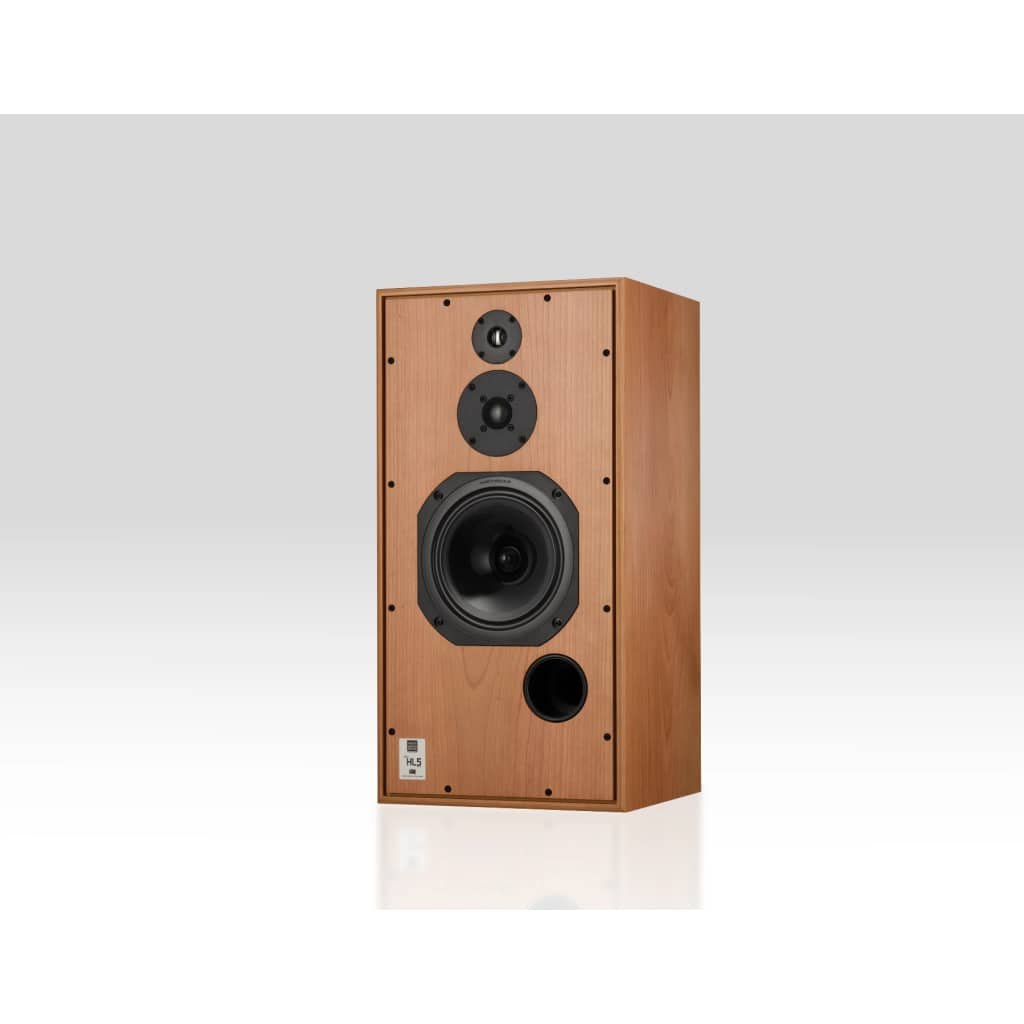
Harbeth SHL5 Plus XD2 in Cherry
The SHL5 Plus XD2 is a BBC-inspired monitor that leverages Harbeth’s proprietary RADIAL4 polymer cone, which offers high internal damping and very low harmonic distortion in the midband. The integration of a super-tweeter supports airiness without excessive forwardness.
Notable Technical Strengths:
Incredibly smooth frequency response
Linear impedance and benign phase angles
Tuned cabinet resonance used intentionally for natural midrange
Dynaudio Contour 20i Black Edition
Configuration: 2-way, 180mm MSP mid/bass, Esotar2i tweeter
Cabinet: CNC-milled MDF with internal damping upgrades
Sensitivity: ~86 dB/W/m
Impedance: Nominal 4Ω

Dynaudio Contour 20 Black Edition
Dynaudio’s 20i Black Edition incorporates their ultra-refined Esotar2i tweeter, using a precision-coated silk dome, ferrofluid cooling, and rear damping chamber to suppress resonance. The MSP (Magnesium Silicate Polymer) woofer features an ultra-light voice coil and optimised airflow basket. The crossover in the Black Edition uses Mundorf capacitors, improved internal wiring and enhanced cabinet damping.
Notable Technical Strengths:
Excellent off-axis response and vertical integration
Bass linearity down to ~39Hz (-6dB), with minimal port chuffing
Remarkably low distortion in the upper midrange and HF
Triangle Magellan 40th Duetto
Configuration: 2-way, 165mm cellulose/fiber mid-bass, horn-loaded TZ2900 tweeter
Cabinet: High-density MDF with multiple internal braces and decoupled driver mounting
Sensitivity: ~88 dB/W/m
Impedance: Nominal 8Ω

Triangle Magellan 40th duetto in golden oak
The Magellan Duetto is the most forward-sounding speaker in this group, with Triangle’s signature horn-loaded titanium dome tweeter offering ultra-high transient speed and directivity. A proprietary mid-woofer uses a treated cellulose diaphragm with phase plug for enhanced off-axis energy. Triangle goes for high sensitivity and immediacy, creating a more “live” sound.
Notable Technical Strengths:
High dynamic headroom; great for micro- and macro-dynamics
Excellent group delay performance through the crossover region
Cabinet resonance well-damped with multiple layers
Spendor Classic 1/2
Configuration: 3-way, 220mm polyamide and polymer bass cone, 150mm polymer mid and 22mm soft dome tweeter
Cabinet: Polymer-damped wood composite with large internal volume
Sensitivity: ~87 dB/W/m
Impedance: Nominal 8Ω
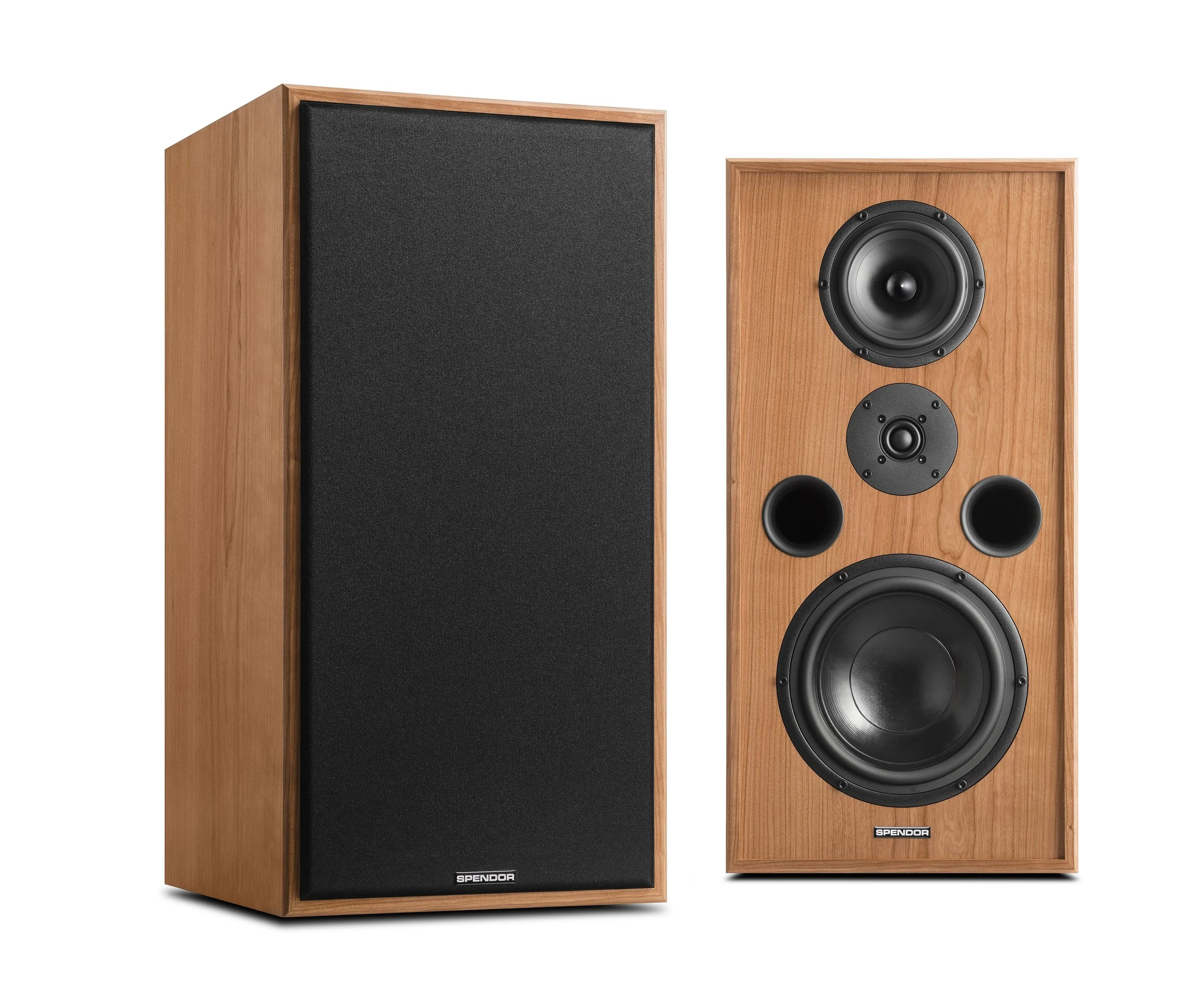
spendor classic 1/2 in cherry
The Spendor Classic 1/2 is a modern reworking of their vintage BBC-style monitors, retaining a large baffle for improved baffle-step compensation. Its bass driver is specifically damped to produce minimal cone breakup, giving the speaker its effortless, rich character. Crossover design is a highlight: time-aligned and phase-consistent, with excellent integration.
Notable Technical Strengths:
Controlled cabinet design for smooth decay, especially in vocals
Minimal crossover-induced phase rotation
Wide horizontal dispersion; smooth power response
Conclusion
Large stand-mount speakers can be a rewarding choice for those who value nuance, intimacy and emotional connection in their listening experience, while not sacrificing scale and weight in their performance. Even larger stand-mounts can disappear in a room — visually and sonically — in a way that bigger floorstanders struggle to do.
It is also worth noting that none of the above speakers is cheap — you get a very capable floorstander for around £5,000 or £6,000 — but with less cabinetry, the stand-mounts we listened to have a beautifully finished, jewel-like quality that contrasts with the sometimes monolithic appearance of some big floorstanders.
Each of the models featured here brings something special to the table. Whether it’s the vocal purity of the Harbeths, the analytical strengths of the Dynaudios, the dynamism of the Triangles, or the graceful presentation of the Spendors, these speakers make a compelling argument for themselves.
For those looking to invest in an emotionally engaging, beautifully crafted and room-friendly pair of speakers, large stand-mounts in this range are more than just an alternative — they can be a revelation.
Thanks for reading,
Alan - Audio T Portsmouth
If you have any questions about any of the equipment featured in this article, or any other hi-fi or home cinema enquiries, be sure to Contact Us
If you’ve enjoyed this, why not go ahead and read some more of our other blogs, and be sure to follow us on our social media channels below…