
Crossed wires – Making sense of cables and the difference they make to Hi-Fi
/If there’s one topic that divides hi-fi enthusiasts, it’s the subject of how big a difference, if any, cables can make to our systems. In this blog, we will try to shed light on the technical attributes of cabling and offer advice on how and why to upgrade.
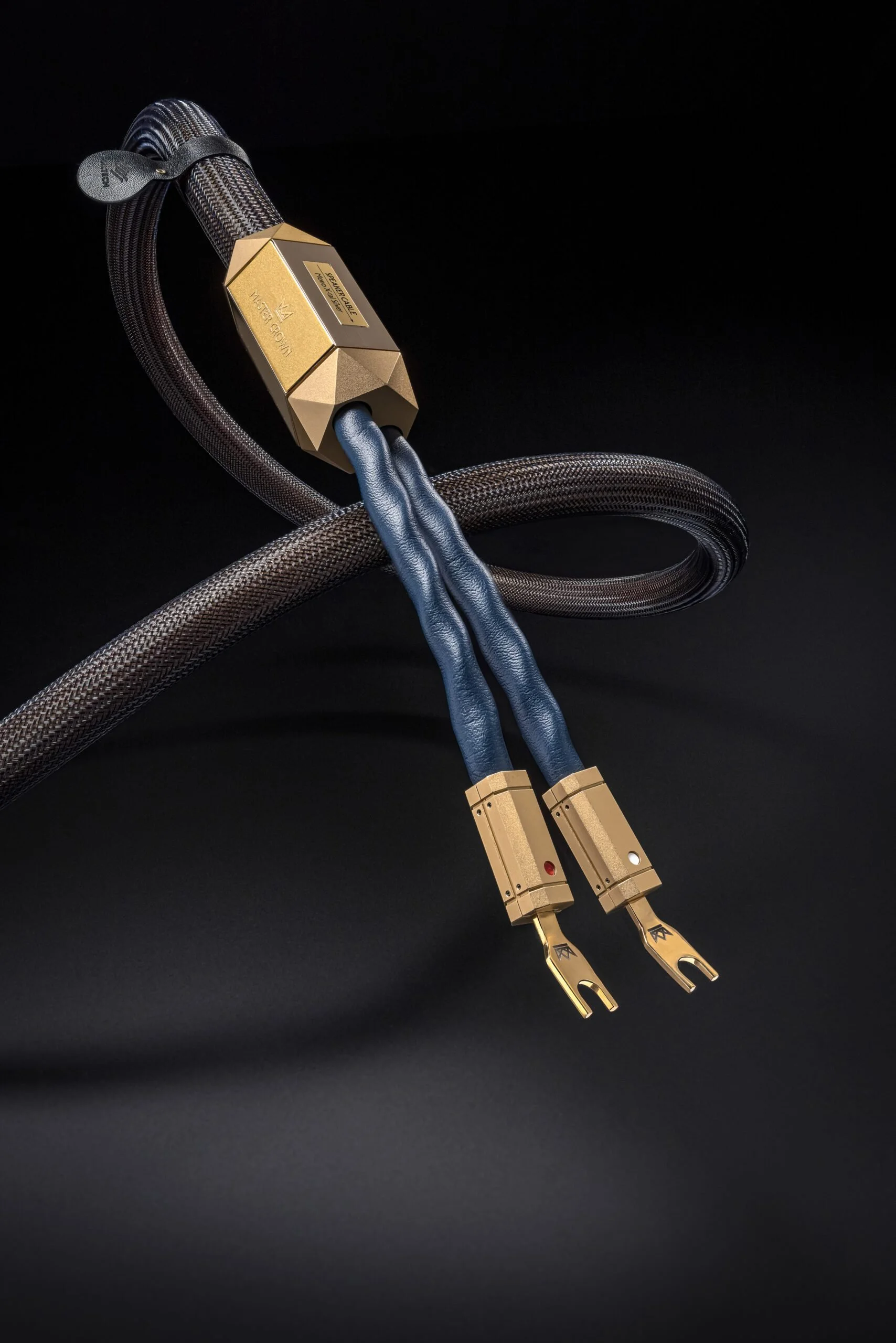
Siltech Master Crown speaker cables retail for around £70,000 for a 2m pair
There are two extremes in the cable debate. On one side, there are those in the cables-are-just-wires camp who believe that any half-decent length of copper will do, and all the rest is basically snake oil.
On the other, there are the cable connoisseurs for whom the more exotic a cable’s materials and construction methods, the better. And they may be right.
But the majority of us hi-fi mortals lie somewhere on a spectrum between those two points.
Certainly, most of us will not be looking at the top-of-the-range cables made by the likes of Nordost, Siltech, Audioquest or Chord, some of which cost tens of thousands of pounds.
And neither will we be looking to wire up the £10K system we’ve worked hard to build with some generic copper cable sold online for 50p a metre.
But how are we meant to judge how much to spend and what’s the ‘right’ cable for our system?
Some basics
To start, it might help to understand how a cable works – hopefully without this turning into a school physics lesson!
Every cable – whether interconnects, speaker or power cables – can be thought of as a single circuit with the following properties:
R (Resistance) – caused by conductor material and cross-section. A high-resistance cable will tend to reduce an amplifier’s control over the speakers, especially in the bass region, leading to softer or less defined low frequencies.
L (Inductance) – created by the cable geometry (i.e. the physical design of the cable) and spacing between conductors. High-inductance cables can cause a gentle roll-off in high frequencies. Twisted or parallel geometries reduce inductance, which helps preserve transient accuracy.
C (Capacitance) – determined by the dielectric (i.e. shielding) material and conductor proximity. Excessive capacitance in cables can cause high-frequency loss or even instability in some amplifiers.
Each of these influences the signal.
It might seem counterintuitive at first to think of a cable having ‘moving’ parts. But the signal in the cable interacts with and is affected by the materials that make up the cable, and not just the wire itself.
Conductor material: Copper is standard, but higher-purity or silver conductors can lower resistance and improve high-frequency detail.
Geometry: Twisted, braided, or solid-core designs reduce interference and manage impedance more effectively.
Shielding: Shielding type (braid, foil, or hybrid) helps mitigate radio frequency interference, which can raise the noise floor and lead to a loss of silence or space between notes.
Dielectric quality: The insulation around conductors affects capacitance, effectively interacting with the signal. Better materials can maintain signal integrity and timing.
Hi-fi cable manufacturers strive to balance these variables to produce cables that lower the noise floor in your system and allow as much of the music signal from each of your components to pass with minimum interference to the next.
Choosing cables
The first rule of buying cables is to accept that they cannot perform miracles. They will not change the innate performance limits of your system – the sound from a modest system will not suddenly be transformed into high-end by adding a pair of very good cables.
But, and it’s a big but, the right cables can help your system reach its full potential. Or, to put it another way, many of us are perhaps unwittingly handicapping our systems by using unsuitable cables.
Which makes it especially sweet when, by upgrading our cables – interconnects or speaker cable or power cables – we realise what our hi-fi systems, whether entry-level or high-end, are truly capable of.
We are fortunate in the Portsmouth shop in having a variety of cables we can swap in and out of systems, and anyone who tells you all cables are made the same and make no audible difference in a system have probably not taken the time to make the number of comparisons we have.
The next thing to consider is matching the quality of your cables to your system through some common-sense price matching. It would make little sense to run a £3,000 pair of RCA interconnects between a £600 CD player and a £600 amp. Or, conversely, using £5-per-metre speaker cable in a £50,000 system.
In terms of total spend, the old rule of thumb was to allocate 10 per cent of the total cost of your hi-fi components to cabling. It’s not a bad rule, but you may get better results if you think of your cables as another component.
So, for example, if your amp, CD player and speakers cost £1,000 each, then consider spending around £1,000 on your cabling – before you panic, that’s not per cable but in total on all of your cabling, e.g. interconnects, digital cables, speaker cables and power leads.
Of course, if you say to a non-hi-fi person that you spent £1,000 on some cables, they will think you’ve totally lost the plot. But if you treat your cables as another component, then you stand a good chance of matching the quality of your cables to your system.
Think of it this way: we wouldn’t buy a £3,000 pair of speakers to stick on the end of a £500 amp. You would most likely get sound, but it would be a waste of the speakers’ potential. The same holds with cabling.
Once you’ve accepted that your system deserves decent cabling, and the cost that comes with it, then there is matching the sonic characteristics of a cable with the sound signature of your system.
If you like a brighter, more forward sound and you feel your existing system could do with a bit more sparkle, then consider silver-plated copper cables.
And high-quality insulation, such as the Taylon material used by Chord Company in some of its cables, will give you a more open and detailed sound.

silver-plated and taylon covered Chordmusic Phono cables
Or, if your system is a little forward, try a good quality, high purity OFC (Oxygen-Free Copper) cable and steer away from silver.
To XLR or not XLR
That’s a question we get asked a fair amount.
An XLR cable is a balanced cable, which means that it carries two signal cables and a ground conductor. One of the signal cables carries an in-phase signal, the other an equal and opposite out-of-phase signal. These cancel each other out, meaning a balanced and clean signal at the other end.

naim Signal interconnect 2XLR to 4 pin din
They are especially useful for long cable runs and are used in professional settings because the in- and out-of-phase signals are always balanced, no matter how far along the cable they must travel. An unbalanced cable may lose phase integrity over long runs.
But, for all practical purposes, with the very short interconnects used in most home settings, there is likely to be little, if any, audible advantage in using balanced. You may even find you get better sound buying shorter runs of the best unbalanced interconnects you can afford.
The bottom line
Upgrading cables is not about adding colouration to your system. It’s about removing distortion that obscures the signals from your system.
Good cables should preserve the timing, dynamics and harmonic integrity from source to loudspeaker. They should let you hear what your system is truly capable of, free from as much distortion and interference as possible.
Sometimes the difference a cable makes can be fairly dramatic; other times it is more subtle. But as every hi-fi enthusiast knows, the small improvements are worth the effort.
Thanks for reading,
Alan - Audio T Portsmouth
Check out Audio T’s range of cables online and give us a call on 0239 266 3604 or email at portsmouth@audio-t.co.uk, or simply drop into the Portsmouth shop.
Not local to Portsmouth? You can find your nearest Audio T store here.
If you’ve enjoyed this, why not go ahead and read some more of our other blogs, and be sure to follow us on our social media channels below…